
For a quicker response, please send all inquiries
via info@canfloor.com or
text to
416-735-0075.
| Monday - Friday | 10:00 am - 7:00 pm |
| Saturday & Sunday | 10:30 am - 4:00 pm |
The safest basement wood flooring options are usually not solid wood. For most Canadian basements, waterproof vinyl plank or SPC is the safest wood-look choice over concrete, while engineered wood can work in the right basement and solid hardwood is usually not the first recommendation below grade.
There is no single best flooring for a basement over concrete in Canada because slab moisture, humidity swings, room use, and comfort priorities all change the right answer. Cold concrete, winter heating cycles, and occasional leaks make basement floors work harder than main-floor installations.
Waterproof vinyl plank basement flooring is usually the best all-around pick when you want wood look basement flooring with lower moisture risk. Engineered wood basement flooring is the better real-wood option when the slab is dry, the product is approved for below-grade use, and vapor control is handled properly.
Solid hardwood is usually not recommended in most basements because wood expands and contracts with moisture and humidity changes. That movement can lead to cupping, gaps, or finish problems even when the concrete looks dry.
A simple way to choose is this: use engineered wood in a dry, controlled basement; use vinyl or tile in a damp basement; and use the most water-tolerant, easiest-to-clean materials in a flood-prone basement. Flooring should never be used to hide an active moisture problem.
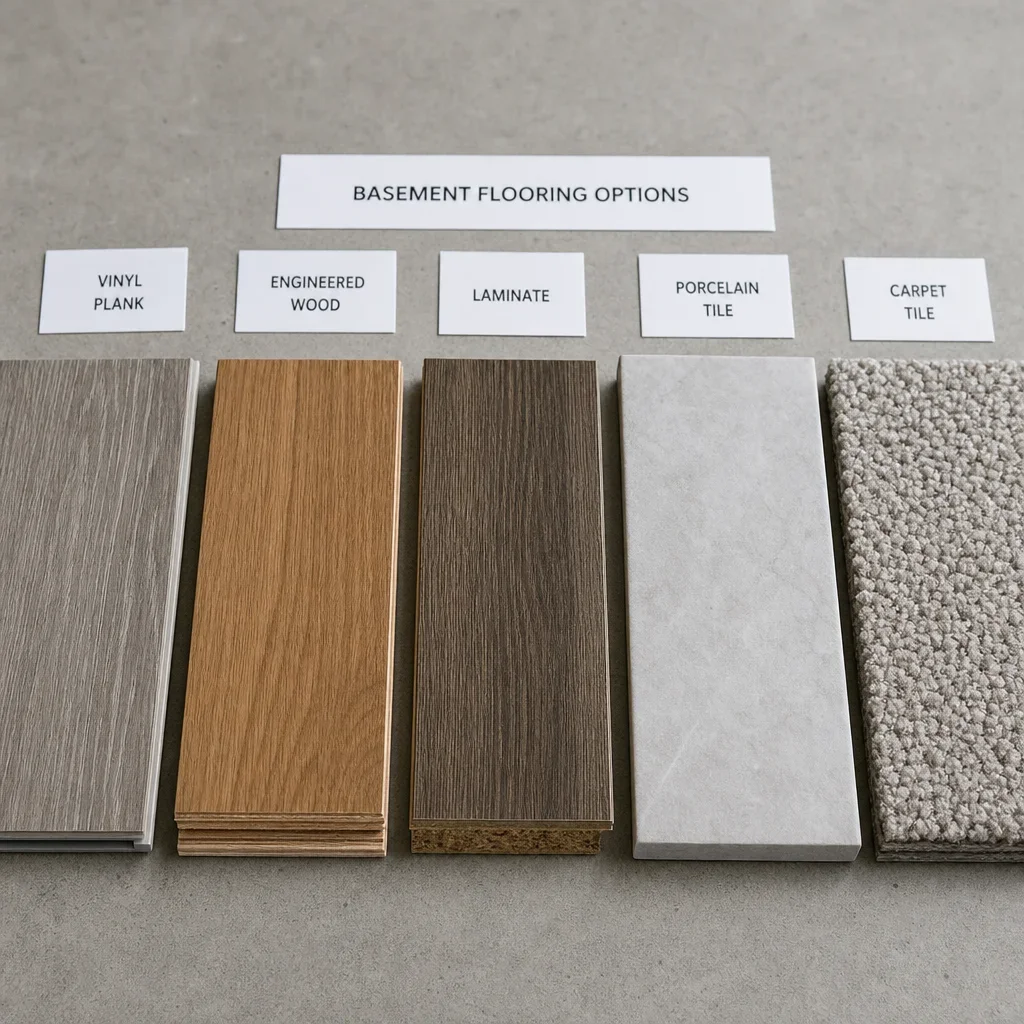
| Flooring type | Moisture tolerance | Comfort over concrete | Wood-look realism | Ease of repair | DIY friendliness | Best fit | Typical installed cost |
|---|---|---|---|---|---|---|---|
| Vinyl plank / SPC | High | Moderate to good | Good to very good | Good if planks can be replaced | Good for floating systems | Best all-around for many basements | $4-$16/sq.ft. |
| Engineered wood | Moderate, not waterproof | Good | Best real-wood look and feel | Fair to moderate | Moderate, product-dependent | Best for dry basements wanting real wood | $6-$15/sq.ft. |
| Laminate | Moderate to low, product-dependent | Moderate | Good | Fair | Good | Budget option for dry basements | Broadly varies by product and prep |
| Tile | High | Low without heat or rugs | Wood-look options available | Good, but grout adds work | Moderate to low | Best for wet zones and leak-prone spaces | $7-$24+/sq.ft. |
| Carpet tile | Low to moderate, room-dependent | High | Not a wood look | Very good in sections | Good | Best for soft rec rooms in dry basements | $2-$8/sq.ft. material range |
| Rubber | High | High for impact areas | No wood look | Good in tiles or rolls | Moderate | Best for home gyms | $7-$25/sq.ft. |
| Foam | Moderate, product-dependent | Very high softness | No wood look | Easy in sections | Very good | Best for temporary play or workout zones | $1-$3/sq.ft. |
Vinyl separates itself because it balances moisture tolerance, wood-look style, comfort, and easier replacement better than most alternatives. Engineered wood wins on authentic grain and warmth, but it gives up ground on water exposure.
A dry basement can handle more options, including some engineered wood basement flooring, but only after moisture testing and product approval for below-grade installation. A finished walk-out basement with stable humidity is a very different environment than a fully underground basement with a history of seepage.
A damp basement should push you toward waterproof or highly moisture-tolerant flooring such as vinyl plank, SPC, or tile. Musty smell, visible efflorescence, condensation, past seepage, or recurring dampness are warning signs that wood-based floors become riskier.
A flood-prone or leak-prone basement should prioritize floors that tolerate water better and are easier to clean or replace in sections. Tile, vinyl plank, some rubber products, and removable carpet tiles usually make more sense than real wood or standard laminate after repeated water events.
Walk-out basements are usually safer for wood-based options because they often get more light, better airflow, and less below-grade exposure than fully underground spaces. Fully underground basements generally demand more caution because concrete stays cooler and moisture risk is higher.
Flooring is not a moisture fix. If the slab or foundation has an active problem, deal with that first, then choose the floor.
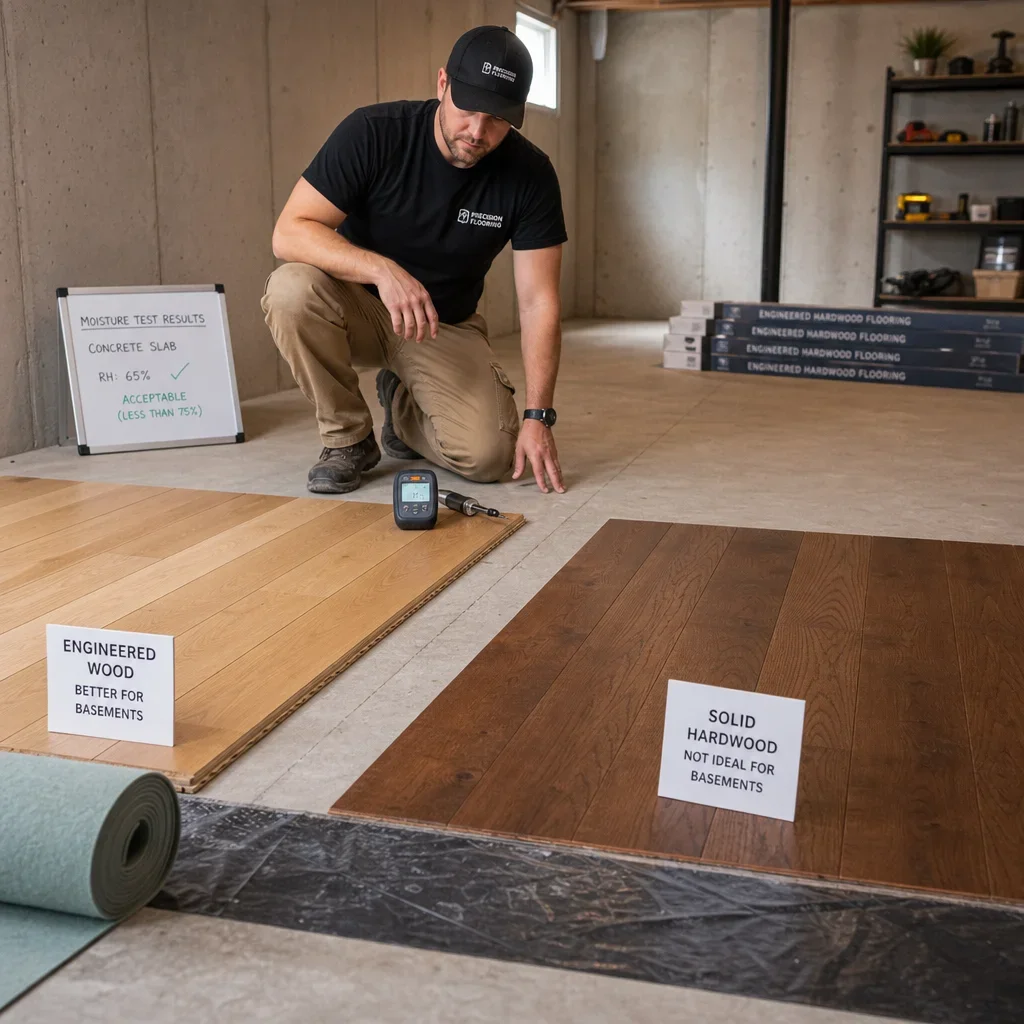
Engineered wood is usually the best type of wood flooring to put over concrete when you want a real-wood surface in a basement. Its layered construction makes it more dimensionally stable than solid hardwood, but it is still not the same as waterproof flooring.
Solid hardwood is usually not suitable for basement flooring because below-grade concrete and seasonal humidity swings can cause expansion, shrinkage, cupping, and gaps. Even a basement that feels dry can still transmit moisture through the slab.
Engineered wood can be a good choice in a dry basement if the slab passes moisture testing, the room has controlled humidity, the product is rated for below-grade use, and the installation system matches the manufacturer instructions. That is the honest answer to what kind of wood flooring is best for a basement when the goal is real wood, not just a wood look.
Installation over concrete depends on the product system, not wishful thinking. Some engineered floors float, some glue down, and some need specific underlayments or vapor-control layers, so the product spec matters more than broad internet advice.
If you want the warmth and grain of wood, engineered is the realistic path. If you want the lowest moisture risk, vinyl usually wins.
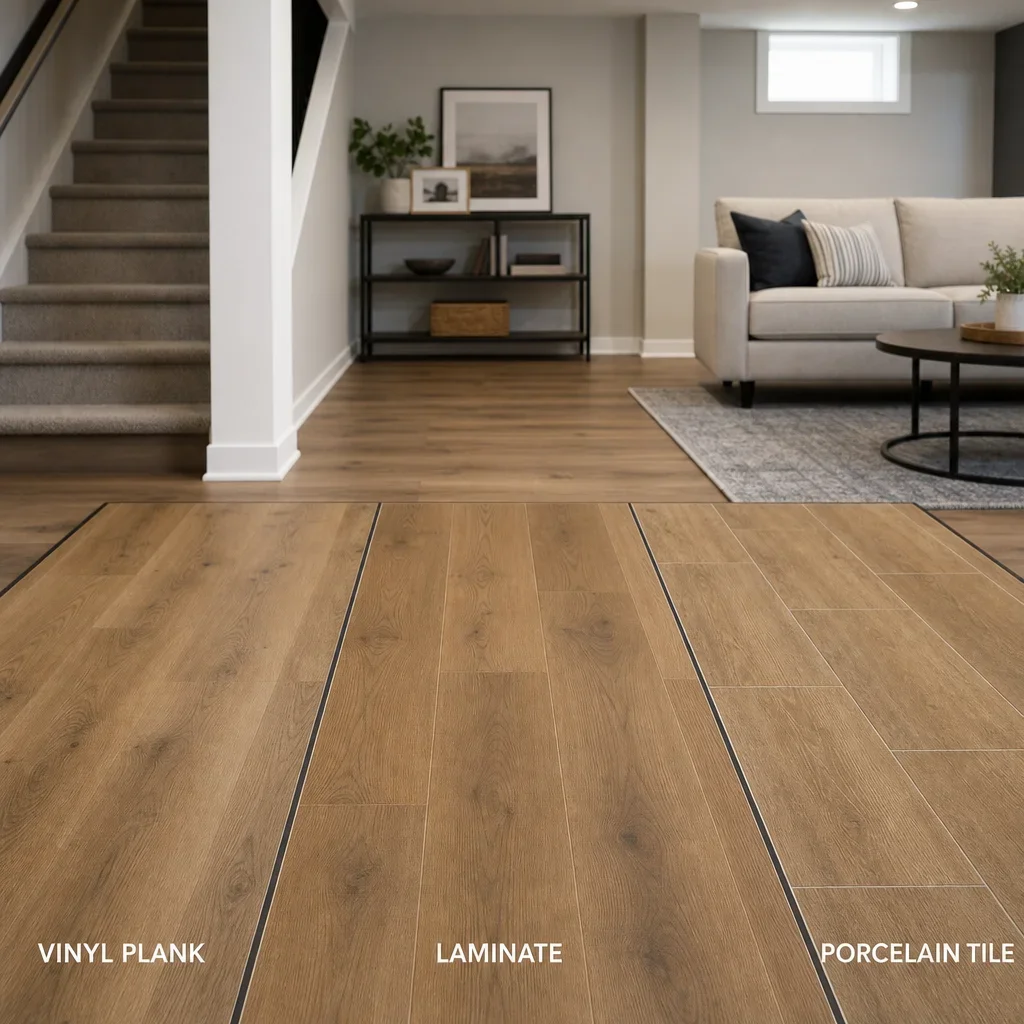
Vinyl plank basement flooring is the leading wood-look option because it handles moisture better than wood-based floors, comes in a wide range of oak and wide-plank visuals, and usually feels more forgiving over concrete than tile. That makes it the default answer for many people comparing basement flooring over concrete.
Waterproof claims need context. A waterproof core does not mean the seams, perimeter gaps, underlayment, slab moisture, or wall cavities can be ignored after a leak.
Laminate flooring can be used in a basement when the space is dry and the product is designed for that setting, but laminate is generally more moisture-sensitive than vinyl. In a damp or leak-prone basement, laminate can swell or fail faster than a vinyl plank floor.
Wood-look porcelain or ceramic tile is one of the safest options for water exposure and works well in bathrooms, laundries, and some flood-prone basements. The tradeoff is feel: tile is usually colder and harder underfoot unless you add radiant heat, mats, or rugs.
If you want a light wood basement floor, vinyl and engineered wood both offer strong design choices such as light oak, natural oak, matte finishes, and Scandinavian-style visuals. Vinyl usually gets you there with less moisture risk.
Solid hardwood is one of the main flooring types not recommended for basements because natural wood movement and below-grade moisture do not mix well. That risk rises in fully underground basements and in homes with any seepage history.
Standard non-water-resistant laminate is also a poor fit in damp basements because core swelling, edge lift, and surface damage can start after water exposure. The same caution applies to any wood-based floor installed over unresolved slab moisture.
Broadloom carpet is risky in leak-prone basements because it can hold odour, trap moisture, and make cleanup harder after a water event. Carpet tile is usually safer because damaged sections can often be removed and replaced individually.
Adhesives, underlayments, and floating floors can all fail if the slab is uneven, too damp, or poorly prepared. Telegraphing, delamination, mold risk beneath the floor, and persistent odour are common failure patterns when the concrete work is skipped.
Products marketed as water-resistant or waterproof still need proper prep. Marketing terms do not override slab conditions.
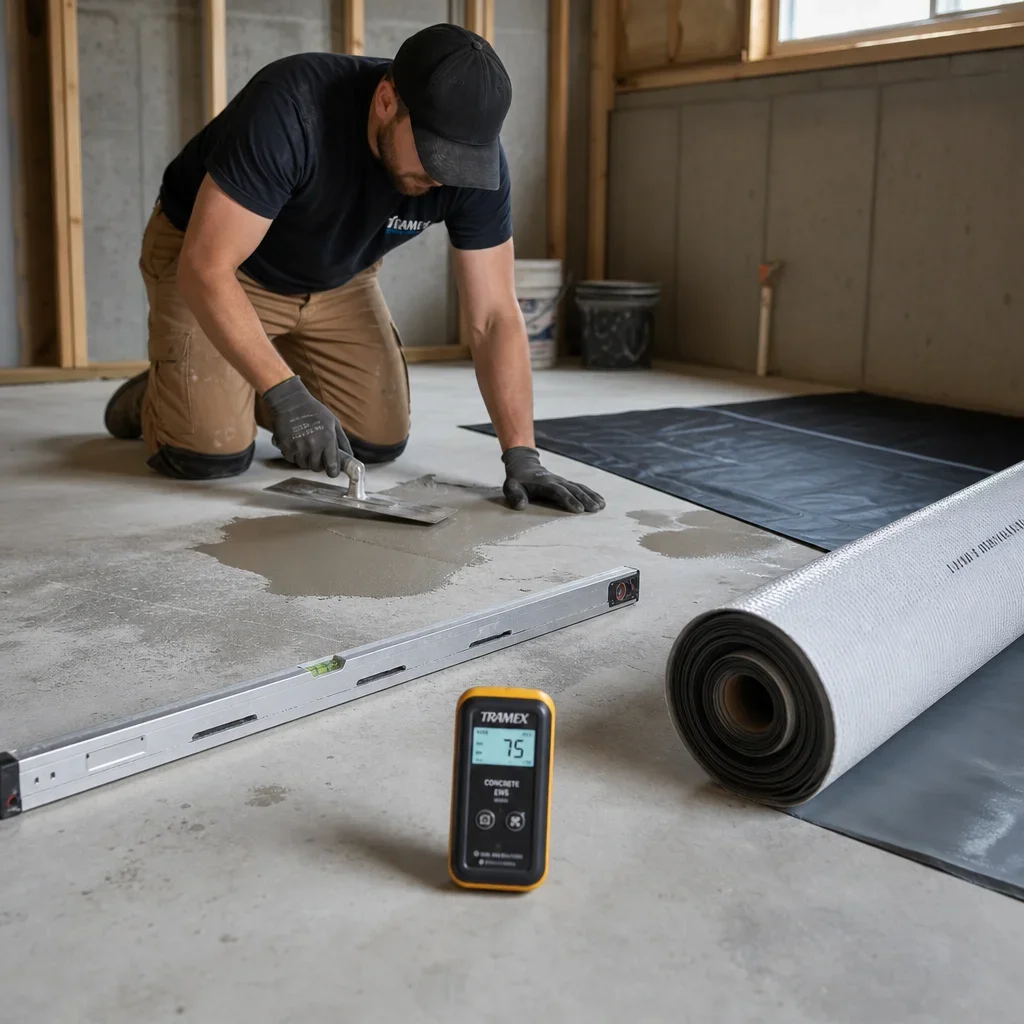
Concrete can look dry and still emit moisture, so moisture testing is one of the first steps before choosing basement flooring over concrete. That is especially true if you are considering engineered wood, laminate, or any glue-down system.
A floating floor still needs a properly prepared slab. Cracks, low spots, surface dust, and height changes can affect lock systems, wear patterns, and how the floor sounds and feels underfoot.
Some flooring can go directly over concrete, but only when the slab condition, underlayment, and vapor-control requirements match the product instructions. Vinyl plank, some laminate systems, tile, and certain engineered products may all go over concrete in the right assembly.
A vapor barrier or integrated underlayment often matters as much as the floor itself in a basement. Those layers help manage moisture transfer, soften the feel, reduce sound, and improve warmth, but they must match the product warranty requirements.
Underlayment is not a cure for a wet basement. It can improve comfort and acoustics, but active moisture problems need repair before any finished floor goes down.
Rec rooms and family rooms usually work best with vinyl plank, SPC, or engineered wood in a dry basement because those surfaces balance comfort, style, and cleanability. If the room sees kids, pets, and drinks, vinyl usually gives you more forgiveness.
A home office usually benefits from a stable, easy-to-clean floor with controlled acoustics. Vinyl and engineered wood both work well, while chair mats may be worth adding under rolling chairs.
Playrooms need a floor that is warmer and easier to clean than tile. Vinyl, carpet tile, or foam in dedicated zones usually make more sense than hard, cold surfaces over concrete.
Home gyms usually favour rubber, vinyl, or foam depending on equipment weight and impact. Rubber is stronger for weights, foam is softer for bodyweight exercise, and vinyl works well for lighter mixed-use rooms.
Laundry rooms, bathrooms, and kitchenette areas should lean toward moisture-tolerant floors such as tile or vinyl plank. Wood-based materials are harder to justify there unless the space is exceptionally controlled and the exact product is approved.
Guest suites usually need a more residential look and a quieter feel. Engineered wood in a dry basement, or a higher-end vinyl plank with a softer underlayment, usually gives the best balance.
Carpet tile is usually the warmest and softest common basement finish underfoot, while tile usually feels the coldest over concrete. Vinyl and engineered wood often sit in the middle, especially when paired with a suitable underlayment.
Hard floating floors can create more echo in large basement rooms than soft surfaces. Underlayment, area rugs in dry zones, fabric furniture, and wall treatments can improve sound noticeably without changing the floor choice.
The healthiest flooring for a basement starts with moisture management, not marketing claims. A dry slab, good cleanup after leaks, and materials that do not trap water easily usually matter more than broad product labels.
If indoor air quality is a priority, check the product documentation for verified low-emission or indoor-air certifications before buying. That is a better standard than relying on vague health claims.
Basement flooring costs are shaped by both material and prep, not just the sticker price of the planks or tile. Concrete repair, leveling, vapor barriers, transitions, trim work, floor removal, and installation can move the total more than many buyers expect.
Current entry-level supply pricing at CanFloor starts from $3.99/sq.ft. for hardwood, $2.99/sq.ft. for engineered wood, $1.69/sq.ft. for laminate, and $1.99/sq.ft. for vinyl . Those are starting product prices, not installed basement project totals.
Broad installed cost ranges are roughly $4-$16/sq.ft. for vinyl plank or SPC, $6-$15/sq.ft. for engineered wood, $7-$24+/sq.ft. for tile, and $3-$12/sq.ft. for epoxy . Carpet tile material often lands around $2-$8/sq.ft., while rubber can run about $7-$25/sq.ft. and foam about $1-$3/sq.ft.
The cheapest way to cover a basement concrete floor is usually paint, basic foam, entry-level vinyl, or simple carpet tile, depending on the room and condition of the slab. The cheapest successful basement floor is different: that means choosing a product that matches the moisture risk so you do not pay twice.
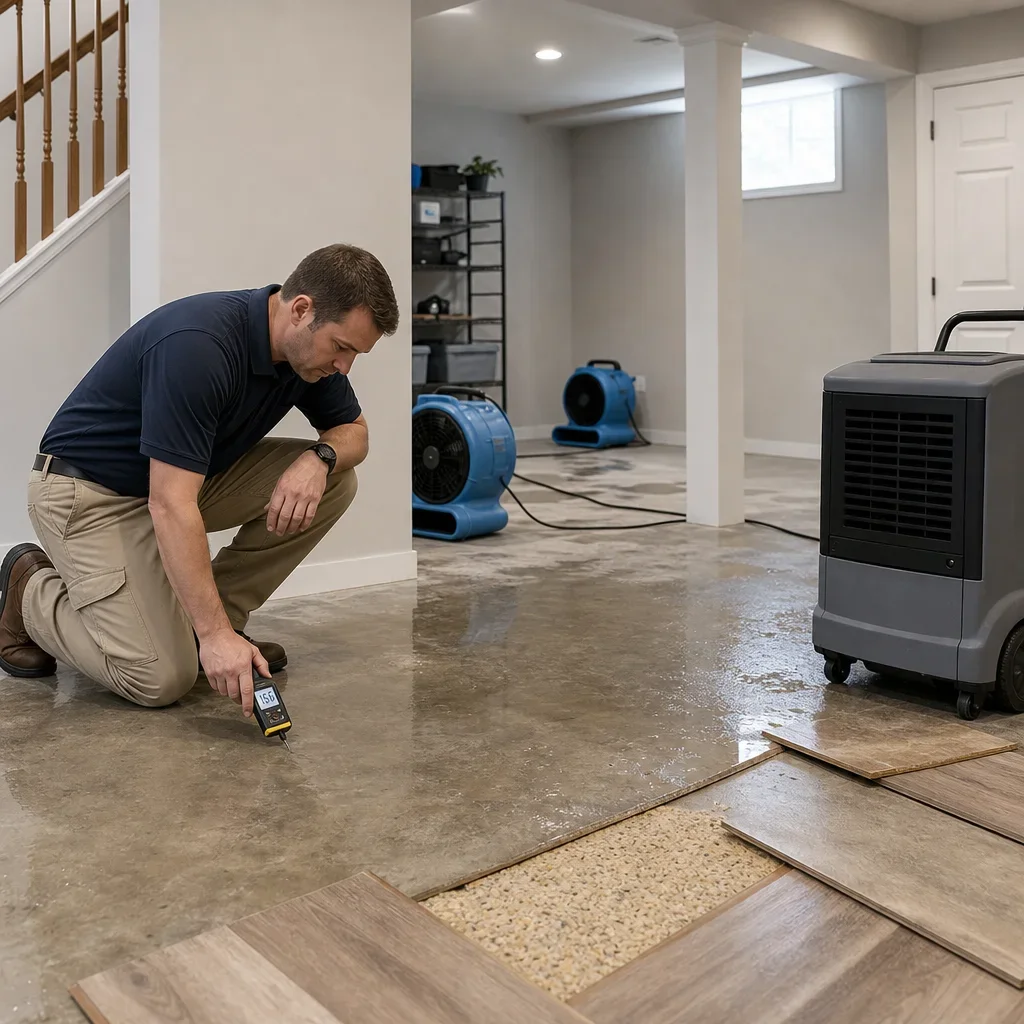
Vinyl and tile usually recover better after a leak than wood-based floors, but neither gives you permission to ignore the subfloor or underlayment. Water can still sit underneath, create odour, or affect the walls and baseboards.
Engineered wood and laminate are usually harder to save after significant water exposure because swelling, edge damage, staining, or board movement can remain even after drying. In many cases, the damaged sections or larger areas need to be removed.
Carpet tile is often easier to repair in sections than broadloom because individual tiles can be lifted and replaced. Rubber and foam can also be practical in utility and gym spaces where modular replacement matters.
Fast action matters more than the product label after a leak. Stop the source, dry the area quickly, inspect the concrete and walls, and make sure the space is fully dry before reinstalling anything.
A light wood basement floor can make a lower-light room feel larger and cleaner. Light oak, natural oak, and soft matte finishes are especially effective in basements with low ceilings or limited daylight.
Wide planks create a calm, modern look, but they work best when the room is open enough to show them properly. Smaller or busier basement layouts sometimes look more balanced with narrower visuals or a simpler colour variation.
For a modern basement, look for light oak or greige wood-look planks with a matte finish. For a cozy family room, medium oak tones and warmer furnishings usually soften the feel of concrete-based spaces.
For a high-end guest suite, engineered wood can bring the most authentic wood appearance when the basement conditions support it. If the room needs more moisture insurance, a premium vinyl floor in a natural oak visual usually gives a similar style direction with less risk.
Vinyl plank and SPC offer strong moisture tolerance, easy maintenance, and a wide style range, but lower-end products can sound hollow or feel less substantial over concrete. Better underlayment and proper slab prep improve that.
Engineered wood brings real grain, warmth, and a more upscale finish, but it costs more than many vinyl options and needs tighter moisture control. It is the better aesthetic choice, not the safer moisture choice.
Laminate can be budget-friendly and attractive, but it remains more vulnerable to moisture than vinyl. It makes the most sense in dry basements where price matters and water risk is genuinely low.
Tile gives excellent water resistance and long-term durability, but it is hard, cold, and less forgiving in family spaces. It usually works best in wet zones or for homeowners who value performance over softness.
Carpet tile, rubber, and foam all solve niche basement needs well. Carpet tile helps with warmth and sectional repair, rubber suits gyms, and foam helps with comfort, but none of them replaces a true wood-look finish for every room.
The rule of 3 in flooring is not a formal basement flooring standard. People use that phrase in different ways for design balance, plank variation, or room styling, but it should not decide what floor goes over a concrete basement slab.
The real basement rules are simpler: check moisture history, prepare the slab, match the floor to the room, and follow the product installation requirements. That is what actually keeps a basement floor performing.
Engineered wood is usually the best real-wood option for a basement because it is more stable than solid hardwood. It still needs a dry slab, controlled humidity, and a product approved for below-grade use.
For many homes, waterproof vinyl plank or SPC is the best all-around basement floor over concrete because it balances moisture tolerance, comfort, style, and cost. Tile can be better in wetter zones, while engineered wood can work in drier, controlled basements.
Yes, in the right basement. It is a good choice when moisture is controlled, the slab is tested, and the exact product is rated for below-grade installation.
Usually no. Solid hardwood is typically not the first recommendation below grade because moisture and humidity swings can cause movement and damage.
Solid hardwood, standard non-water-resistant laminate in damp spaces, broadloom in leak-prone areas, and any flooring installed over unresolved moisture issues are all risky choices.
Some vinyl, laminate, tile, and engineered systems can go over concrete, but only with the right slab prep, underlayment, and vapor control for that product. The manufacturer instructions decide the assembly.
Engineered wood is usually the best real wood flooring for concrete because it is more stable than solid hardwood. Over concrete, the right underlayment or vapor-control layer matters as much as the plank itself.
Yes, but mainly in dry basements with a suitable product and proper prep. In damp or leak-prone basements, vinyl is usually the safer choice.
The lowest-cost options are usually simple paint, entry-level vinyl, foam, or carpet tile, depending on the room. The best budget choice depends on the slab condition and moisture risk.
A healthy basement floor starts with moisture control, easy cleanup, and products with verified low-emission documentation if that matters to you. A dry basement is healthier than any flooring label.
Start with the basement, not the sample board. Check for moisture history, test the slab, decide how water-tolerant the floor needs to be, match it to the room, then compare comfort, style, and budget.
See full-size samples in person if you can. Basement lighting changes colour more than most people expect, especially with light oak and other pale wood-look tones.
If you are comparing engineered wood, vinyl, and laminate for a Toronto or GTA basement, a showroom visit helps because you can feel the surface, compare underlayments, and talk through the concrete conditions before ordering. CanFloor's North York showroom carries basement-friendly options and custom finishes, and financing is available as a secondary convenience through Affirm .
The floor that looks best on day one is not always the floor that performs best after year three. Compare moisture risk first, then style.