
The best engineered hardwood flooring is rarely one universal product. The right choice depends on moisture exposure, subfloor type, room use, board construction, and installation quality, not just the name on the box.
For most buyers, the best engineered hardwood flooring is a stable, well-milled board with a real plywood-style core, a meaningful wear layer, and a finish that fits the room instead of fighting it. If you are comparing the best engineered flooring or the best engineered hardwood, start with the room first: kitchens need better spill tolerance and easier maintenance, basements need proven moisture control, and concrete subfloors need the right install system as much as the right product.
For kitchens, the best engineered hardwood flooring for kitchen use is usually a matte or low-sheen white oak or hickory look with a durable factory finish and realistic water-resistance claims, not a glossy floor that shows every scratch and crumb. For basements, the best engineered wood flooring for basements is only the product that is approved for below-grade use and installed over a dry, tested slab with the correct vapor protection. For pets and busy families, the most durable engineered hardwood flooring usually means a harder species, a textured surface, and a finish that hides wear better visually.
Buyers searching for the best engineered hardwood flooring brands often want a simple ranking, but that is not how good flooring decisions are made. A premium design brand can be excellent in a main floor renovation and still be the wrong call for a damp basement, while a moisture-focused product can be practical without looking as refined. The honest way to compare is by construction, finish, support, and fit for the room.
High-quality engineered hardwood starts with construction you can verify on the sample or spec sheet. Wear layers are commonly discussed in the 2 mm to 6 mm range, and thicker wear layers usually support better longevity and, in some cases, future refinishing potential. Total board thickness is commonly found from about 3/8 inch to 3/4 inch, and thicker boards often feel more substantial underfoot and can signal a more premium build.
Core type changes how the floor handles movement, sound, and subfloor conditions. Multi-ply or plywood cores are generally valued for stability, while HDF-based products can feel dense but may react differently to moisture, and rigid composite-backed constructions are often marketed for extra dimensional stability. The best engineered hardwood flooring brands usually explain the core clearly instead of hiding behind vague phrases like "high-performance technology."
Finish quality matters because daily wear shows on the coating long before the board itself fails. UV-cured finishes and aluminum-oxide-enhanced coatings are common in the category, and textured, wire-brushed, or matte surfaces usually hide scratches, dust, and pet wear better than smooth high-gloss planks. I would compare how the finish looks after traffic, not just how it looks under showroom lights.
Milling quality tells you a lot in five minutes. Good boards fit tightly, have consistent bevels, show straight edges, and do not vary wildly from plank to plank unless the style is meant to be highly rustic. Poor milling creates lip, gaps, noise, and frustration even before long-term moisture issues show up.
Species choice affects both design and durability. White oak stays popular because it balances grain character, colour flexibility, and broad design appeal, while hickory gives a busier grain that can hide dents better, maple reads cleaner and harder-edged visually, walnut looks rich but is softer, and red oak has a warmer, more traditional grain pattern. The best engineered hardwood for kitchen traffic is often less about one species being magic and more about matching species, finish, and sheen to how the room is used.
Waterproof engineered hardwood claims need careful reading. Most products sold under that language are better described as water resistant, meaning they can handle routine spills better than older wood floors but are not flood proof and are not immune to slab moisture, standing water, or leaks. If the packaging says waterproof, read the warranty and installation requirements before treating it like vinyl.
The best engineered hardwood flooring brands are the ones that match your room, budget, and installation conditions with clear specs and dependable support. In Canada, buyers often compare names such as Mirage, Lauzon, Kährs, Bruce, Mohawk, Shaw, Mannington, Somerset, Hallmark Floors, Johnson Hardwood, and Carlisle, but the right comparison is not a beauty contest. It is a spec-and-support comparison.
| Brand | Typical market position | Common strengths | Watch for |
|---|---|---|---|
| Mirage | Premium | Consistent milling, refined visuals, strong reputation in higher-end homes | Budget may not suit every project |
| Lauzon | Premium | Canadian recognition, design-forward options, upper-tier positioning | Line-specific specs still need checking |
| Kährs | Premium | Established engineered wood reputation, design appeal | Confirm local availability and approved install methods |
| Bruce | Value to mid-range | Broad recognition, accessible options | Quality can vary by line, so compare specs carefully |
| Mohawk | Mid-range to broad-market | Wide selection and dealer reach | Read line-by-line construction details |
| Shaw | Mid-range to broad-market | Large assortment and style range | Warranty and build can differ by collection |
| Mannington | Mid-range | Good design selection, broad category experience | Confirm the exact core and moisture suitability |
| Somerset | Mid to premium | Traditional wood appeal in some lines | Availability can vary by dealer |
| Hallmark Floors | Premium design-focused | Strong style story in select collections | Verify Canadian supply and service support |
| Johnson Hardwood | Mid to premium | Variety of visuals and formats | Compare finish and core details by line |
| Carlisle | Luxury | Custom-style appearance and premium wood visuals | Usually a high-budget choice |
The most useful way to compare the best engineered flooring brands in Canada is to separate premium design brands, value brands, and moisture-focused options. Premium lines tend to focus on longer planks, refined oak visuals, and stronger fit-and-finish, while value lines can still perform well if the core, finish, and installation suit the project. Dealer support matters too, because a good warranty on paper is less useful if nobody helps when there is a service issue.
Warranty language is usually broad and varies from shorter limited coverage to multi-decade residential warranties depending on the line. That is why I tell buyers to compare the exclusions, moisture conditions, and installation requirements, not just the length printed in large type.
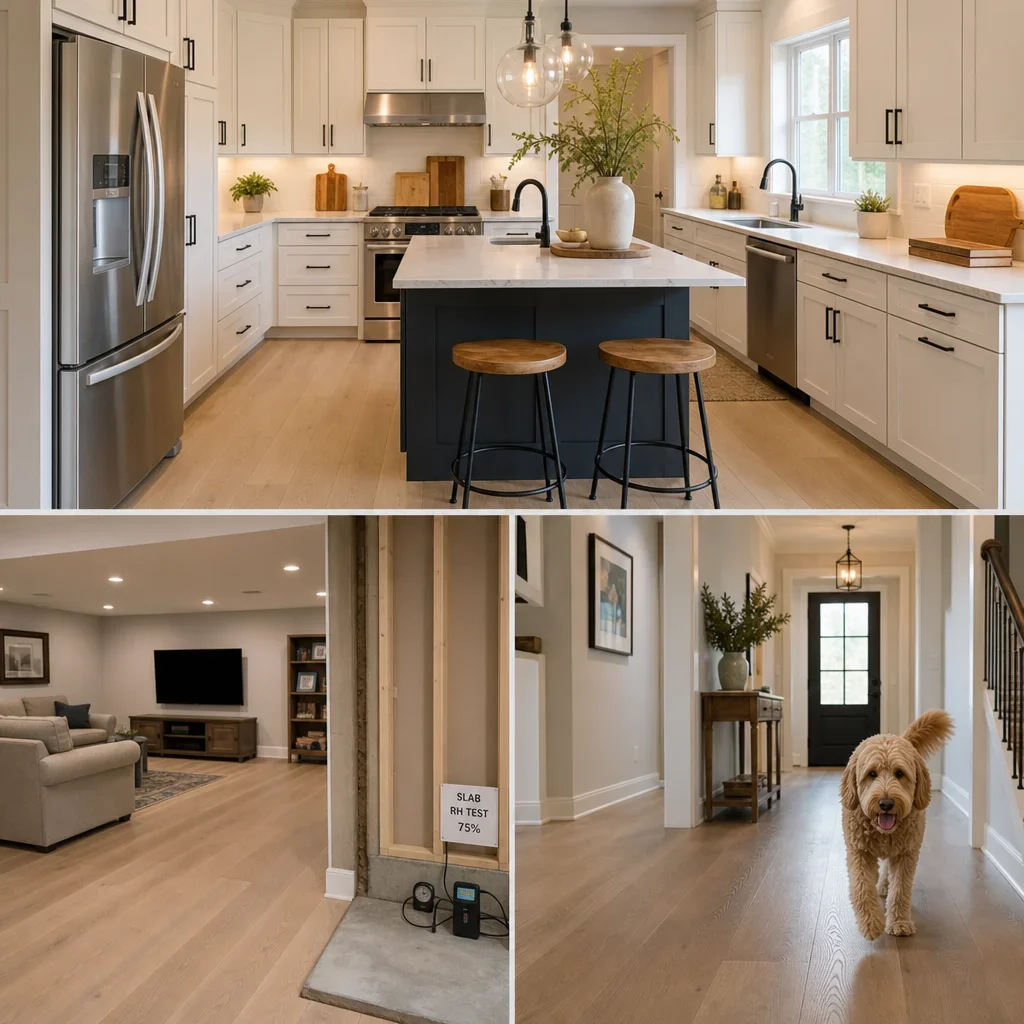
The best engineered hardwood flooring for most homes changes by use case. For kitchens, look for stable construction, a durable finish, lower gloss, and a colour that hides crumbs and daily wear. For basements, look for below-grade approval, slab moisture testing, and realistic expectations about risk. For concrete, the best engineered wood flooring for concrete is the one whose installation method matches the slab condition and manufacturer instructions.
For pets and high traffic, the best engineered hardwood flooring for dogs is usually a harder-looking and more forgiving floor rather than the glossiest or darkest one. Wire-brushed white oak, hickory, and matte finishes tend to hide claw marks and dust better than polished dark boards. A floor that looks good after six months is usually a better choice than one that only looks good on day one.
For a premium appearance, wider and longer planks, calmer oak visuals, and well-matched trims make the biggest difference. Wider planks can look more upscale, but they also demand flatter subfloors and better installation discipline. That is where product quality and installer quality meet.
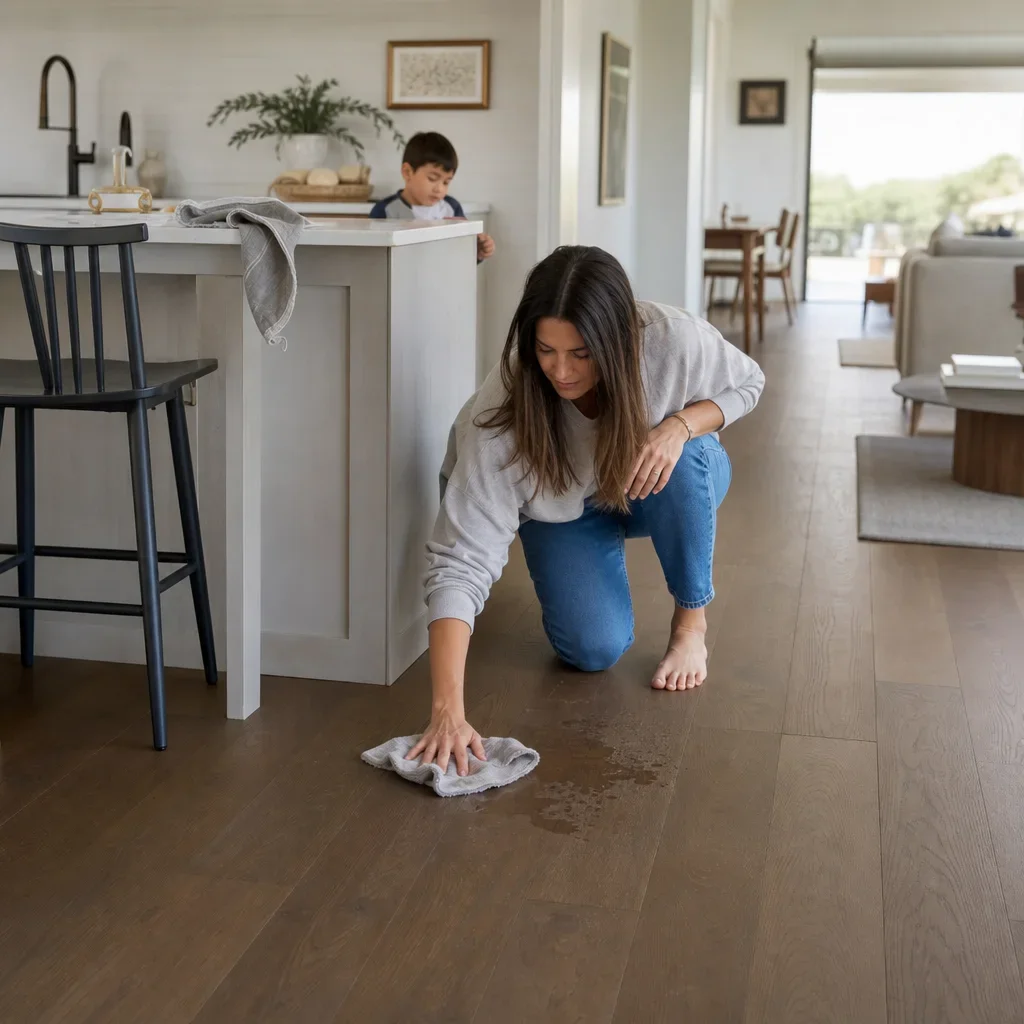
Yes, engineered hardwood is often a good kitchen floor if spills are cleaned quickly and the product is chosen with realistic expectations. It is more dimensionally stable than solid hardwood, gives a warmer feel than tile, and creates continuity if the kitchen opens into a main living area. That is why many buyers looking for the best engineered hardwood for kitchen spaces start here.
The downside is simple. Engineered wood flooring in kitchen pros and cons always comes back to water. It is not the best choice for standing water, ignored leaks, or households where the floor is routinely soaked, and it can still dent or scratch from dropped cookware, chairs, pets, and grit. If your kitchen is leak-prone or extremely busy, vinyl or tile may be the smarter call.
The kitchen features that usually age best are matte finishes, textured surfaces, stable cores, and colours that do not exaggerate dust or scratches. Matching transitions to adjacent rooms and good finishing around dishwashers, islands, and patio doors matter just as much as the plank itself.
| Pros | Cons |
|---|---|
| Warmer underfoot than tile | Not truly waterproof in most cases |
| Better stability than solid hardwood | Standing water can still damage edges and core |
| Premium real-wood look | Can dent or scratch |
| Good continuity with open-concept layouts | Needs more careful maintenance than vinyl or tile |
| Can work well over suitable subfloors | Finish and warranty depend on proper cleaning and installation |
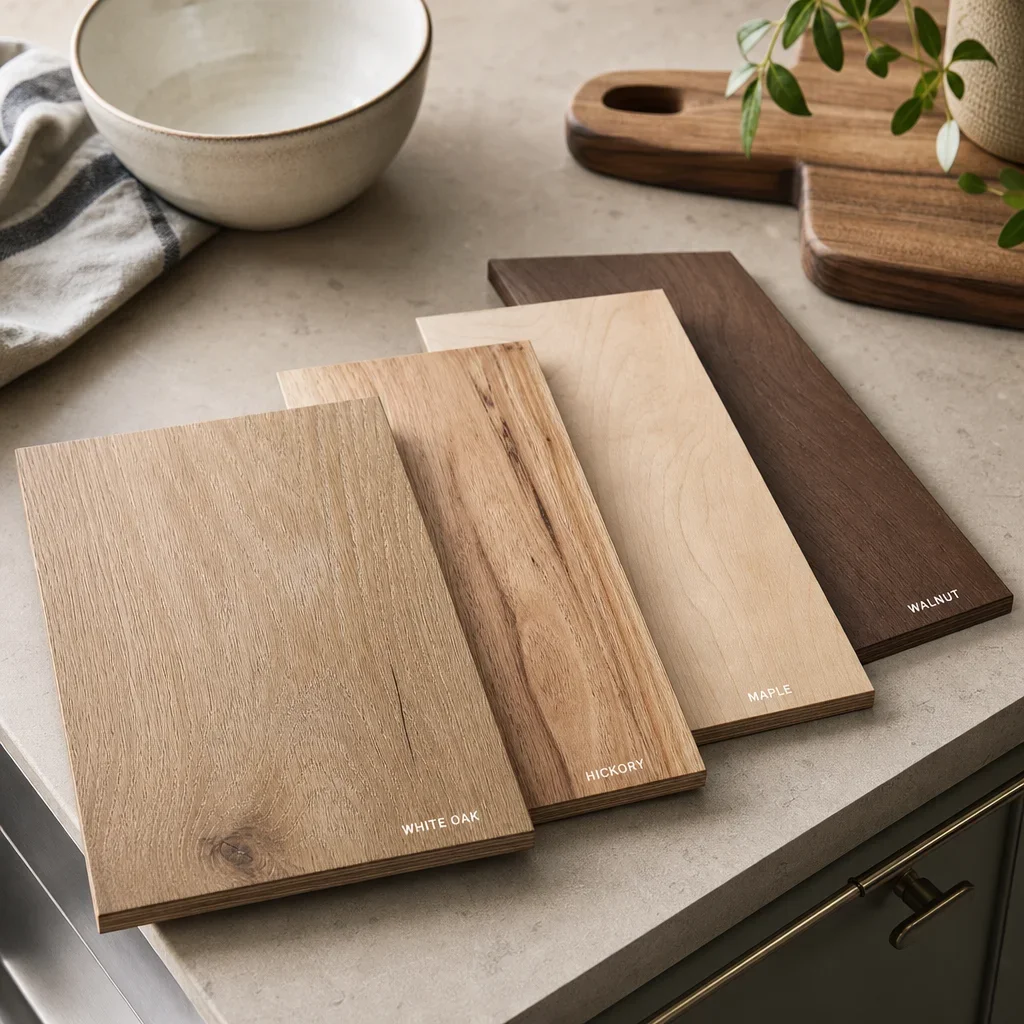
White oak is one of the safest choices for kitchen use because it balances grain movement, colour flexibility, and a timeless look. Hickory is busier and more dramatic, which can help hide small dents and daily wear, while maple looks cleaner and more contemporary but can show damage differently because the grain is less forgiving. Walnut reads rich and upscale, but it is usually a softer visual-and-performance choice for heavy family kitchens.
If you are deciding between light oak and light hickory, the choice is mostly visual and practical. Light oak usually looks calmer and more contemporary, while light hickory has more natural contrast and movement, which can disguise wear and crumbs better in active homes. The best engineered wood flooring for kitchen use is often the one that still looks clean between deep cleans.
Textured, brushed, and low-sheen finishes usually perform better visually than smooth gloss finishes. Dark glossy floors can make a kitchen look sharper in a photo, but they also tend to show dust, footprints, and fine scratches faster. That is why the best engineered hardwood flooring for kitchen projects is often understated rather than flashy.
The flooring direction buyers keep coming back to is natural-looking wood, lower gloss, wider planks, and lighter to mid-tone oak visuals. Those looks fit a wide range of cabinet colours and tend to age better than extreme grey or very dark glossy floors. If you are asking what flooring is trending for 2026 or what color floors are in for 2026, that natural-and-warm direction is the safer answer than chasing a dramatic fad.
The wood colour that rarely falls out of favour is a natural to medium oak tone with visible grain and a matte finish. It works with more countertop materials, cabinet colours, and repaint cycles over time. Very cool greys and very dark espresso looks can date a room faster and usually show more dust.
Floors do not need to match countertops, but the undertones should not fight each other. A kitchen usually looks more considered when the floor and counters have some contrast in value while still sharing compatible warm, neutral, or soft cool undertones. Mismatched undertones, plastic-looking embossing, abrupt material changes, and shiny finishes that magnify every flaw are common reasons a kitchen looks cheaper than it should.
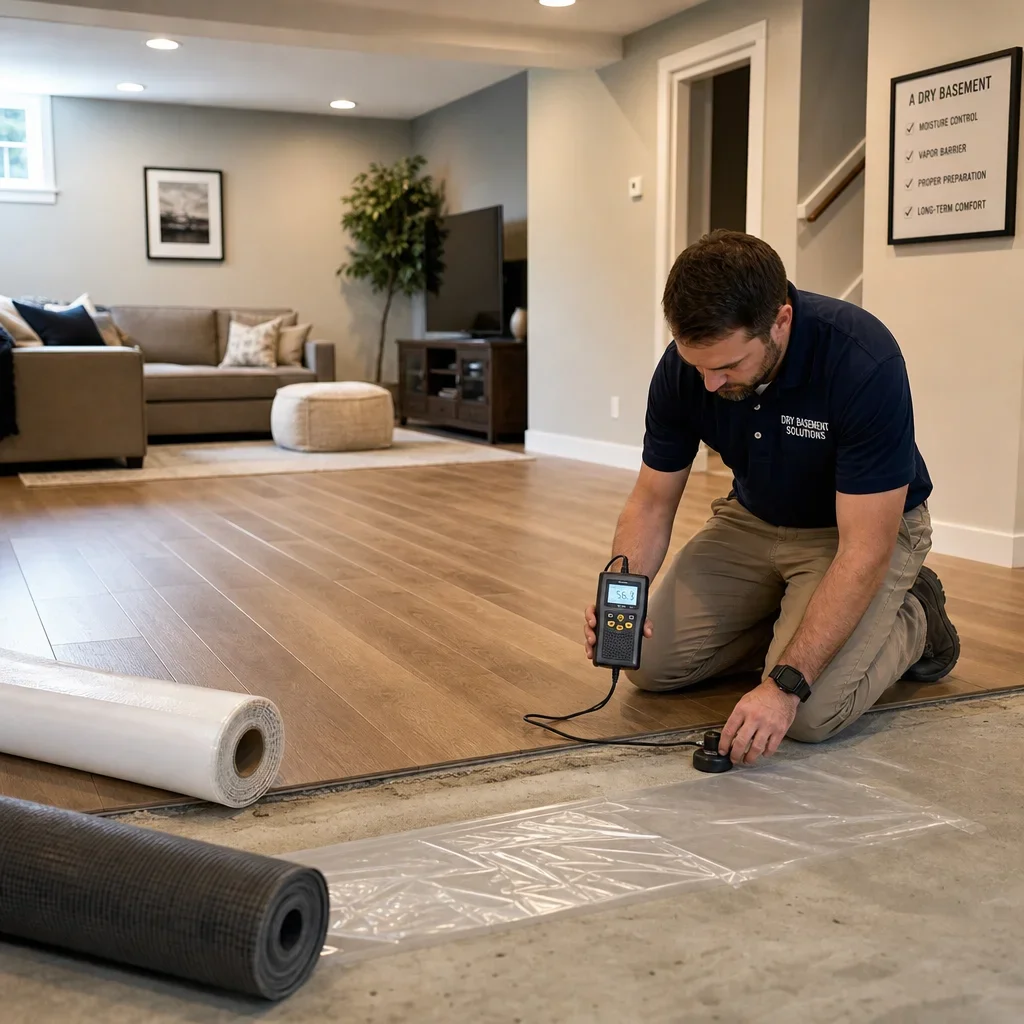
Engineered hardwood can work in some basements, but only in dry, controlled spaces with proper moisture testing and the right product approval. Below grade engineered hardwood is not a blanket yes. It is a condition-based decision. If the basement has known water intrusion, regular dampness, drain backups, or unresolved slab moisture, engineered hardwood flooring for basement use is usually not the safest choice.
Compared with solid hardwood, engineered wood handles below-grade conditions better because its layered construction is more stable. Compared with vinyl, it is still more sensitive to moisture and usually less forgiving when something goes wrong. In a dry finished basement where the owner wants a genuine wood surface, engineered can be a strong option. In a damp basement, vinyl often wins on risk control.
The floors that are not recommended for basements are the ones being forced into a space that has not been made dry first. Solid hardwood is usually the riskiest wood choice below grade, and even a good engineered product should not go over a slab that has not been tested and prepared. Moisture problems do not care how premium the board is.
Engineered hardwood wins over concrete when the slab is dry, flat, and tested, and when the owner wants real wood underfoot instead of a wood look. Vinyl plank usually wins when moisture risk is higher, the basement is more utility-driven, or the household wants the most forgiving floor for leaks and humidity swings. Laminate can work in some dry basements, but it is usually less forgiving of moisture at the edges than quality vinyl. Tile is durable and moisture-safe, but colder and harder underfoot.
| Flooring type | Warmth underfoot | Moisture tolerance | Real wood surface | Risk level over basement concrete |
|---|---|---|---|---|
| Engineered hardwood | Good | Moderate, condition-dependent | Yes | Moderate |
| Vinyl plank | Good to very good | High | No | Lower |
| Laminate | Moderate | Moderate to lower, product-dependent | No | Moderate to higher |
| Tile | Low | High | No | Lower |
Canadian basement realities matter here. Concrete slabs, seasonal humidity, and below-grade moisture mean the best flooring for a concrete basement in Canada is not always the prettiest sample in the showroom. It is the floor that suits the space you actually have.
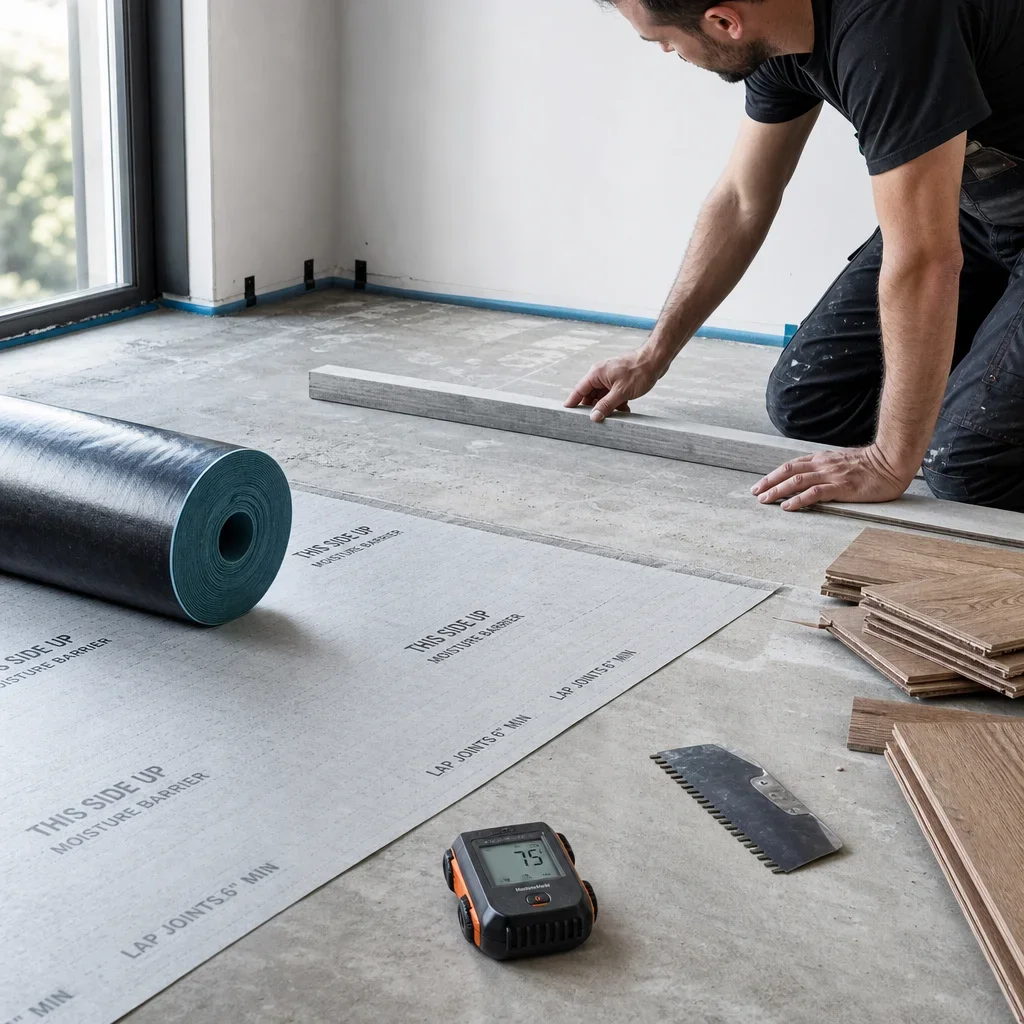
Yes, engineered hardwood can often be installed over concrete if the slab is properly tested, prepared, and matched to an approved installation method. That is one reason engineered wood is more flexible than solid hardwood for many renovation projects. The best engineered wood flooring for concrete still depends on slab moisture, flatness, and the manufacturer's instructions.
Expansion gaps around the perimeter are commonly cited at about 1/4 inch, though the exact requirement depends on the product and room size. Acclimation guidance is often cited around 48 to 72 hours, but some products have stricter or different instructions, so the carton and technical sheet always win. If an installer gives one generic rule for every product, that is a red flag.
Underlay and vapor protection are not optional details on concrete. Some floating systems require a specific underlayment with moisture control, while glue-down systems depend on adhesive compatibility, slab prep, and moisture limits set by the manufacturer. Following the approved system is part of protecting the warranty, not just improving comfort.
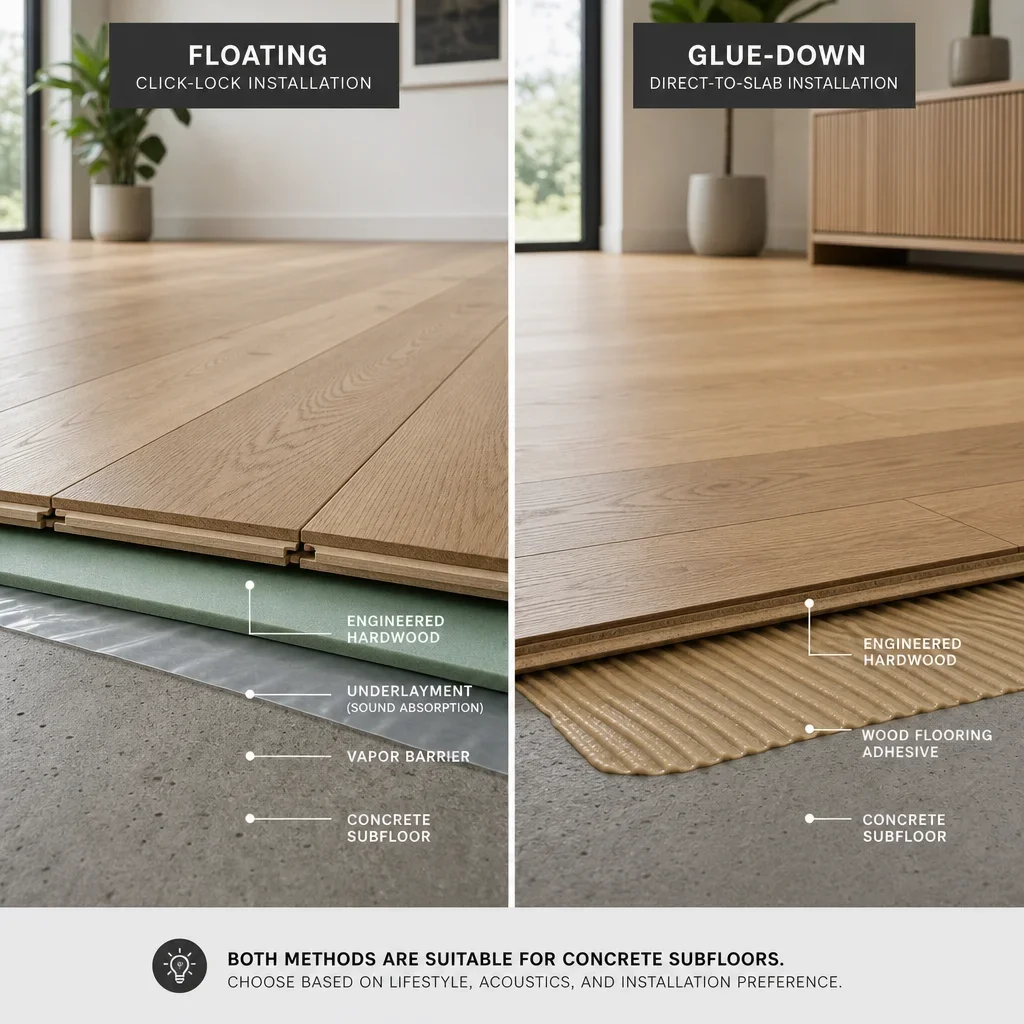
Neither method is universally better. Floating floors are often faster to install and can be a practical option for click systems and some basement conditions, while glue-down floors usually feel more solid underfoot and can sound less hollow when the slab is suitable and the product is approved for adhesive installation. The better method depends on the product, slab condition, sound expectations, and manufacturer specs.
A floating floor can be attractive where speed, serviceability, or underlayment-driven acoustics matter. A glue-down system can be attractive when the goal is a more anchored feel in a premium main-floor or condo install over concrete. Generic advice like "glue-down is always better" or "floating is always safer" usually ignores the exact board you are buying.
The real mistake is choosing the method first and the product second. The install method has to be approved for that specific floor, and the slab has to be tested before anyone decides how to proceed. Warranty failures often start with skipping that step.
Engineered hardwood can usually be cleaned with a microfiber mop and a manufacturer-approved cleaner. It should not be soaked, and steam mops are a bad idea unless the manufacturer specifically allows them in writing. If you are searching for the best engineered hardwood flooring cleaner, the safe answer is the cleaner approved for your finish system, not a one-size-fits-all bottle.
Yes, you can mop an engineered floor, but it should be a damp clean, not a wet wash. Excess water, harsh detergents, abrasive pads, and oil soaps that are not approved for the finish can all create problems ranging from haze to edge swelling. In kitchens, wipe spills quickly and protect sink, island, and entry areas with common-sense mats and pads.
Finish and sheen affect maintenance more than people think. Matte and textured boards usually hide dust and micro-scratches better, while smoother glossy boards demand more upkeep to keep the same clean look. A realistic maintenance plan should be part of the buying decision.
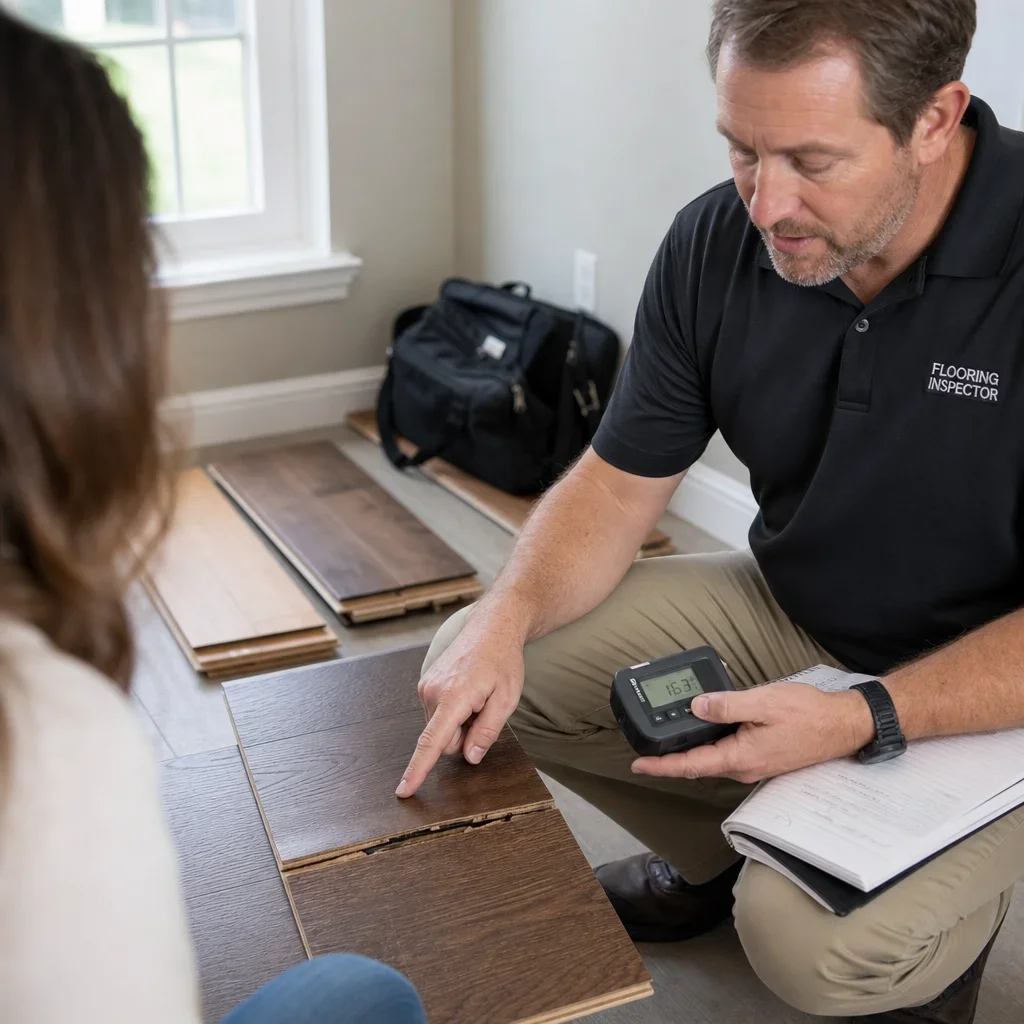
Most flooring failures trace back to weak specs, moisture mistakes, or poor installation discipline. Common failure modes include edge swelling, delamination, finish wear that shows too early, cupping or peaking from moisture, hollow sound, and gapping caused by poor acclimation or subfloor prep. Those issues are more useful to study than searching for engineered hardwood flooring brands to avoid as a simple blacklist.
The clearest red flags are vague wear-layer information, unclear core construction, sweeping waterproof claims, samples with inconsistent colour or milling, and dealers who cannot explain how the floor will be installed over your actual subfloor. Another red flag is when matching trims, stair nosing, or transitions are missing, because whole-home installs rarely look finished without them.
Warranty support matters after the sale. If nobody can explain what voids the warranty, who documents moisture testing, or who handles service issues, the product is not really as safe a purchase as it looks. Good after-sale support is part of quality.
The best engineered hardwood flooring for the money is the floor whose specs, installation plan, and after-sale support are all clear before the job starts. Ask for the wear layer, total thickness, core construction, approved installation methods, and whether the product is suitable for below-grade or concrete use. Those basics eliminate a lot of expensive surprises.
Ask how slab or subfloor moisture will be tested, what underlayment or adhesive is included, how flatness issues will be handled, and what happens at transitions, stair nosing, vents, and doorways. On open-plan projects, also ask how continuity across rooms will be managed and where expansion planning will happen.
Ask who owns the warranty claim process if something goes wrong later. On a major investment, that answer matters as much as the board itself. You also want to know what photos, moisture readings, cartons, invoices, and maintenance records you should keep in case a warranty issue shows up years later.
Tiny swatches are a weak way to choose a floor. The best engineered hardwood flooring should be viewed in larger samples, in daylight, in evening light, and under the task lighting used in the room where it will be installed. Colour shift, grain movement, and gloss can look completely different once lighting changes.
Check grain variation, texture, bevel size, stain consistency, and the mix of board lengths. A floor can look premium in one perfect display plank and much less convincing when the board length mix is short or the surface pattern repeats too obviously. That is especially true when comparing the best engineered hardwood flooring brands Canada buyers see in person.
Bring cabinet, countertop, paint, and tile samples if you have them. Matching undertones early is easier than trying to fix a floor that looked fine under showroom lights but fights the rest of the house at home. Before finalizing, also confirm the matching trims, transitions, and stair nosing are available.
Engineered hardwood and solid hardwood both give you real wood, but engineered is usually more stable across changing humidity and is more practical over concrete or in kitchens and some basements. Solid hardwood can offer more refinishing potential over a very long ownership period, but it is usually less forgiving in moisture-sensitive spaces. That is the main trade-off, not which one is more "real."
Compared with vinyl, engineered hardwood offers a genuine wood surface and often a more premium feel, while vinyl usually wins on water tolerance and lower-risk basement use. Compared with laminate, engineered hardwood tends to feel more substantial and more natural underfoot, while laminate can compete on price and scratch resistance depending on the product. Compared with tile, engineered is warmer and softer underfoot, while tile is stronger in wet areas and simpler around repeated water exposure.
High-end homes often use real wood or high-quality engineered wood in main living areas because the surface and look still matter. But luxury is not one material everywhere. Practical homes often mix materials by room function, using wood where warmth and continuity matter most and using tile or resilient flooring where moisture risk is higher.
| Material | Real wood surface | Better over concrete | Better in wet-risk rooms | Warmth/comfort | Typical use case |
|---|---|---|---|---|---|
| Engineered hardwood | Yes | Yes | Moderate only | Good | Main floors, kitchens, some basements |
| Solid hardwood | Yes | Less suitable | Lower | Good | Main floors above grade |
| Vinyl plank | No | Yes | Yes | Good | Basements, busy kitchens, utility areas |
| Laminate | No | Yes, condition-dependent | Moderate to lower | Moderate | Budget-conscious dry areas |
| Tile | No | Yes | Yes | Lower | Wet-prone kitchens, entries, basements |
Price is driven by species, wear layer, core construction, board width and length, finish quality, country of manufacture, and installation complexity. Material price alone does not tell you the whole value of the floor once trims, subfloor prep, stairs, transitions, and labour enter the picture.
At CanFloor, engineered wood flooring starts from $2.99 per square foot. That is a useful entry point, but the installed total depends on the exact product, room conditions, layout complexity, stair work, trims, and any required subfloor preparation. The floor that costs less per square foot can still cost more in the long run if the specs or installation are wrong for the space.
Value is the total installed outcome. If you are comparing the best engineered hardwood flooring Canada buyers can get for a fair price, compare sample quality, board specs, installation planning, trim availability, and support after the job, not just the sticker price. For buyers who want to compare options in person, bringing kitchen, basement, or whole-home plans to the North York showroom can make the decision clearer because you can line up larger samples, room conditions, and matching trims before ordering.
There is no universal best brand for every home. The best brand is the one with clear specs, stable construction, reliable support, and a product line that matches your room conditions.
Look for a clearly stated wear layer, solid core information, precise milling, consistent finish quality, and approved installation guidance for your subfloor. Vague specs are a warning sign.
Engineered boards commonly range from about 3/8 inch to 3/4 inch overall, and thicker boards often signal a more substantial build. The best thickness still depends on the product design and installation plan.
Yes, often. It works well in kitchens when spills are cleaned quickly, the finish is practical, and the installation fits the room conditions.
Yes, in some basements. The space must be dry, tested, and suitable for the exact product. If moisture problems are unresolved, look at vinyl instead.
Yes, often. The slab must be tested, prepared, and matched to an approved floating or glue-down system.
Neither is automatically better. Floating can be faster and practical for some click systems, while glue-down can feel more solid and sound quieter on suitable slabs.
Many systems do, especially floating floors, but the exact requirement depends on the product and the moisture-control system approved by the manufacturer.
Yes, with a damp microfiber mop and an approved cleaner. Do not soak it, and do not use steam unless the manufacturer allows it.
It is still vulnerable to standing water, can dent or scratch, and depends heavily on proper installation and moisture control.
Look for lower-sheen finishes, textured surfaces, and visually forgiving species like white oak or hickory looks. Hiding wear is part of durability in real life.
Vinyl plank is usually the stronger alternative in a damp basement because it handles moisture risk better.