
The biggest mistake we see is treating every wood floor the same. The best soundproof underlayment for nail down hardwood floors is usually not a soft foam roll at all. For solid hardwood that is nailed down, the right answer is usually an approved nail-down acoustic system, a suitable paper or felt layer where allowed, or a different floor assembly altogether. Your choice depends first on installation method, then subfloor, then moisture risk, then any condo sound rules. This is general information, not a product recommendation for your exact floor.
For nail-down solid hardwood, the best option is usually a firm, approved acoustic layer or system that still lets the floor fasten properly, not a generic cushioned floating-floor underlay. That matters because nails need solid holding power in the subfloor, and soft compressible layers can interfere with fastener grip and floor stability. If you are searching for what is the best underlayment for nail down hardwood floors, start by checking whether the hardwood manufacturer allows a membrane, panel, felt, or paper under that exact installation method.
The best soundproofing underlayment for hardwood floors changes completely once the installation method changes. Floating engineered hardwood and laminate can use dedicated acoustic underlays in roughly the 2 mm to 6 mm range , while glue-down engineered floors may use adhesive-compatible sound and moisture systems instead of loose underlay. Nail-down and floating floors are not the same conversation, even if both have wood on top.
Real hardwood does not always need underlayment, and sometimes the wrong underlayment is worse than none. Solid hardwood nailed over plywood or OSB often uses a thin slip or moisture-moderating layer such as rosin paper or felt where the floor maker allows it, but that is not the same as thick cushioned underlay. The best underlay for real wood flooring depends on whether the floor is solid or engineered, and whether it is nailed, glued, or floated.
A moisture barrier, an acoustic membrane, rosin paper, felt, plywood underlayment, and a floating-floor pad all do different jobs. A vapor barrier helps slow moisture movement, an acoustic layer targets impact noise, paper or felt can reduce wood-to-wood rubbing and minor dust transfer, and a cushioned click-floor underlay is mainly for floating floors. Mixing those up is how buyers end up with squeaks, movement, or a denied warranty claim.
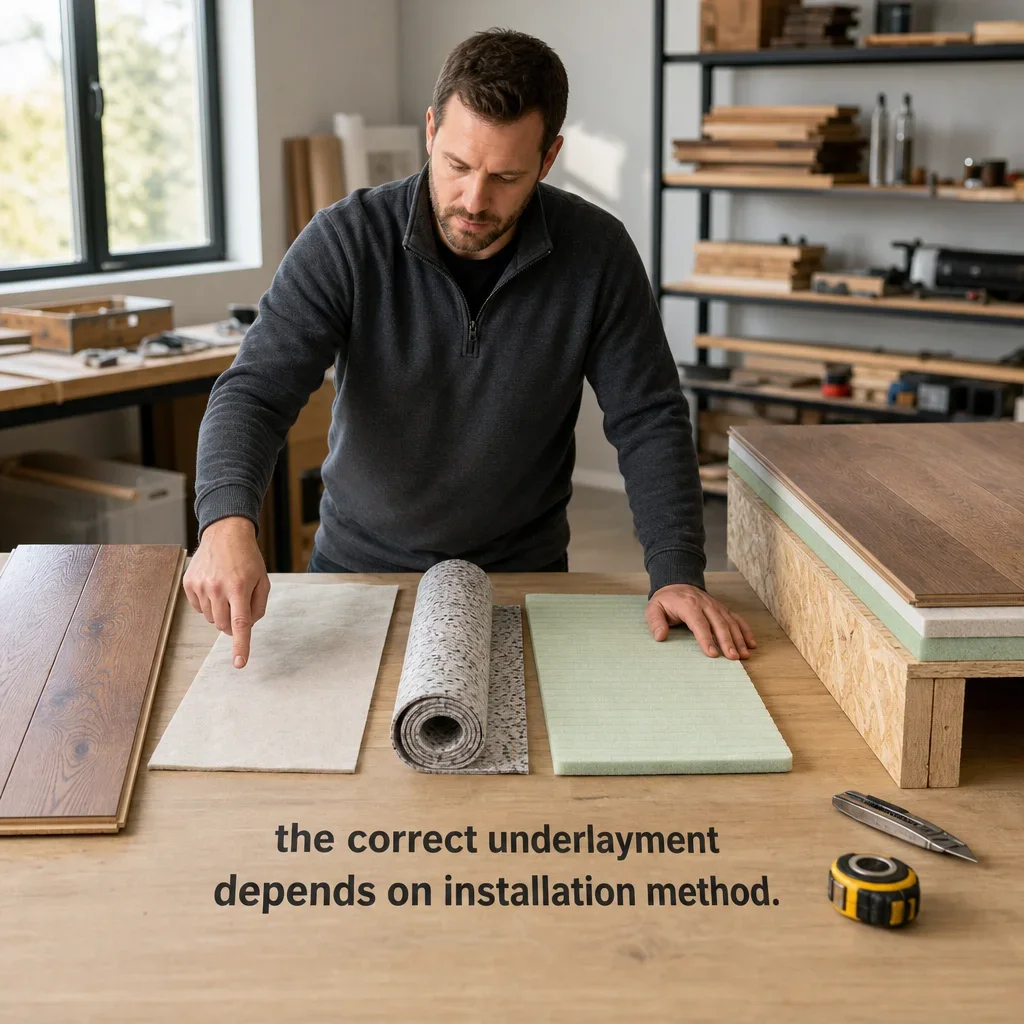
The right underlay for nail down hardwood flooring is whatever the floor manufacturer approves for that fastening method and subfloor. In practice, that usually means a thin approved layer, a nail-down acoustic panel or membrane system, or no cushioned underlay at all. If the goal is sound control in an upstairs room or condo, we tell buyers to decide on the installation method before shopping underlay, because the method limits the products that can go underneath.
For glue-down engineered hardwood, the right system is usually an adhesive-compatible acoustic or moisture-control layer, especially over concrete. Some assemblies use a trowel-applied adhesive with built-in sound or moisture benefits, and others use a separate membrane designed for glue-down work. Loose foam underlay is generally for floating floors, not glue-down installations.
For floating engineered hardwood or laminate, the best underlayment for noise reduction is usually a dense floating-floor underlay matched to the locking system, room use, and moisture needs. Common categories include foam, IXPE, felt, cork, and combo underlays with an attached vapor layer. Thicker is not automatically better, because click joints need support as much as cushioning.
| Floor type | Typical install method | Usually suitable underneath | Best use case | Avoid |
|---|---|---|---|---|
| Solid hardwood | Nail-down | Approved paper, felt, or nail-down acoustic system | Main floors over wood subfloor | Generic soft foam underlay |
| Engineered hardwood | Nail-down | Manufacturer-approved nail-down layer or none | Wood subfloors where engineered is preferred | Floating-floor pads unless approved |
| Engineered hardwood | Glue-down | Glue-compatible membrane or adhesive system | Concrete slabs and condos | Loose underlay not meant for adhesive |
| Engineered hardwood | Floating | Foam, felt, cork, IXPE, combo vapor-barrier underlay | Quick installs and sound control | Overly thick pads that destabilize joints |
| Laminate | Floating | Foam, felt, IXPE, combo underlay | Budget-friendly sound and comfort | Wrong thickness for the click system |
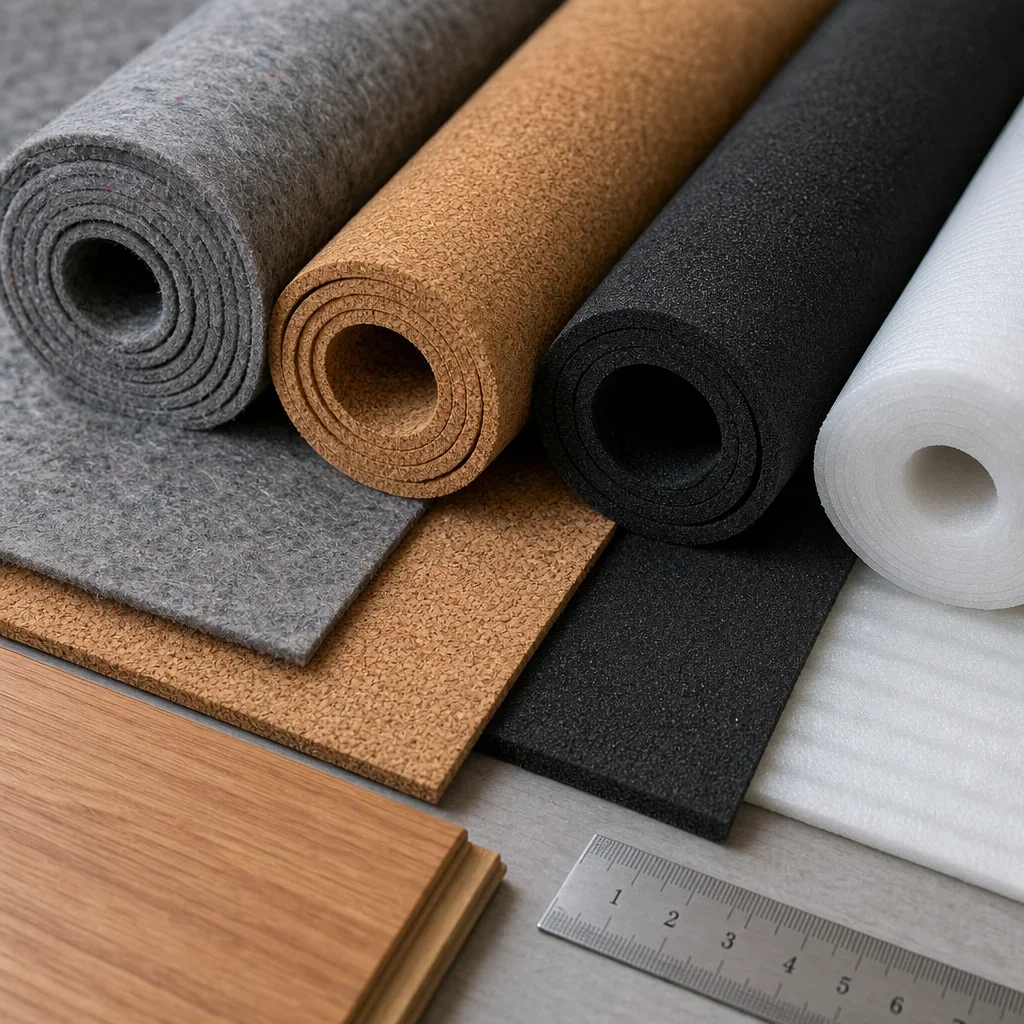
Dense materials usually do a better job with footfall noise than soft spongy materials, but the best flooring underlayment for sound still has to match the floor above it. Rubber and dense felt are often chosen for impact-noise control in floating or specialty acoustic systems, while cork can add modest sound and comfort benefits and foam is usually the entry-level choice for floating floors. None of those materials is universally the best soundproofing underlayment for hardwood floors in every assembly.
Cork underlayment for hardwood floors is usually chosen for floating floors or selected glue-down systems, not as a default answer under nailed solid hardwood. Cork is firmer than basic foam and can help with minor sound and comfort, but it also needs compatibility with the floor, the subfloor, and any moisture barrier plan. On concrete, cork alone is not a moisture strategy.
Felt underlayment for hardwood floors is valued because it is denser than many basic foams and can help reduce impact noise in floating assemblies. Dense felt also tends to feel less hollow underfoot than thin bargain foam, but it still has to be the right thickness for the locking profile. A better acoustic material used the wrong way is still the wrong system.
Foam and IXPE underlays are common because they are easy to roll out and come in thin profiles around 2 mm to 3 mm . They work well under many floating floors, especially where buyers want a simple combined sound-and-moisture layer, but they are usually not what we mean when discussing the best underlay for real wood flooring that will be nailed down. These products solve a different installation problem.
| Material | Sound control | Moisture resistance | Typical use | Main caution |
|---|---|---|---|---|
| Rubber | Strong impact-noise potential | Depends on product | Acoustic systems and some specialty assemblies | Must be approved for the install method |
| Felt | Good impact-noise support | Depends on product backing | Floating engineered and laminate | Wrong thickness can affect click joints |
| Cork | Moderate sound and comfort | Limited unless paired with barrier | Floating floors and selected systems | Not a stand-alone moisture fix on concrete |
| Foam | Basic cushioning | Some have attached film | Budget floating floors | Too soft or too thick can feel hollow |
| IXPE | Better resilience than basic foam | Often includes vapor film | Floating floors over dry or concrete subfloors | Still method-specific |
| Fibreboard | Can smooth minor irregularities | Low by itself | Some floating wood and laminate installs | Not for wet or damp conditions |
| Paper/Felt slip layer | Not true soundproofing | Limited moderation only | Some nail-down wood installs | Not a cushioned acoustic underlay |
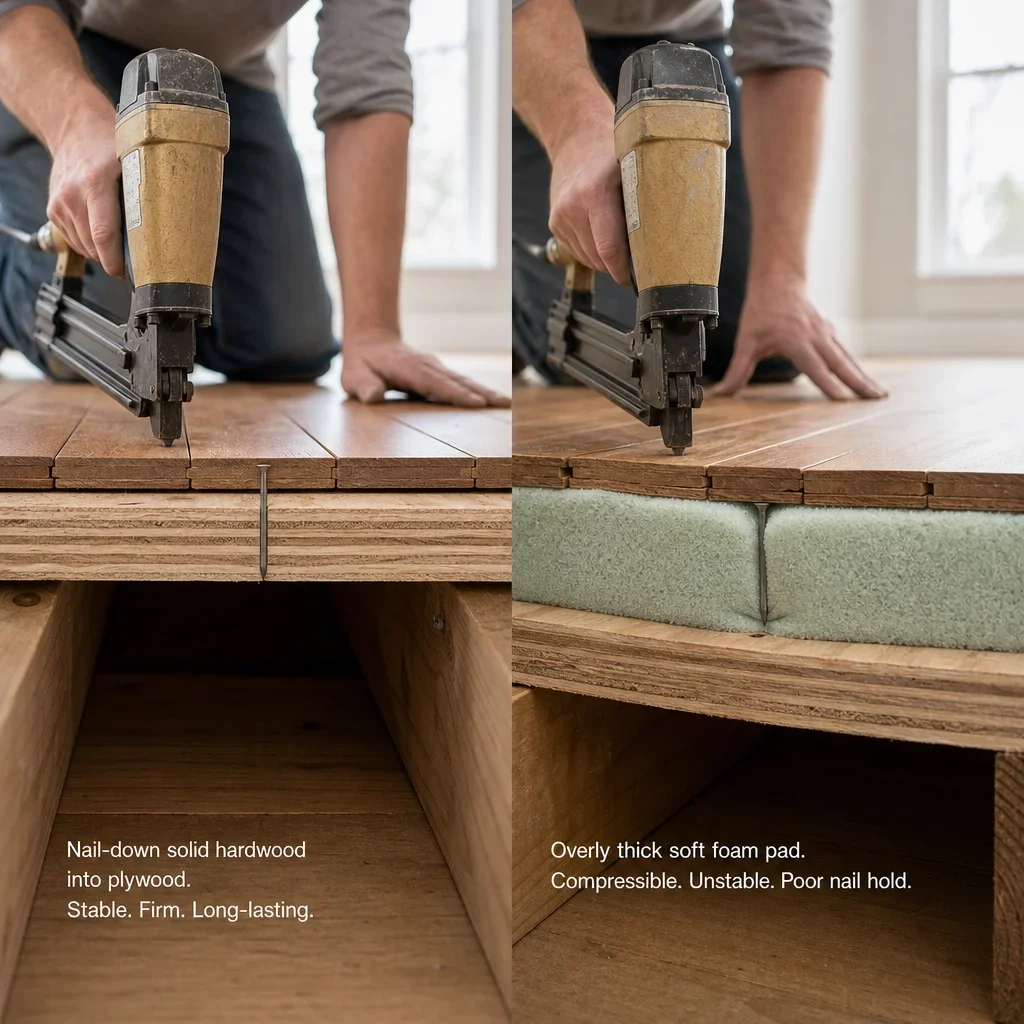
Thick, soft, compressible pads are usually the wrong choice under nail-down solid hardwood. They can let the boards move too much, reduce fastener hold, create squeaks, and leave the floor feeling hollow or uneven underfoot. If you are comparing the best underlayment for solid wood flooring, the first filter is not comfort. It is fastening stability.
More cushion does not mean better soundproofing under a nailed floor. In an old house with a plywood subfloor, the real noise issue may be loose sheathing, joist movement, or gaps that need repair before the hardwood goes down. In an upstairs bedroom, a floating engineered floor with a dense acoustic underlay may control footstep noise better than forcing a nail-down assembly to do a job it is not best at.
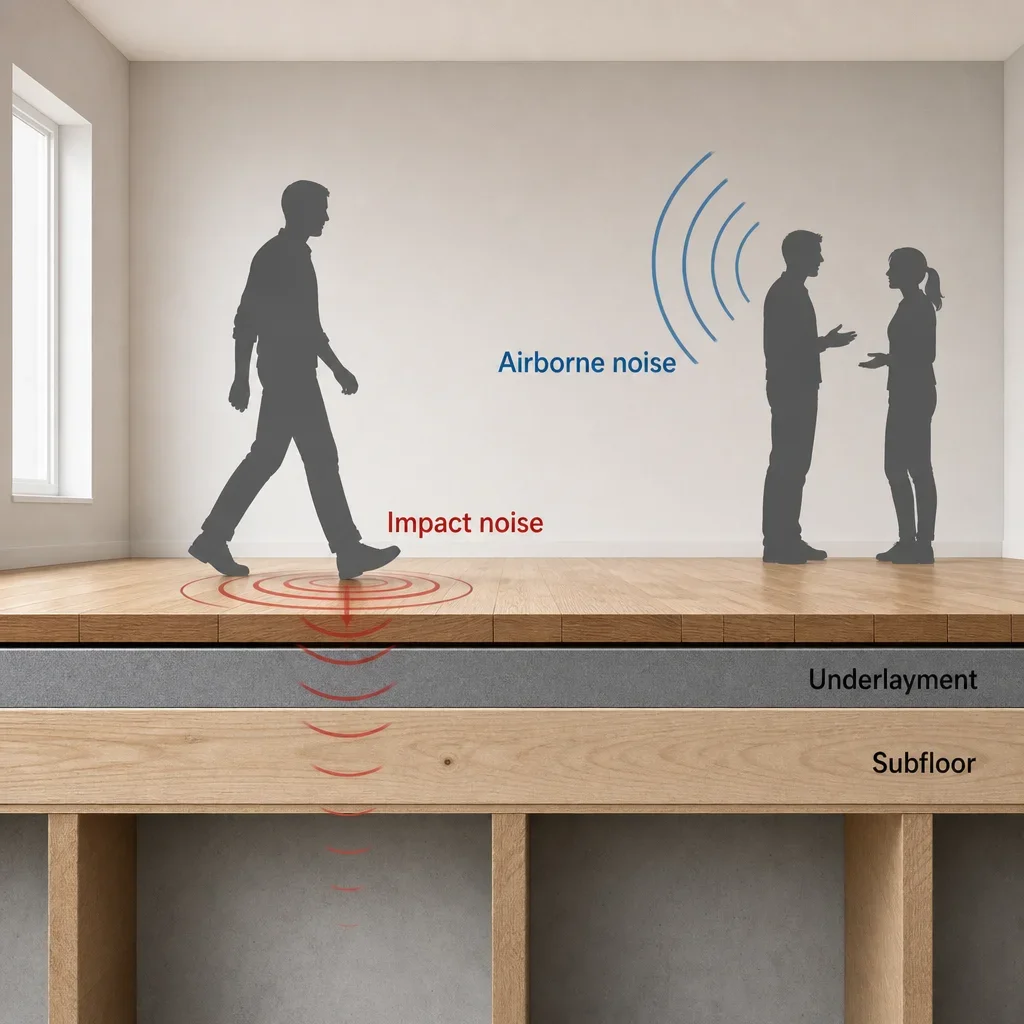
Underlayment mainly helps with impact noise, not full soundproofing in the studio sense. Impact noise is footsteps, chair movement, and dropped objects, while airborne noise is voices, music, and TV sound. A soundproof underlayment for hardwood floors can reduce the first category more effectively than the second.
A quieter floor usually comes from a system, not one layer. Subfloor repair, dense acoustic material, the right fastening or adhesive method, insulation between joists, rugs or runners, and sometimes ceiling work below can all matter more than buying the thickest pad on the shelf. When buyers ask whether soundproof underlayment works, I tell them it works for the job it is built for, which is usually impact control.
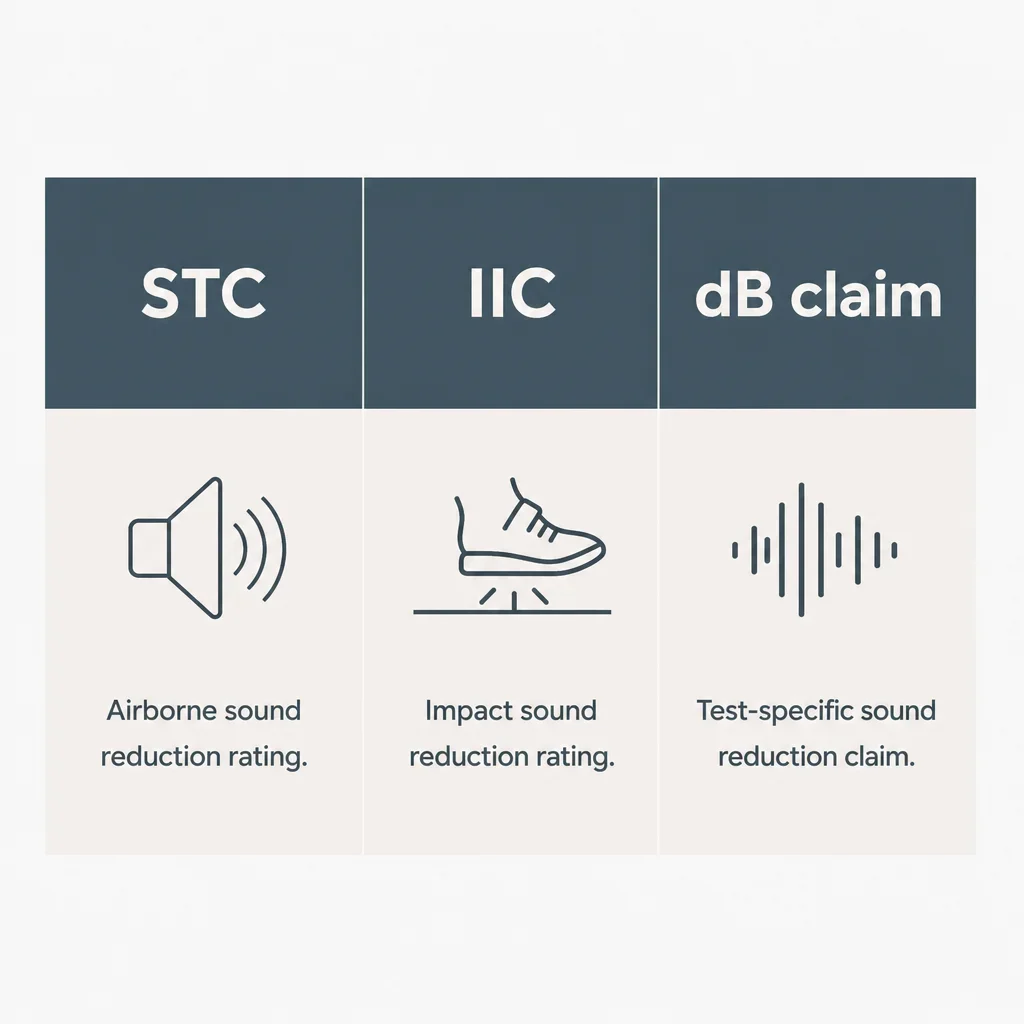
STC measures airborne sound control and IIC measures impact sound control. If your main complaint is footsteps from upstairs, IIC is usually the more relevant number to look for. Claimed dB reduction figures can be useful, but only if the test assembly matches your real floor type, subfloor, and ceiling setup.
A sound rating only means something inside the assembly that was tested. Comparing one product tested under laminate on concrete to another tested under engineered wood on a wood-framed floor is not an apples-to-apples comparison. Condo buyers should also remember that board requirements may specify an assembly target, not just an underlay product. We would verify those requirements before you buy.
| Metric | What it tells you | What it does not tell you |
|---|---|---|
| STC | How well a floor/ceiling assembly reduces airborne sound | How quiet footsteps will feel |
| IIC | How well an assembly reduces impact noise like walking | Whether the product works the same in every subfloor |
| dB claim | A tested reduction in a specific setup | A guaranteed result in your room |
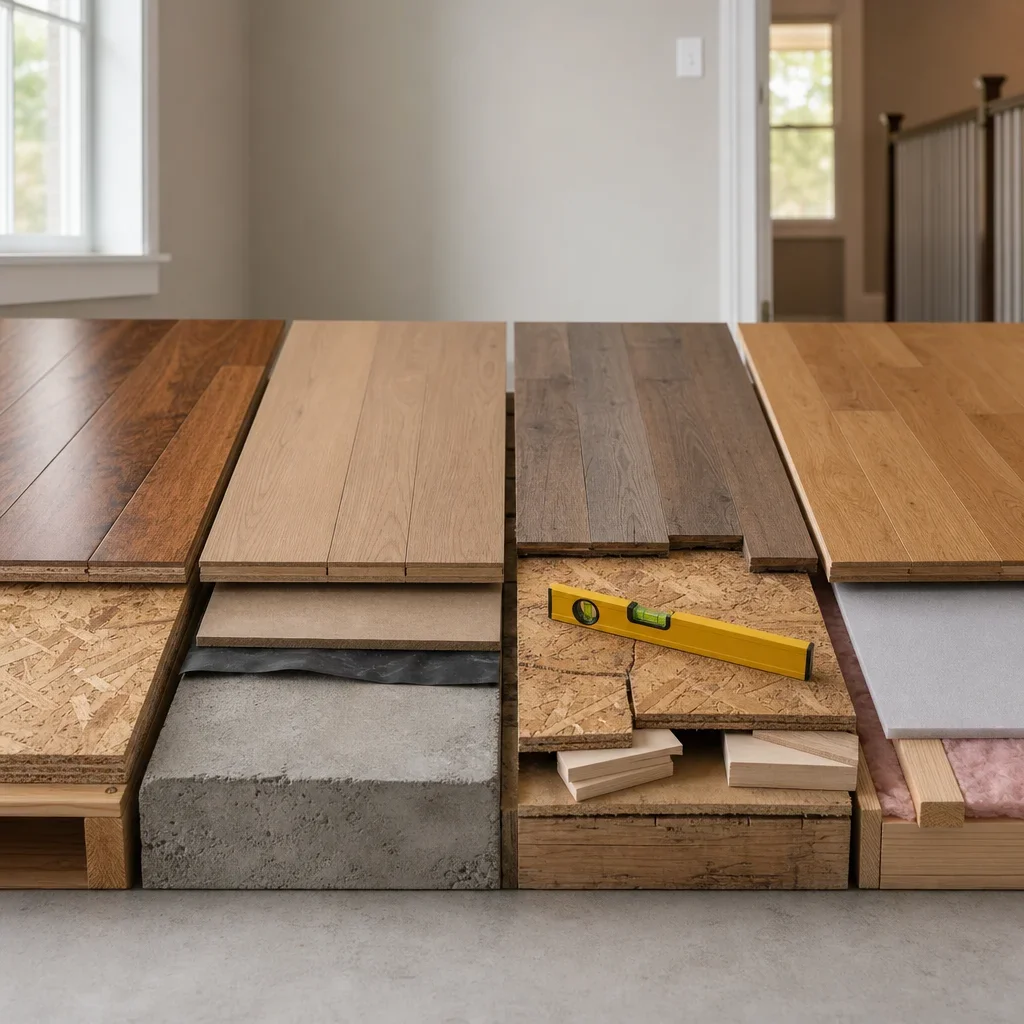
The best underlayment for hardwood floors on plywood is usually tied to whether you are nailing, gluing, or floating the floor. For nail-down solid hardwood over plywood or OSB, the priority is a stable fastening base and an approved layer under the boards, not a cushioned pad. For floating engineered floors over wood framing, a dense acoustic underlay can make sense if the click system allows it.
The best underlay for real wood flooring on concrete is rarely the same answer as wood over plywood. Concrete brings moisture risk, so engineered hardwood or another more dimensionally stable floor is often the practical choice, paired with a suitable vapor-control and acoustic system. Solid hardwood on concrete usually requires a different build-up, such as a plywood-over-concrete approach or another manufacturer-approved assembly, rather than a simple loose underlay.
Basement slabs need extra caution because underlayment does not stop a damp slab from affecting real wood. If the room has basement moisture risk, the first decision is whether solid hardwood is even the right floor for that space. In many lower-grade projects, buyers compare engineered wood, laminate, or vinyl because moisture tolerance matters as much as appearance.
Uneven floors should be levelled or repaired before underlay goes down, because underlayment is not a substitute for proper subfloor prep. A soft pad over dips and humps can make movement feel worse and can stress click joints. We see this with floating floors that looked fine on day one and started separating later because the substrate was never corrected.
Upstairs rooms and apartments should prioritize impact-noise reduction and any building rules before product style. If footfall noise is the main concern, a floating engineered floor with a dense underlay or a glue-down acoustic system may suit the room better than 3/4'' hardwood flooring underlayment choices built around a nail-down assembly. Flooring thickness and acoustic performance are not the same thing.
| Subfloor or condition | Usually best approach | Main priority | Main risk |
|---|---|---|---|
| Plywood / OSB | Nail-down wood or floating engineered, depending on floor | Stability and squeak control | Using cushioned underlay under nailed wood |
| Concrete slab | Engineered with glue-down or floating moisture-safe system | Moisture management | Treating concrete like plywood |
| Basement slab | Moisture-aware floor system | Damp control and product choice | Choosing solid hardwood without a proper assembly |
| Uneven subfloor | Repair and level first | Flat support | Using underlay to hide defects |
| Upstairs wood framing | Acoustic-focused assembly | Impact-noise reduction | Ignoring floor-ceiling system limits |
| Condo unit | Check building rules first | Tested acoustic assembly | Buying underlay before verifying requirements |
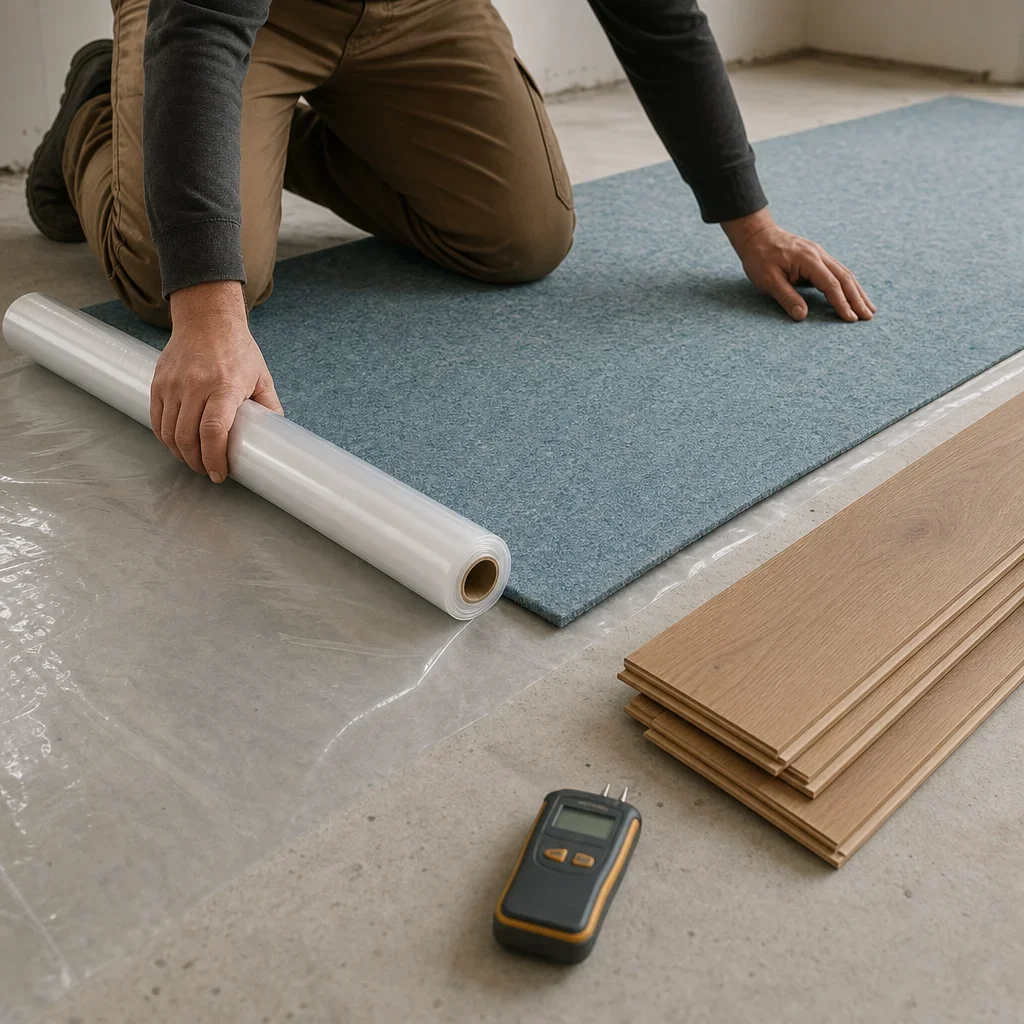
Wood flooring over concrete usually needs a moisture-control plan, and sometimes that means a separate vapor barrier or damp-proof membrane. In floating floors, that may be an underlay with an attached film or a separate poly layer where the flooring manufacturer permits it. In glue-down work, the moisture strategy may be part of the adhesive or membrane system instead.
The best underlayment options for moisture resistance depend on the subfloor, the moisture test results, the floor type, and the installation method. A good acoustic pad cannot rescue a floor from slab moisture, and moisture damage can show up as cupping, swelling, staining, or adhesive failure. If you are working over concrete, the floor maker's moisture instructions matter more than any generic advice online.
The right thickness is the thinnest profile that gives the floor the support and performance it was designed for. Floating floors commonly use underlay in the 2 mm to 6 mm range , but a thicker pad can reduce joint stability if the locking system was designed for a firmer base. That is why the best underlayment for engineered hardwood is usually the one the floor maker lists as compatible, not simply the one with the biggest number on the package.
For 3/4-inch solid hardwood, thicker underlay is usually not the answer because the issue is fastening, not softness. If you are searching for the best underlayment for solid wood flooring or best underlayment for solid hardwood floors, focus on approved nail-down systems, proper subfloor prep, and sound control through the full assembly. The board being thicker does not create permission for a softer pad underneath.
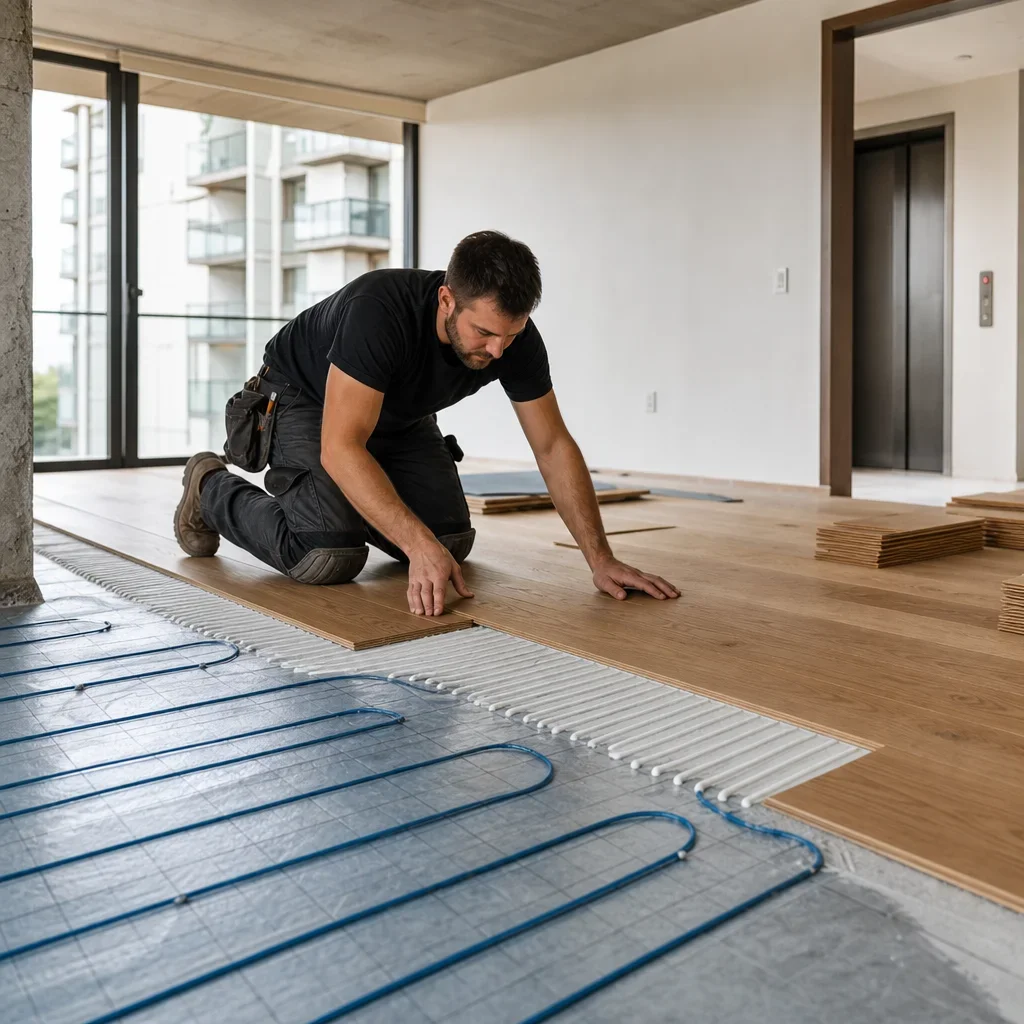
Underfloor heating compatibility depends on the full floor assembly, not just the underlay alone. Some floating underlays are designed to keep thermal resistance lower, while thicker or denser layers may slow heat transfer. The best underlayment for concrete floor projects with radiant heat is whatever both the floor and underlay manufacturers approve together.
Condo buyers should check acoustic requirements before buying materials, especially in buildings with concrete slabs and neighbor-noise rules. What counts as the best soundproofing underlayment for hardwood floors in Canada can change from one condo board to another because the building may require a tested assembly, a specific installation method, or paperwork from the supplier or installer. We would verify that before ordering material.
Canadian conditions also matter because winter humidity swings can affect wood movement, and many urban condos are built on concrete. Proper acclimation, moisture testing, and product matching are part of the system, not extras. That is one reason a showroom conversation with floor type, subfloor details, and room use is worth more than chasing a single underlay label online.
The best way to reduce footstep noise from upstairs is usually to combine the right floor assembly with fixes to the structure below or beneath the floor. A denser acoustic layer can help, but so can tightening the subfloor, adding insulation in joist cavities, using runners or rugs, and improving the ceiling assembly below. If the house already has squeaks, solve those before blaming the underlay.
For apartments and multi-storey homes, soundproof flooring for apartments usually means impact-noise control first. Floating engineered wood with the right underlay may outperform a poorly planned hardwood install, even if the hardwood itself is a more expensive product. We tell buyers to compare the whole assembly, not just the visible plank.
The best underlayment for hardwood floors is the one approved for your exact floor, subfloor, and installation method. Before you buy, confirm whether the floor is solid or engineered, whether it will be nailed, glued, or floated, what the subfloor is made of, whether the room is on concrete or upstairs framing, and whether there is any moisture or condo sound requirement. That checklist rules out most bad options quickly.
Floor height transitions, radiant heat, room use, and budget should be checked before the order is written. A premium acoustic layer can be good value if it prevents callbacks, hollow sound, or a failed condo review, but a costly product that is not approved for the assembly is money wasted. The best soundproof underlayment for hardwood floors is rarely the most advertised one. It is the one that matches the system.
| Situation | Usually the best direction |
|---|---|
| Nail-down solid hardwood | Approved nail-down acoustic system, felt/paper where allowed, or no cushioned underlay |
| Floating engineered hardwood | Dense floating-floor underlay matched to the click system |
| Concrete subfloor | Moisture-safe acoustic system for engineered glue-down or floating install |
| Upstairs room | Prioritize impact-noise control and tested assembly logic |
| Condo noise concern | Verify building requirements before product selection |
| Uneven subfloor | Repair and level first, then match underlay |
Underlayment material alone often runs about $0.25 to $2.00+ per sq. ft., depending on whether you are buying basic foam, denser felt or cork, or a premium acoustic membrane or specialty system. That is material cost only. Floor prep, moisture mitigation, adhesive systems, and acoustic requirements can change the total project cost more than the underlay itself.
The cheapest underlay is not always the best-value choice. We see buyers save a few cents per square foot on pad and spend much more later fixing hollow sound, movement, or moisture issues. If you are comparing where to buy underlayment for hardwood or laminate flooring, bring the floor spec, subfloor type, and room details with you so the underlay is matched to the project instead of guessed.
Underlayment choice is tied to the plank you pick, the subfloor condition, the moisture reading, and the installation method. That is why we prefer matching the whole assembly instead of selling an underlay in isolation. At CanFloor, buyers comparing solid hardwood, engineered wood, laminate, vinyl, stairs, and installation can look at the floor and the under-system together, which is how you avoid mismatched products and repeat labour. CanFloor lists solid hardwood from $3.99 per sq. ft., engineered wood from $2.99, laminate from $1.69, and vinyl from $1.99 .
If you want a practical next step, bring your floor plan, room measurements, subfloor details, and any condo requirements to the North York showroom at 2687 Steeles Ave. West . We can help you narrow the floor type first, then the right acoustic layer, moisture control, and install method for that assembly. Financing is available through Affirm if needed .
For nail-down solid hardwood, the best option is usually an approved nail-down acoustic system or a thin approved layer, not a generic soft floating-floor underlay. The key issue is maintaining fastener hold and floor stability.
Yes, but the type of sound-control layer depends on whether the floor is nailed, glued, or floated. Hardwood can have sound-control components underneath, but they must be compatible with the full assembly.
Sometimes yes, sometimes no. Solid hardwood over wood subfloor may use felt or paper where approved, while floating engineered floors typically need a dedicated underlay.
For solid hardwood, the best underlayment is the one the manufacturer approves for that exact install method and subfloor. For nail-down installs, that is usually not a soft cushioned pad.
On concrete, engineered wood with a proper moisture-control and acoustic system is usually the more practical route. Solid hardwood on concrete needs a specific approved assembly, not just a loose underlay.
It helps mainly with impact noise like footsteps and dropped items. It is less effective on airborne sound unless the rest of the floor-ceiling assembly also supports that goal.
Use the right acoustic underlay or floor system, fix squeaks in the subfloor, add insulation where possible, and consider rugs or ceiling improvements below. Underlay helps, but it is only one layer in the solution.
No. Floating floors often need a specific support level, and thicker soft underlay can destabilize joints. Under nailed hardwood, thicker cushioned layers are usually the wrong choice.
Use a floating-floor underlay approved for that engineered floor's locking system and room conditions. Common options include foam, IXPE, felt, cork, or combo products with vapor protection.
Use an adhesive-compatible acoustic or moisture-control system approved for glue-down work. Loose roll underlay is generally not the right category here.
Usually, concrete needs a moisture-control plan. The exact barrier depends on the flooring type, install method, and manufacturer instructions.
There is no universal winner. Dense materials such as rubber or felt often perform well for impact noise, but the best material is the one approved for your floor assembly and subfloor.