
Birch flooring pros and cons come down to a trade-off: subtle grain and warm colour variation, balanced against moisture sensitivity and potentially uneven staining. Birch can make a good hardwood floor. It suits buyers who appreciate natural variation and accept everyday wear.
Birch works well when its appearance, construction and finish match the household. Its fine grain creates a quieter look than oak. However, birch is neither waterproof nor scratch-proof. The species affects dent resistance; the finish affects surface protection.
| Advantage or drawback | Practical effect | Buyer implication |
|---|---|---|
| Fine, understated grain | Less pronounced pattern than oak | Suits calm, uncluttered interiors |
| Sapwood and heartwood contrast | Boards can range from pale cream to reddish brown | Approve a representative board selection, not just a small sample |
| Natural and stained finish possibilities | Birch can support light or deeper colour schemes | Stained finishes need careful sampling |
| Restoration potential | Suitable floors can be recoated or sanded | Construction and remaining wood determine the available options |
| Uneven stain absorption | Pigment can produce blotchy patches | Approve the complete finishing system before work begins |
| Moisture sensitivity | Boards can swell, cup or develop gaps | Installation conditions and moisture management matter |
| Species-dependent hardness | Different birches resist indentation differently | Identify the actual species rather than buying by colour name |
| Visible cosmetic wear | Smooth grain and glossy or dark finishes can expose marks | Choose sheen and colour with household traffic in mind |
Best fit:
Consider alternatives:
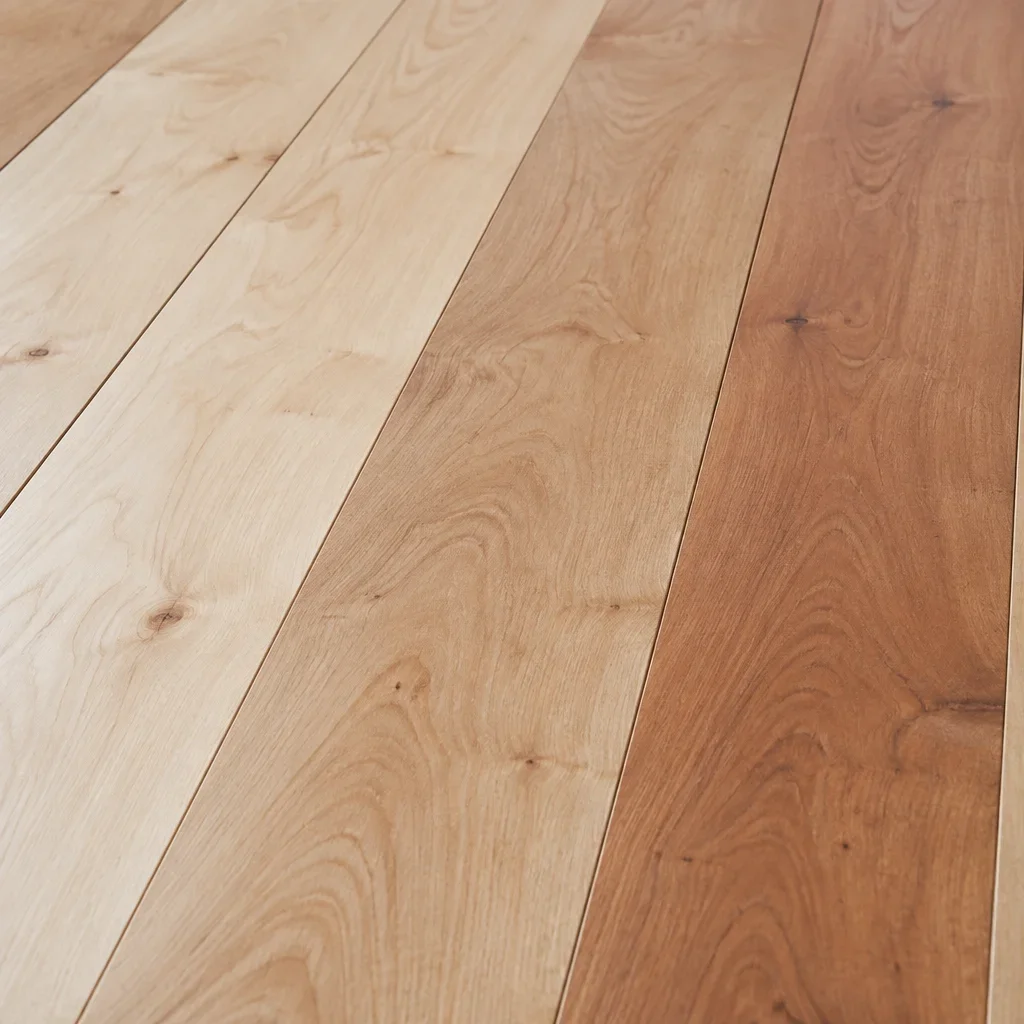
Yellow birch and sweet birch are distinct species with different hardness characteristics. Yellow birch is Betula alleghaniensis; sweet birch is Betula lenta. A product labelled simply “birch” does not tell you which species it contains.
“White birch flooring” can describe pale sapwood selection, but white birch also appears in botanical common names. “Red birch” generally describes reddish heartwood selection rather than a separate red-coloured flooring species. The product's species and grading description matter more than the marketing colour name.
Birch's natural variation comes partly from pale sapwood and darker heartwood. A mixed selection can look much busier across a room than on a sample board. Clear finishes preserve that contrast; stain can modify it without necessarily hiding it.
Herringbone, chevron and parquet require appropriately manufactured pieces. Board dimensions, end cuts and joining systems determine whether a product supports the pattern. Choosing birch as a species does not make ordinary planks suitable for every layout.
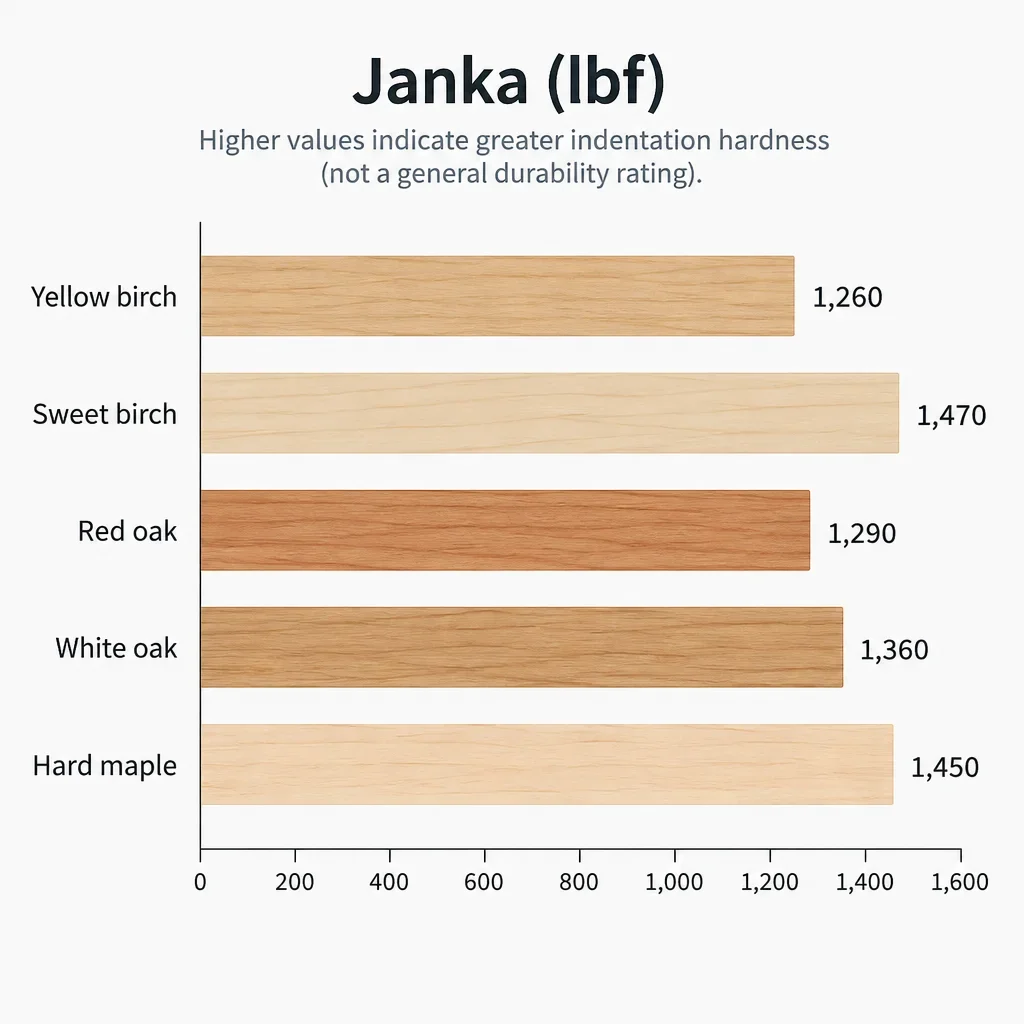
Yellow birch is slightly softer than red oak on the Janka indentation test. Sweet birch is harder than yellow birch and slightly harder than hard maple. These comparisons explain why a single hardness claim for all birch flooring is misleading.
| Species | Janka hardness, pounds-force | Grain and natural colour | Staining behaviour | Practical buying consideration |
|---|---|---|---|---|
| Yellow birch | 1,260 lbf | Fine grain; pale sapwood and reddish-brown heartwood | Can absorb stain unevenly | Evaluate colour selection and finish carefully |
| Sweet birch | 1,470 lbf | Fine grain; pale sapwood and deeper reddish-brown heartwood | Can blotch with penetrating stains | Greater indentation resistance does not prevent finish scratches |
| Red oak | 1,290 lbf | Pronounced grain; pinkish or reddish undertones | Open grain generally accepts pigment more readily | Grain can help disguise some everyday marks |
| White oak | 1,360 lbf | Pronounced grain; tan to brown with less pink | Responds well to suitable staining systems | Compare undertones using finished samples |
| Hard maple | 1,450 lbf | Fine grain; pale cream with possible darker variation | Can also develop blotchy stain | A harder surface still needs protection from grit and claws |
Janka hardness measures resistance to indentation, not finish scratching or waterproofing. It also does not measure how much a board moves with moisture. A harder species can still show scratches clearly under reflected light.
Oak's stronger grain can camouflage marks differently from birch's smoother appearance. Dark colour and high gloss can make dust, dents and scratches more noticeable on either species. Finish selection changes the visual result without changing the underlying wood's hardness.
Maple versus birch flooring is not a simple durability contest. Hard maple exceeds yellow birch in indentation resistance, while sweet birch exceeds hard maple. Birch's stronger heartwood contrast may matter more to the room's appearance than that hardness difference.
Birch is not automatically cheaper than oak, maple or cherry. Grade, construction, board dimensions, finish and installation scope affect the quote. Compare equivalent products and installed totals rather than assuming a permanent species price ranking.
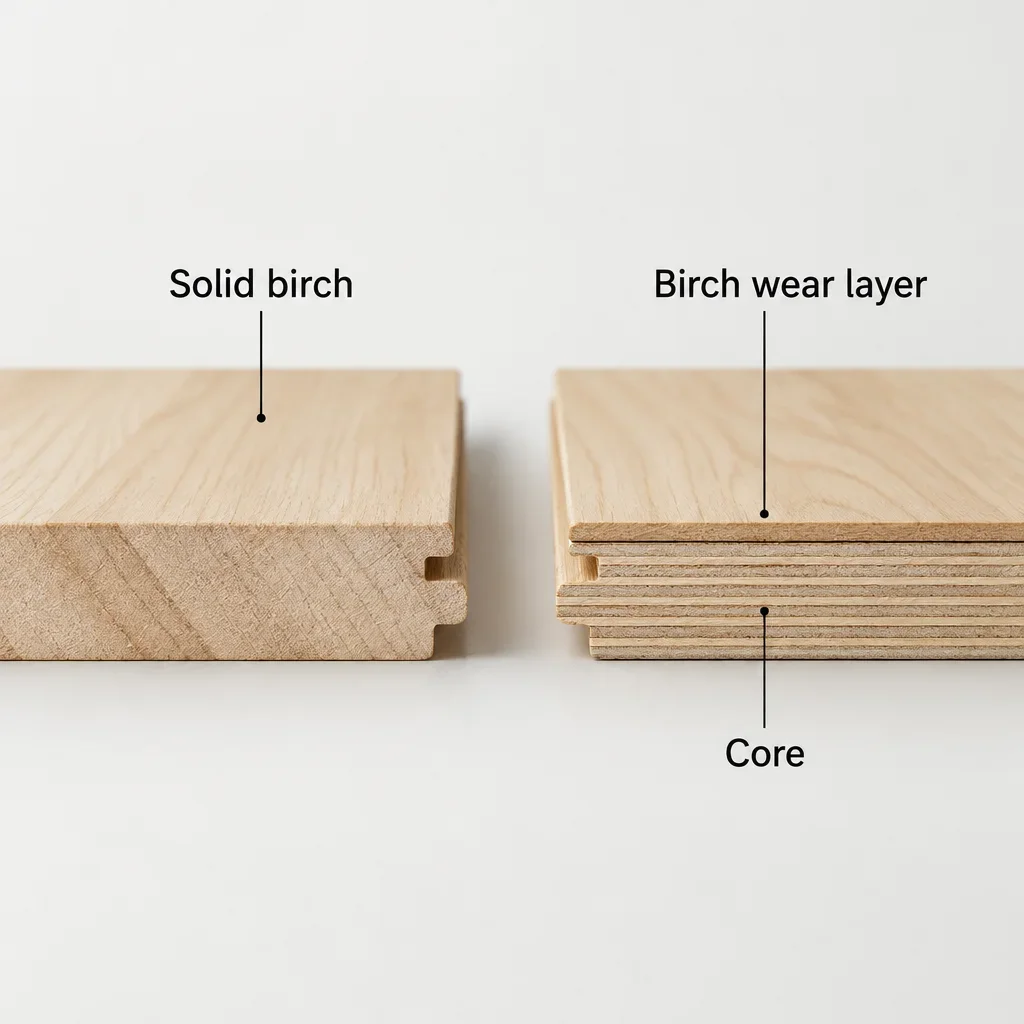
Solid birch consists of wood through the board's thickness. Engineered birch uses a real birch surface bonded to a supporting core. Core materials and construction differ between products, so “engineered” alone does not describe performance.
Nominal 3/4-inch birch hardwood flooring describes overall solid-board thickness, approximately 19 mm. It does not describe usable sanding depth. The remaining wood above the tongue limits how much material can be removed during restoration.
Engineered construction can reduce dimensional movement compared with solid wood. It does not make the birch surface waterproof. For engineered flooring, the usable wear layer matters more to refinishing potential than total board thickness.
| Installation condition | Solid birch considerations | Engineered birch considerations |
|---|---|---|
| Above-grade wood subfloor | Suitable products can use approved fastening systems | Fastening, glue-down or floating depends on product design |
| Concrete slab | Requires a system specifically designed for the application | Some products permit glue-down or floating with specified moisture control |
| Below-grade basement | Ordinary solid-strip flooring is generally a poor candidate | Only products permitting below-grade installation should be considered |
| Radiant heating | Species, construction and heating-system compatibility must align | Some products permit radiant heat, subject to their installation limits |
| Seasonal indoor changes | Solid boards respond to changes in wood moisture content | Engineered boards still move, although cross-layer construction improves stability |
Canadian heating seasons can change indoor moisture conditions and board dimensions. Acclimation, moisture testing and expansion provisions must follow the selected flooring system. A generic instruction to leave every floor indoors for the same period is not a reliable installation plan.
Concrete and radiant heating require product-specific suitability, not an assumption based on construction. The installation plan must address slab moisture, adhesive or underlay compatibility, and heating operation. No universal moisture threshold or heating temperature applies to every birch product.
Birch suits dry living spaces more readily than repeatedly wet areas. Room exposure and household habits matter alongside species hardness. An engineered board can improve stability, but it cannot cancel standing water or unsuitable installation conditions.
| Room or household | Suitability | Main risk | Practical mitigation |
|---|---|---|---|
| Bedrooms | Strong candidate for ordinary residential use | Furniture scratches and sunlight contrast | Use furniture pads and manage direct light |
| Living and dining rooms | Good candidate where wood wear is acceptable | Chair movement and spills | Protect chair feet and wipe spills promptly |
| Busy hallways | Conditional | Tracked grit and concentrated wear | Use suitable entrance mats and remove grit frequently |
| Kitchens | Conditional | Leaks, dropped objects and standing water | Address leaks promptly and prevent water from lingering |
| Bathrooms with repeated wetting | Poor match for ordinary wood flooring | Recurring moisture exposure | Compare flooring systems designed for wet conditions |
| Below-grade basements | Product-dependent | Slab moisture and water intrusion | Use a permitted construction with a suitable moisture-control plan |
| Home offices | Conditional | Repeated caster and chair movement | Use a compatible protective mat and suitable casters |
| Homes with dogs and children | Conditional | Claws, toys, grit and impacts | Maintain nails, protect furniture and accept cosmetic wear |
| Rental properties | Depends on maintenance expectations | Unmanaged spills and delayed repairs | Compare repairability, finish requirements and replacement disruption |
Dogs and children do not automatically rule out birch. Claws can scratch the finish, and dropped objects can dent the wood. Buyers who want minimal visible wear should compare lower-sheen samples and textured alternatives rather than relying only on a hardness rating.
Vinyl or another suitable wet-area system may be more practical where water exposure dominates the decision. Product construction, seams and installation still matter. Replacing hardwood with a different category does not remove the need for a suitable subfloor.
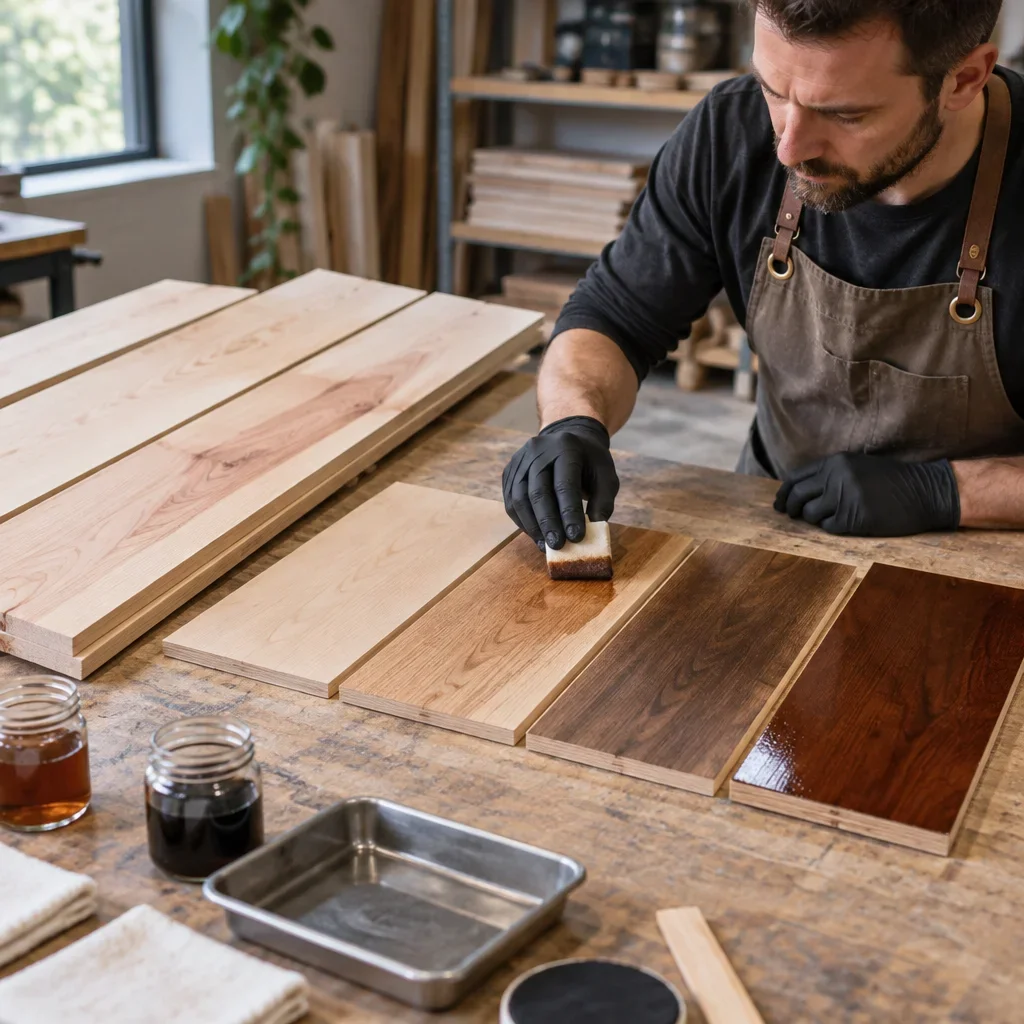
Birch can stain unevenly because different areas absorb colour differently. The result can be dark patches rather than a consistent tone. Applying a darker stain does not automatically solve that problem and may exaggerate it.
Colour application and surface protection are separate steps. Stain changes colour; the topcoat provides the protective surface. A clear topcoat does not correct blotching already present beneath it.
Compatible sealers, conditioners, dyes or controlled professional finishing systems can help manage colour absorption. They are not interchangeable recipes. The preparation and colour system must work with the chosen topcoat.
Use a complete sample-approval process before committing to a stained floor:
Natural finishes avoid pigment-related blotching but retain the wood's colour differences. Dark finishes can reduce some contrast while highlighting dust or light-coloured scratches. Matte and satin surfaces scatter reflected light differently from gloss; lower sheen does not prevent damage.
Prefinished flooring arrives with its factory-applied colour and protective finish. That reduces on-site finishing work, but board replacement and repair matching still need consideration. Site finishing allows colour decisions across the installed floor, while adding sanding, finishing disruption and system-specific curing requirements.
A useful birch flooring budget separates material supply from the installed scope. A material-only price per square foot does not include every project cost. Compare Canadian-dollar quotes using the same measured area, product specifications and inclusions.
| Cost component | What the quote should describe | What changes the cost |
|---|---|---|
| Flooring supply | Species, construction, grade, dimensions and finish | Product specification, quantity and board selection |
| Installation labour | Layout and permitted installation method | Pattern, room shape, access and fastening or bonding system |
| Removal and disposal | Existing flooring and debris handling | Material type, attachment method and access |
| Subfloor preparation | Flattening, repairs or reinforcement included | Existing condition and installation requirements |
| Moisture control | Required testing and specified control system | Substrate, moisture conditions and product requirements |
| Underlay or adhesive | Named system and included materials | Installation method and compatibility |
| Transitions and trim | Profiles, quantities and finishing | Doorways, adjoining floors and trim scope |
| Stairs | Treads, risers, nosings and installation scope | Stair configuration and finish matching |
| Custom or site finishing | Preparation, colour work and protective finish | Finish system, sampling and site conditions |
| Delivery and access | Delivery scope and material handling | Location, stairs, elevators and access restrictions |
| Applicable tax | Whether tax is included or additional | Tax treatment of the quoted work |
Board width, grade and layout can change both supply and installation costs. Patterned floors require suitable pieces and more layout work than straightforward plank installations. Small or divided rooms can also require more cutting relative to their floor area.
Long-term value depends partly on restoration options and repair matching. Recoating may address suitable surface wear without removing wood. Deep damage, discontinued boards or an exhausted wear layer can make repairs more disruptive. A low purchase price does not explain those future costs.
I would compare birch, oak and maple using matching construction, grade, dimensions and installation scope. Adding cherry to the comparison only helps if its product specifications are comparable. Otherwise, the price difference may reflect the product rather than the species.
Birch care centres on removing abrasive grit and limiting unnecessary moisture. Cleaning methods must suit the protective finish, not just the wood species. Steam and saturated mopping can expose the floor to damaging heat or moisture.
Light exposure can change wood and finish colour over time. Covered areas beneath rugs or furniture may age differently from exposed areas. Window coverings and thoughtful rug placement can reduce contrast, but UV-resistant finishes do not stop every colour change.
Recoating renews a compatible protective surface without sanding deeply into the wood. Sanding and refinishing remove material to address suitable deeper wear or change the finish. Contamination, previous maintenance products and finish compatibility can affect whether recoating will bond properly.
Solid and engineered birch can sometimes be refinished, but neither has an unlimited sanding allowance. Solid flooring needs sufficient wood above the tongue. Engineered flooring needs an adequate usable wear layer, along with suitable construction and condition. Restoration should follow an assessment rather than a calendar-based schedule.
Scratches, gaps and cupping do not all require the same repair. Surface damage concerns the finish or wood; movement can indicate changing moisture conditions. Treating the appearance without addressing the cause can lead to repeat damage.
| Symptom | Possible cause | Sensible first action | When assessment is needed |
|---|---|---|---|
| Fine finish scratches | Grit, claws or furniture movement | Remove the abrasive source and improve protection | Before selecting a repair or recoating product |
| Deeper dents | Concentrated impact or pressure | Prevent repeat impacts and document the damage | To compare local repair, replacement or refinishing |
| Blotchy stain | Uneven absorption or preparation | Stop further colour work on unfinished areas | Before stripping, sanding or applying another treatment |
| Cupped boards | Moisture imbalance through the board | Identify leaks or changing moisture conditions | Before sanding or deciding boards need replacement |
| Seasonal gaps | Wood shrinkage as moisture content falls | Observe whether gaps track seasonal conditions | If gaps persist, worsen or accompany other movement |
| Water staining | Spills, leaks or prolonged dampness | Stop the moisture source and dry safely | For discolouration, swelling or suspected concealed moisture |
| Uneven colour | Light exposure, coverings or mixed board selection | Identify the exposure or selection pattern | Before attempting colour correction |
Cupped flooring should not be sanded as an immediate cosmetic response. If moisture conditions later change, prematurely flattened boards can develop a different distortion. The moisture source and the floor's condition need assessment before restoration.
Finish repair, board replacement and full refinishing solve different problems. Local repairs can remain visible because surrounding wood has aged or changed colour. Replacement boards also need compatible dimensions, joining profiles and finish, not merely the same species name.
Responsible sourcing depends on the actual flooring product and its supply chain. A North American species name does not establish responsible forest management. Documented origin and product-specific certification provide more useful information than broad environmental language.
FSC certification concerns forest sourcing and chain-of-custody claims within its certification system. It is not an indoor-air-quality rating. Any certification claim needs to apply to the actual product, not simply another product sold under the same brand.
Wood origin, manufacturing location and brand location are different facts. Canadian-grown wood may be processed elsewhere, while a Canadian brand may sell imported flooring. “Birch hardwood flooring in Canada” therefore describes a buying market, not necessarily Canadian manufacture.
No flooring category is universally the healthiest choice. Product emissions, adhesives, finishes, cleaning and moisture management all contribute to the indoor environment. Solid wood is not automatically emission-free, and engineered wood is not automatically unhealthy.
Birch provides a hard walking surface, not a therapeutic one. Underfoot comfort depends on the complete floor assembly and individual needs. Compatible cushioning may change feel, but unsuitable underlay can compromise the installation, and unsecured rugs can create trip hazards.
Yes, birch can provide a practical real-wood floor in suitable dry rooms. Its defining appeal is fine grain with natural colour variation. Product construction, finishing and household maintenance determine how well that appeal holds up.
The main flooring drawbacks are moisture sensitivity, potential stain blotching and visible cosmetic wear. Dent resistance also differs by species. A finish can protect the surface without making the underlying wood waterproof or dent-proof.
Oak suits buyers who prefer stronger grain, which can help disguise some wear. Birch suits buyers who prefer a smoother visual pattern. Neither species overrides the need for a suitable finish, construction and installation system.
Birch can serve a family household, but claws and impacts can leave marks. Grit removal, furniture protection and prompt spill cleanup reduce avoidable damage. Durability should not be confused with a permanently unmarked surface.
Hard maple is harder than yellow birch but slightly softer than sweet birch on the Janka indentation scale. That comparison does not predict finish scratching. The actual birch species must be identified for the comparison to mean anything.
Some engineered products permit below-grade installation over a suitable substrate. The floor still needs a product-specific moisture-control and installation plan. Active leaks or unresolved slab moisture cannot be solved merely by choosing engineered wood.
Only a flooring product designed for the proposed radiant-heating application should be considered. Construction, installation method and permitted operating conditions must align. Engineered construction alone is not proof of compatibility.
A controlled, compatible finishing system can reduce unwanted unevenness. Representative samples remain essential because birch absorbs colour unevenly. A darker stain or an extra clear topcoat does not automatically correct blotching.
Suitable solid and engineered floors may be refinished when enough usable wood remains. The floor's condition, previous sanding and construction determine the options. Overall board thickness alone cannot establish refinishing eligibility.
The useful comparison is between specific products and installation systems, not blanket category claims. Evaluate emissions information, adhesives, finishes and cleaning requirements. Moisture control also matters because persistent dampness can affect the indoor environment.
Avoid products mismatched to the room, substrate, heating system or maintenance expectations. Ordinary moisture-sensitive hardwood is a poor choice for repeatedly wet spaces. An unsuitable installation system can undermine an otherwise appropriate species.
Birch should not be chosen as a treatment for arthritis. It is a hard surface, and comfort depends on the complete assembly and the person's needs. Stable footing and avoiding trip hazards remain separate considerations from softness.
There is no objective winner. Birch offers restrained grain and potentially strong light-to-dark board variation; oak offers a more pronounced pattern. A representative sample spread shows which appearance works with the room's furnishings and light.
Either can work when undertones and contrast support the room. Pale birch can contrast with darker walls, while deeper flooring can anchor light walls. Compare finished boards beside wall colours under both daylight and evening lighting.
Birch can support modern, traditional, minimalist or rustic interiors through its grade, colour and finish. No species becomes objectively outdated because a colour preference changes. For a lasting decision, prioritize room proportions, undertones and an appearance you can maintain rather than a claimed trend ranking.
The right comparison starts with appearance, wear tolerance and room conditions. Then compare construction, finish and the complete installed budget. A pale, smooth sample may look appealing while concealing the colour variation or maintenance demands of a full floor.
Prepare these details for an itemized supply-and-install quote:
At Canadian Flooring, we manufacture solid hardwood and provide flooring supply and installation services, including stairs. We can explain how construction, finishing and site conditions affect your options. Request an itemized quote to compare available hardwood options on the same scope.
You can also visit our showroom at 2687 Steeles Ave. West, North York, Ontario. Bring your room details and colour references. Compare the whole flooring system, not just the prettiest board.