
For a quicker response, please send all inquiries
via info@canfloor.com or
text to
416-735-0075.
| Monday - Friday | 10:00 am - 7:00 pm |
| Saturday & Sunday | 10:30 am - 4:00 pm |
The myth is that every bedroom floor has to match perfectly. Different wood floors in bedrooms can look right when the contrast is intentional, the undertones relate, and the transition makes visual sense.
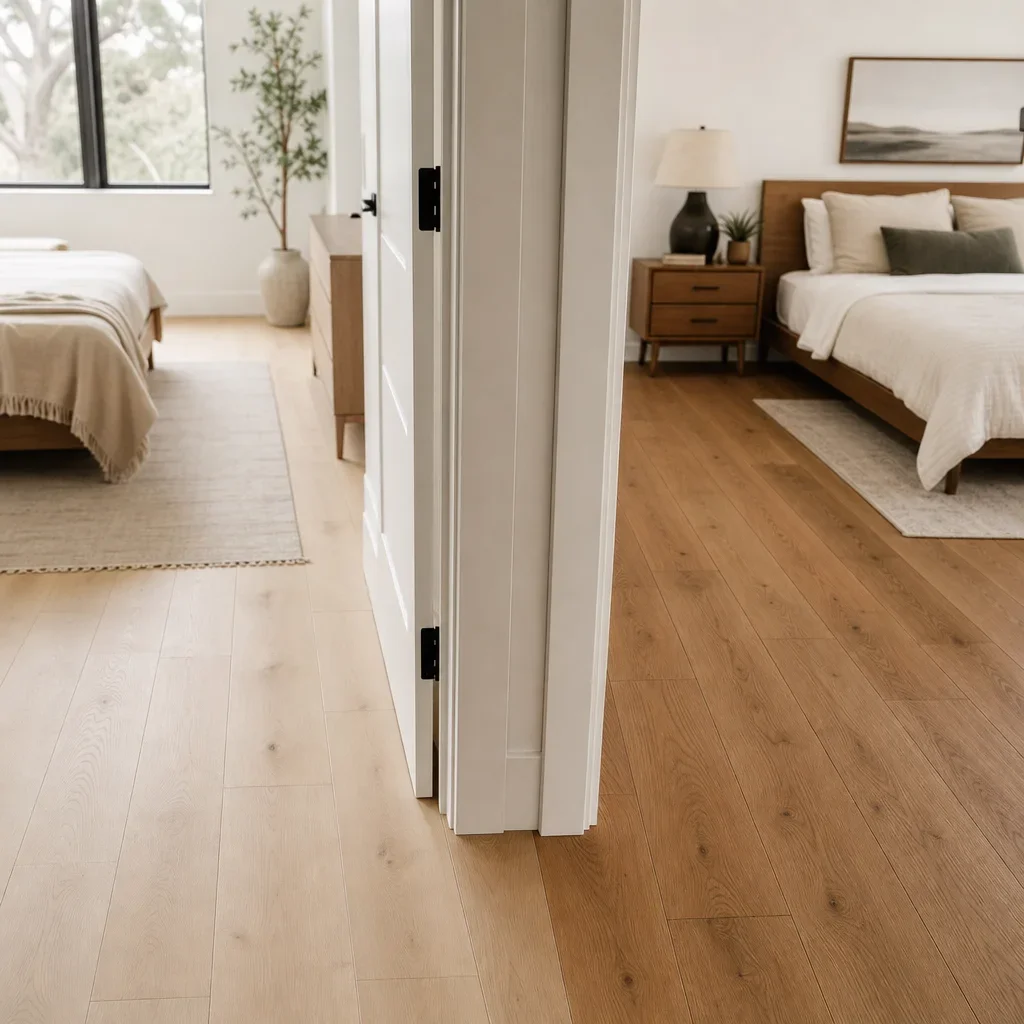
Yes, it is okay to have different flooring in each bedroom when the rooms are separated and the materials coordinate instead of pretending to be an exact match. Bedrooms behind doors are usually easier to vary than spaces connected by long, open sightlines because the doorway creates a natural visual stop.
Coordination matters more than identical colour across the whole house. The factors that decide whether different hardwood floors in bedrooms look designed or accidental are undertone, sheen, plank width, species look, and how the flooring meets at the doorway or hall.
Mixing floors is common in phased renovations, additions, insurance repairs, and discontinued-product situations. A complementary floor usually looks better than a poor near-match that misses the original tone by a little but fails in a very visible way.
Mixed flooring looks intentional when at least one design element repeats across both rooms. That shared element can be undertone, sheen level, plank scale, or a similar wood character, even if the colour itself changes.
Near-matches are what usually cause trouble with two different wood floors next to each other. If one floor tries to copy the other but ends up slightly redder, greyer, glossier, or narrower, the difference reads like a mistake rather than a choice.
Clear contrast usually works better than awkward imitation. A lighter neutral oak hallway with a medium warm oak bedroom can feel balanced because the relationship is obvious, while a red-toned glossy strip floor beside a pale grey matte plank often clashes in both tone and finish.
Sightline is the deciding factor when bedroom flooring is different than the hallway. A short doorway view is forgiving, while a direct line from a hall into several rooms, a stair landing, or an open upper level makes plank width, colour shift, and sheen differences much easier to notice.
High gloss is harder to mix than matte or satin. Gloss reflects more light, exaggerates colour differences, and can make an older traditional floor beside a newer low-sheen product look unrelated unless the whole design is intentionally formal.
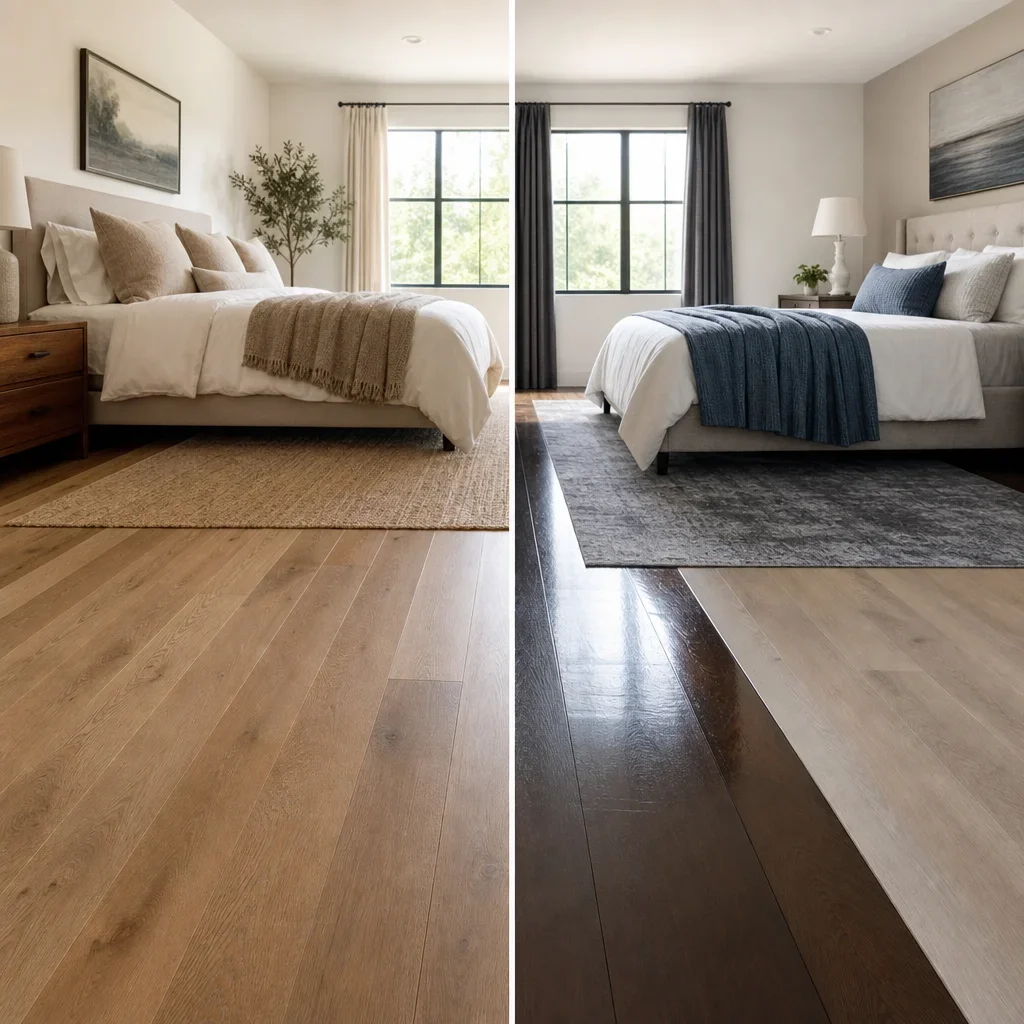
A good mix repeats the mood even when the colour changes. Light natural oak with medium warm oak, matte white-oak visuals with beige walls, or a walnut-look bedroom off a lighter hall with a doorway break usually reads as intentional.
A bad mix usually stacks too many differences at once. Narrow traditional strips beside extra-wide modern planks, glossy red undertones beside cool washed grey, or rustic heavy-grain boards beside sleek minimal flooring in a direct sightline tend to feel disjointed.
The safest formula is same family, different shade. If the species look, undertone direction, or finish level still feels related, different hardwood floors in adjoining rooms are far less likely to look dated.
Exact matching is most useful in open-plan spaces and major sightlines. When the hall, living area, and bedroom are all visible together, continuity usually makes the home feel calmer and more spacious.
Bedrooms can vary more freely when the door, casing, and threshold break the view. In that layout, the floor does not need to match the hallway exactly as long as it respects the home's broader palette and style.
Upstairs and downstairs do not always need the same floor. A whole house can use one look, but it can also use one flooring family upstairs and a different but coordinated family downstairs if the shift is justified by function, construction, or renovation timing.
Buyer perception usually reacts better to consistency than chaos. That does not mean every room must match, but abrupt style changes without a clear reason can make a home feel patched together.
Grey bedroom flooring with warm oak works best when the grey leans greige, taupe, or beige rather than icy blue. A soft neutral grey can bridge warm wood if both floors share a muted base and the walls, trim, or furnishings repeat that neutral note.
Warm and cool wood tones clash when the undertones fight each other in plain view. Orange or red oak beside a stark blue-grey floor with no shared tone elsewhere in the room often looks off because the colours pull in opposite directions.
Contrast looks more intentional when the rest of the design supports it. Black accents, white trim, modern lighting, and a restrained wall palette can help a cool-leaning bedroom floor sit beside a warmer hall.
Safer alternatives to flat grey are natural oak, beige-blonde oak, sand tones, and neutral white-oak visuals. Those options usually coordinate better with warm oak or bamboo because they stay closer to wood's natural colour language.
Samples need to be checked in both daylight and evening light before you buy. Bedroom lighting changes colour perception, and a sample that looks balanced at noon can read much cooler or more yellow under lamps at night.
Room function should guide the product before colour does. Bedrooms often prioritize comfort and quiet, halls need durability and continuity, and lower levels may favour engineered wood or vinyl if site conditions are less suitable for solid hardwood.
Style direction should stay consistent across the house even when floors differ. Modern rooms usually suit cleaner grain, wider planks, and matte finishes, while traditional interiors often accept narrower boards, richer stains, and slightly more formal wood character.
Natural light changes how flooring reads. North-facing rooms can make cool grey boards feel colder, while strong south or west light can intensify yellow and red undertones in oak, maple, or bamboo-look products.
Furniture density gives you more flexibility than most buyers expect. A heavily furnished bedroom with a bed, rug, dressers, and curtains shows less floor, so the room can tolerate more variation than a sparse hallway or landing.
One common denominator is usually enough to tie mixed floors together. If the undertone, sheen, plank family, or species look repeats, can you use different wood floors in different rooms becomes less of a design problem and more of a selection exercise.
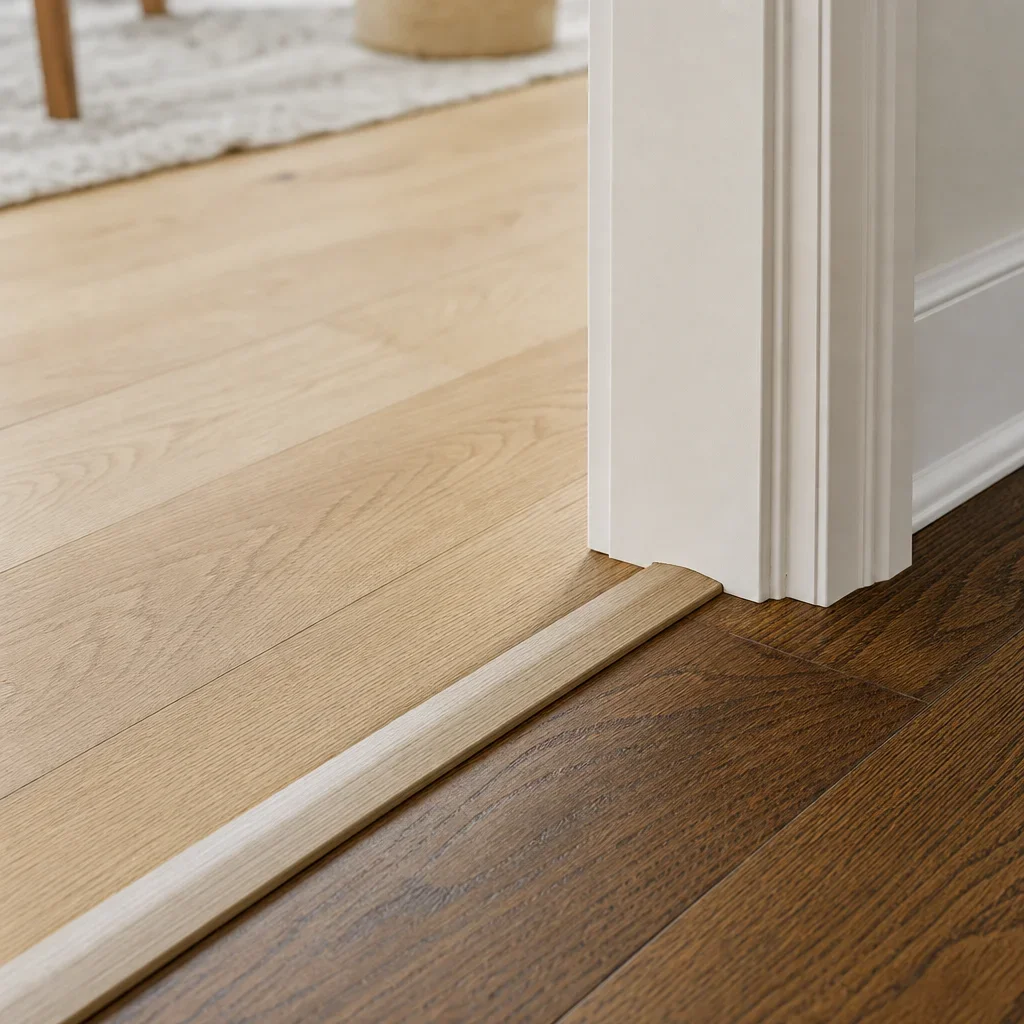
A doorway is the easiest place to change flooring because it creates a clean visual stopping point. That is why different hardwood floors in adjoining rooms usually look better when the switch happens under the door rather than drifting into an open hall.
The right transition depends on height and installation method. A flush transition can work when both floors finish at the same height, a T-moulding bridges equal-height floating floors, and a reducer helps when one surface sits higher than the other.
Expansion requirements also matter during installation. Wood, laminate, and some floating products need perimeter and transition allowances set by the manufacturer, so the trim choice has to fit both the look and the product system.
Open-plan adjacencies need more caution than bedrooms off a hall. A hard switch between two unrelated floors in one continuous sightline usually works only when the spaces are clearly zoned by layout, island, level change, or another architectural break.
Stair nosings and upper landings should be planned before ordering materials. Mixed products with different thicknesses can create awkward edges at stairs, so professional measuring before purchase helps prevent a transition problem that cannot be disguised later.
A discontinued floor is normal, not a failure in your project. Product lines change, stains get dropped, and older floors age in colour, so a perfect match is often unrealistic even if the original product still exists.
A complementary choice is usually smarter than a forced copy. If the existing floor cannot be matched well, choosing a related undertone and a clearly intentional difference tends to look more finished than choosing the closest photo match and hoping for the best.
Large samples and room photos make showroom decisions far more accurate than a phone snapshot alone. Bring a removable sample if you have one, plus photos of the hallway, trim, wall colour, natural light, and any fixed furniture finishes.
Custom colour, surface, and gloss options can help bridge old and new floors when standard products miss the mark. That is one reason manufacturer-direct selection is useful for coordination work rather than simple one-room replacement.
Refinishing an adjacent wood floor can sometimes help, but only if that floor is a refinishable hardwood product and the budget and disruption still make sense. It is not a universal fix, and it does not apply the same way to every prefinished, engineered, laminate, or vinyl floor.
Solid hardwood and engineered hardwood can both work well in a bedroom. Solid hardwood is made from a single piece of wood, while engineered hardwood has a real wood top layer over a layered core for added dimensional stability.
Engineered hardwood is often chosen where installation conditions are less forgiving. Upper floors, condos, and rooms with seasonal humidity swings may suit engineered products because the layered construction is designed to manage movement differently than solid wood.
Solid hardwood still appeals to buyers who want traditional all-wood construction. It can be a strong choice in the right home and subfloor setup, but it should be selected with the room conditions and installation method in mind rather than by habit.
Bedroom projects should compare the full specification, not just the label. Thickness, wear layer, board width, finish level, subfloor type, and the relationship to the existing hall or stairs all matter more than a simple solid hardwood vs engineered hardwood for bedroom debate.
CanFloor lists hardwood from $3.99 per sq. ft. and engineered wood from $2.99 per sq. ft. for supply pricing. Those are starting prices, not installed totals, and the right product still depends on the room, the subfloor, and the floor you are trying to coordinate with.
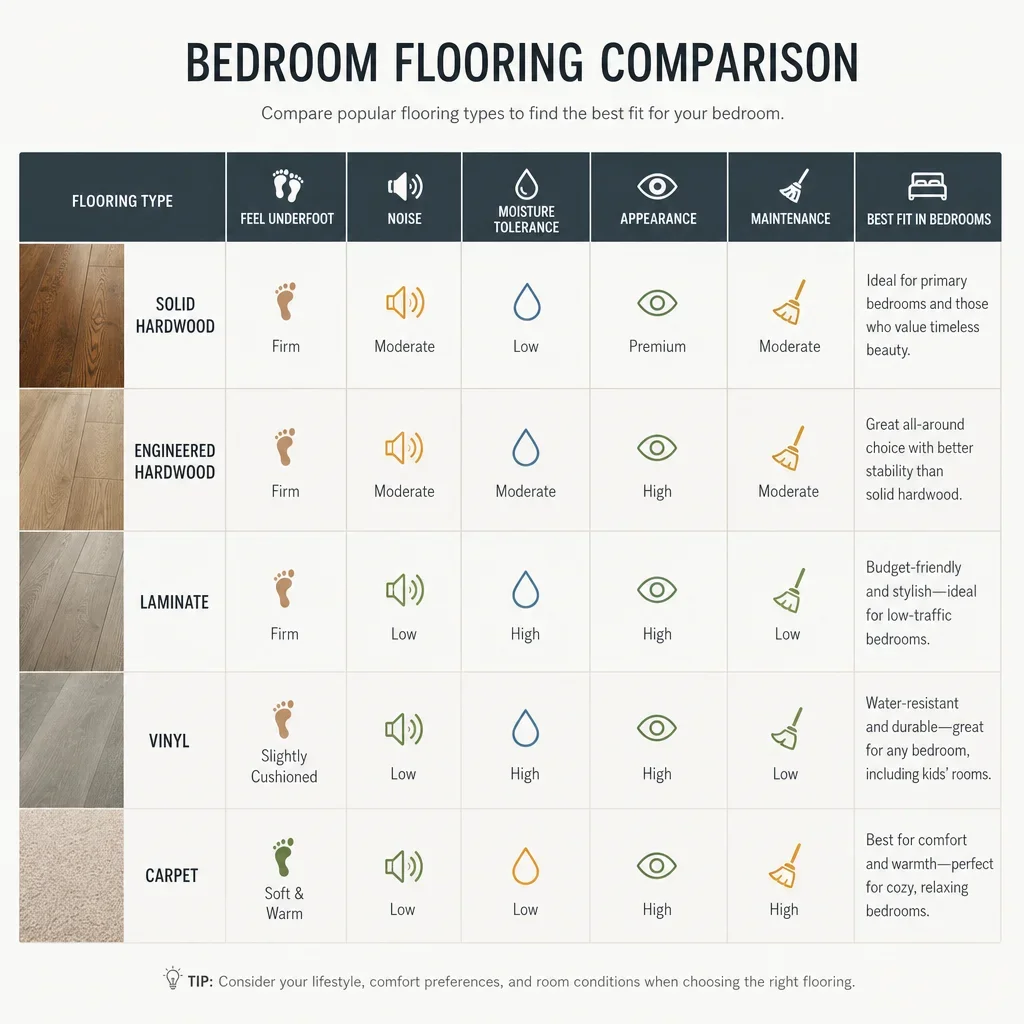
The best flooring for a bedroom depends on comfort, noise, look, maintenance, and site conditions rather than one universal winner. This comparison is a buying guide, not a product recommendation for your exact room.
| Flooring type | Feel underfoot | Noise | Moisture tolerance | Appearance | Maintenance | Best fit in bedrooms |
|---|---|---|---|---|---|---|
| Solid hardwood | Firm | Moderate footfall noise | Lower tolerance than vinyl; room conditions matter | Premium real-wood look | Regular sweeping and dry-clean routine | Dry, stable rooms where true hardwood is the goal |
| Engineered hardwood | Firm | Moderate footfall noise | Better suited than solid in more variable conditions, depending on product | Real-wood surface with broad style range | Similar to hardwood | Bedrooms needing wood look with more installation flexibility |
| Laminate | Firm | Can sound hollow without the right system | Better for dry rooms than wet exposure | Good wood visuals at lower cost | Easy daily cleaning | Budget-conscious bedrooms where real wood is not required |
| Vinyl | Slightly softer than laminate | Usually quieter than laminate depending on build | Stronger water tolerance than wood-based floors | Wide range of wood looks | Low-maintenance | Bedrooms where easy care and resilience matter |
| Carpet | Softest and warmest | Best for sound absorption | Not ideal for moisture issues | Cozy rather than wood-look | Requires regular vacuuming and stain care | Bedrooms prioritizing softness, warmth, and quiet |
Laminate is a practical bedroom floor when budget matters and the room stays dry. It gives a wood-look surface at a lower entry price, and CanFloor lists laminate from $1.69 per sq. ft. for supply.
Vinyl makes sense when easy maintenance and water tolerance matter more than having a real-wood surface. It is a common choice for busy households, and CanFloor lists vinyl from $1.99 per sq. ft. for supply.
Carpet is still hard to beat for softness, warmth, and sound control in bedrooms. If your priority is a quieter upstairs room or a softer first step in the morning, carpet can outperform hardwood on comfort even if it does not offer the same wood appearance.
What flooring to avoid depends more on mismatch than material category. Very glossy finishes, overly cold tones that fight the rest of the house, and cheap near-matches chosen only for colour tend to age poorly regardless of whether the product is hardwood, laminate, or vinyl.
Underlay requirements depend on the flooring type and installation system. Floating laminate, some engineered floors, and many vinyl systems may use attached pad or separate underlay, while nail-down or glue-down wood installations follow different build-ups.
Hard surfaces usually sound firmer underfoot than carpet. That matters most in upstairs bedrooms, hallways, and children's rooms where footfall noise transfers through the floor assembly more easily.
Area rugs can solve part of the comfort problem without changing the floor choice. A properly sized rug under the bed softens the room, reduces echo, and helps tie mixed floors together visually.
Underfloor heating compatibility is product-specific and should be verified before you buy. Some floors are approved for certain radiant systems and others are not, so that decision belongs with the product specification, not a general article.
Hard-surface floors are often easier to keep free of dust and pet dander than wall-to-wall carpet. That is why many buyers asking about the healthiest flooring for bedrooms look first at wood, laminate, or vinyl rather than broadloom.
No floor is asthma-proof, and flooring is not the only trigger source in a home. Dust, dander, moisture, mould, cleaning products, and indoor air conditions can all affect symptoms, so the best flooring for asthma sufferers is part of a broader housekeeping and air-quality plan.
Easy-clean surfaces and low-odour materials are usually the safest direction for buyers focused on indoor comfort. Product-specific emissions or certification claims should be checked on the exact item you are considering rather than assumed by category alone.
Wood flooring is generally hygienic and straightforward to clean when the finish is intact and the cleaning method matches the manufacturer instructions. Regular vacuuming with a hard-floor setting and prompt dust removal usually matter more than chasing a perfect material label.
Natural oak visuals remain one of the safest bedroom choices because they coordinate well with many paint, furniture, and trim palettes. White oak looks, beige-blonde tones, and quieter grain patterns are especially versatile when you need a new floor to relate to existing spaces without copying them exactly.
Matte and satin finishes are easier to live with than high gloss in most bedrooms. Lower-sheen surfaces usually show less glare, less minor dust, and fewer obvious light reflections, which helps mixed floors feel calmer and less busy.
Texture can be a useful tool when colour matching is impossible. Wire-brushed, lightly rustic, or low-variation visuals can soften the difference between old and new floors by making the contrast feel stylistic rather than mistaken.
Trends are better treated as direction, not rule. The newest trend in flooring may lean lighter, wider, and more natural, but the floor still has to suit the home's architecture and the rooms beside it.
Rugs are the simplest bridge between different floor tones. A rug that repeats both warm and cool notes can connect a warm oak hall to a greige bedroom floor far better than trying to force the boards themselves into a fake match.
Consistent trim and paint can calm mixed flooring immediately. Matching baseboards, door casings, and wall colour across the upper floor give the eye a stable frame even when each bedroom uses a slightly different wood look.
Furniture should echo the room palette, not compete with both floors at once. If the hall is warm and the bedroom floor is cooler, bedding, casegoods, and accent wood finishes should support one or both tones instead of introducing a third unrelated stain.
A few combinations usually work well in practice. A warm oak hallway with a greige bedroom floor can look balanced with white trim and a neutral runner, while a darker bedroom floor can feel deliberate when light walls, coordinated stain accents, and a soft area rug connect the palette.
Proceed when the room is separated by a door, the undertones coordinate, the plank widths and sheen feel compatible, and you have seen large samples in the actual home lighting. That combination usually means the contrast will read as intentional instead of accidental.
Modify your choice when only one variable feels wrong. If the floor is too grey, too glossy, too narrow, or too close-but-not-close-enough to the existing hall, changing that one feature may solve the problem without restarting the project.
Start over when the new floor clashes strongly in undertone, sits in a major uninterrupted sightline, or creates an obvious failed match. That is the point where changing products is cheaper than living with a result that will bother you every day.
Bring photos, measurements, and an actual sample before you finalize. Sample-shopping advice sounds basic, but it prevents most expensive mistakes with different wood floors in bedrooms because the comparison happens against your real trim, walls, and lighting.
Yes, if the rooms are separated and the floors coordinate in undertone, finish, or style. It usually works better than a bad near-match.
No. Exact matching helps in open sightlines, but enclosed bedrooms can use a coordinated floor instead of an identical one.
Yes, but the pairing needs a shared neutral base or support from the room palette. Soft greige beside warm oak is easier than icy grey beside orange-red wood.
Choose a complementary floor instead of chasing a weak copy. Bring samples and room photos so the new floor can be selected against the old one properly.
Not always. Engineered can be easier in variable site conditions, while solid suits buyers who want traditional all-wood construction in the right setup.
It can be, depending on the goal. Laminate and vinyl can lower material cost and maintenance demands, while hardwood and engineered offer a real-wood finish.
Many buyers prefer easy-clean hard surfaces, but no single floor is healthiest for every home. Product details, cleaning routine, dust control, and indoor air conditions all matter.
There is no universal best floor for asthma. Hard surfaces can be easier to clean than carpet, but triggers can also come from dust, moisture, mould, pets, and cleaning products.
Use the transition that matches the product heights and install method. Doorways are the easiest and cleanest place to make that change.
Not automatically. Coordinated variation can be acceptable, but random clashes and failed near-matches can make the home feel less finished.
If the samples are confusing, the next step is simple: compare them against your real hall, trim, and lighting before you order. At CanFloor's North York showroom at 2687 Steeles Ave. West, you can bring photos, measurements, and an existing flooring sample to compare hardwood, engineered, laminate, vinyl, carpet tile, custom colour and gloss options, plus supply and installation support, including stairs; Affirm financing is also available.