
The difference between engineered hardwood and laminate is simpler than most showroom talk makes it sound. Laminate usually wins on upfront price and scratch resistance, engineered hardwood usually looks and feels more natural, and solid hardwood usually gives you the longest life and the most refinishing potential.
There is no single best floor for every home. The right pick depends on budget, room, moisture risk, subfloor, pets, and whether you care most about lower cost, better resale, or long-term repairability.
Engineered hardwood is usually the best middle ground for real-home buyers who want actual wood without paying solid-hardwood money. Laminate is usually the best choice for tighter budgets and busy households because CanFloor's laminate starts from $1.69 per sq. ft., engineered wood starts from $2.99 per sq. ft., and hardwood starts from $3.99 per sq. ft. .
Solid hardwood is usually the premium long-term choice because it is made from one piece of wood and can generally be sanded and refinished more than engineered or laminate . That matters more in main-floor living spaces than in basements, where moisture conditions often make solid wood the riskiest option .
The practical answer is this: choose laminate for lower upfront spend and heavier day-to-day wear, choose engineered for better appearance and resale perception, and choose solid hardwood for long-hold renovations where longevity matters most .
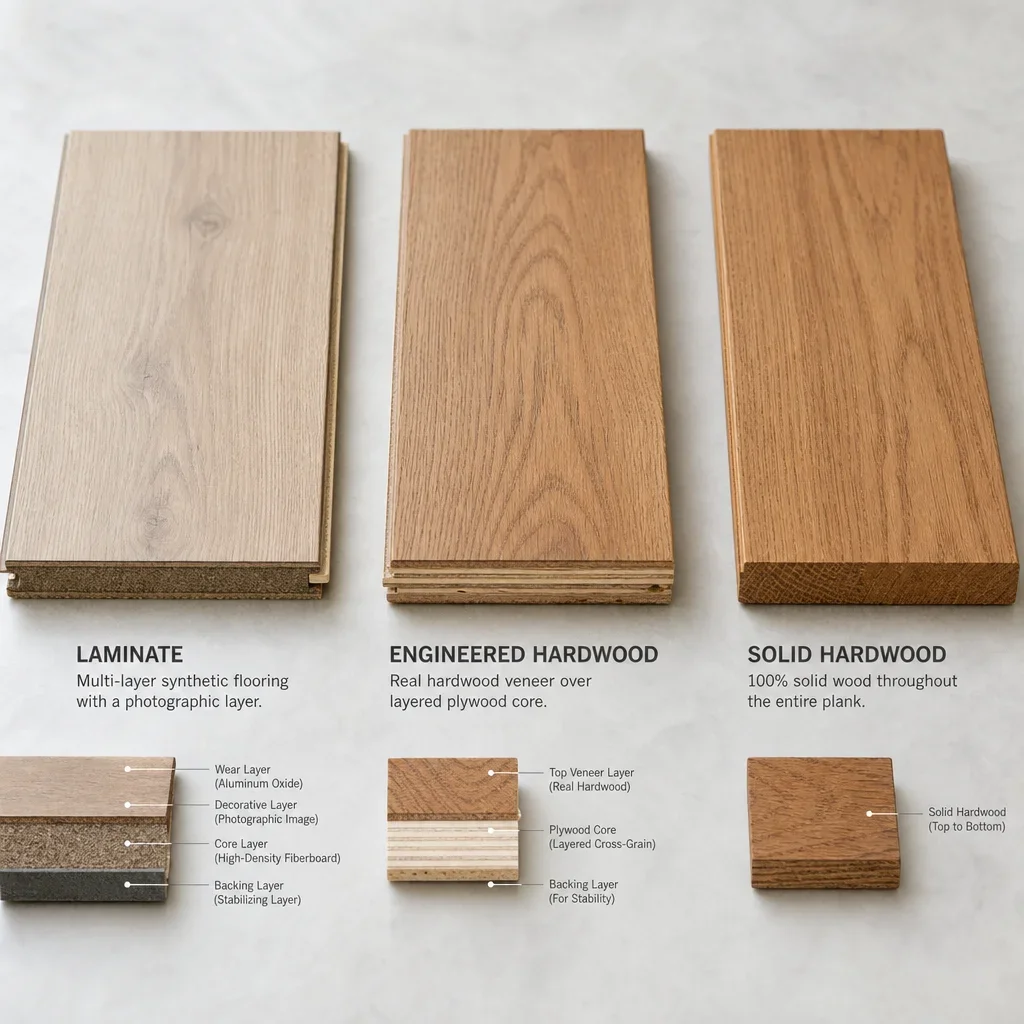
The easiest way to compare the difference between hardwood flooring and laminate is to look at what each plank is actually made of. Engineered hardwood uses a real-wood top layer over a layered core, laminate uses a printed image layer over an HDF core, and solid hardwood is one piece of wood all the way through .
| Feature | Laminate | Engineered Hardwood | Solid Hardwood |
|---|---|---|---|
| What it is | Printed wood-look surface over HDF core | Real wood veneer over layered wood core | One solid piece of wood |
| Looks | Good to very good, depending on print and texture | More natural grain and edge detail | Most natural variation and aging |
| Material price starting point | From $1.69/sq. ft. | From $2.99/sq. ft. | From $3.99/sq. ft. |
| Installation style | Usually click-lock floating | Floating, glue, nail, or staple depending on product | Usually nail or staple over suitable subfloor |
| Moisture tolerance | Better than hardwood on the surface, weak at seams and edges | Better than solid hardwood, still not waterproof | Most sensitive to moisture and seasonal movement |
| Scratch resistance | Often strong on the wear surface | Varies by species and finish | Varies by species and finish |
| Can it be refinished? | No, boards are usually replaced | Sometimes, depending on wear layer | Usually yes |
| Lifespan | Product-dependent; often shorter than real wood | Product-dependent; often longer than laminate | Often the longest-lasting category |
| Resale perception | Usually lower than real wood | Usually better than laminate | Usually strongest resale perception |
| Sound/feel | Can sound harder or hollow without the right underlayment | More natural feel underfoot | Warm, solid feel |
| Best rooms | Bedrooms, rentals, family spaces, some basements if conditions fit | Main floors, bedrooms, condos, some basements if approved | Main floors and upper floors, not usually below grade |
| Stairs | Not every laminate is ideal for stairs | Many engineered products work well on stairs | Common premium stair finish |
| Repairability | Replace damaged planks | Spot repair or refinish in some cases | Best repair and refinish potential |
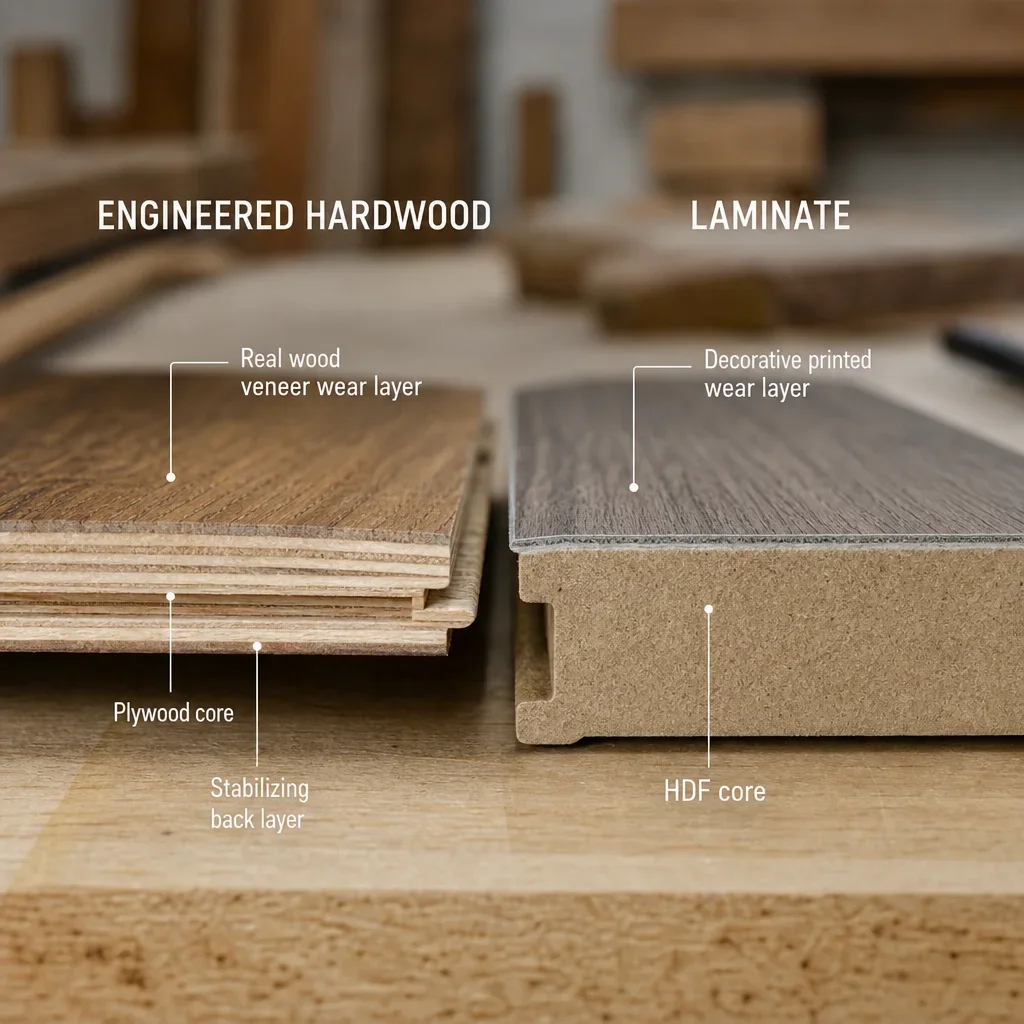
The main difference between engineered hardwood and laminate is that engineered hardwood contains real wood and laminate does not. Engineered wood flooring uses a real hardwood veneer over a stable layered core, while laminate uses a photographic wood image over a dense fibreboard core with a clear wear layer on top .
That construction changes how the floor looks, sounds, and ages. Engineered hardwood usually has more natural grain variation, more believable edge detail, and a less synthetic sound underfoot, while laminate often gives you better scratch resistance at a lower cost .
The difference between engineered wood and laminate flooring also shows up when damage happens. Some engineered floors can be refinished or at least professionally screened and recoated depending on the wear layer, but laminate cannot be sanded because the top visual layer is only a printed surface .
The difference between hardwood flooring and laminate is larger than the price tag alone suggests. Solid hardwood is a plank made from one piece of wood, while laminate is a manufactured plank with a printed top layer over an HDF core .
Solid hardwood usually gives you the best long-term repairability because the wood goes through the full thickness of the plank. Laminate has no real wood layer to sand, so once the face is deeply damaged, replacement is usually the only proper fix .
Solid hardwood also reacts more to humidity and moisture than laminate. That is why hardwood is usually avoided in below-grade spaces, while laminate may work in some basements if the slab, underlayment, and moisture conditions are handled properly .
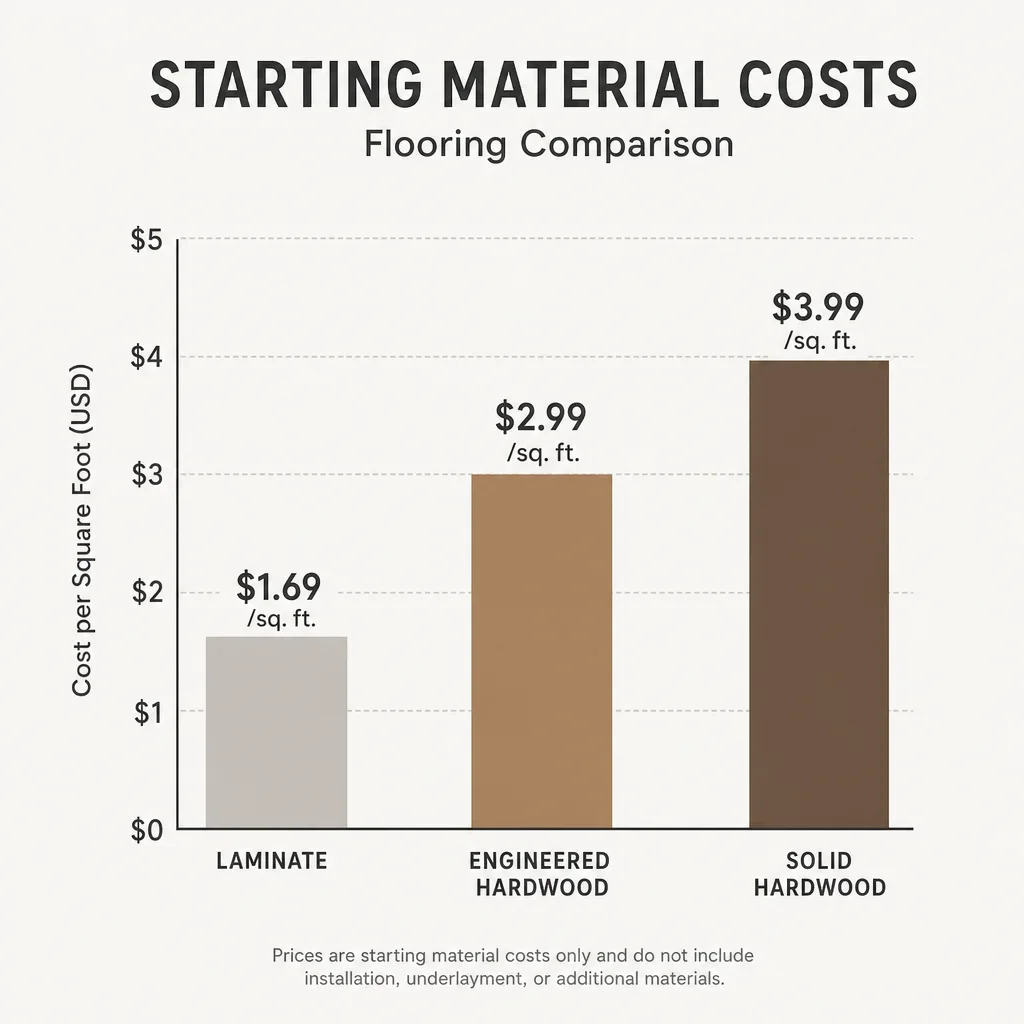
The cost difference between hardwood and laminate starts with material price, but the installed total is what buyers actually live with. CanFloor lists laminate from $1.69 per sq. ft., engineered wood from $2.99 per sq. ft., and hardwood from $3.99 per sq. ft. .
Installation cost is never one flat number because prep changes the job. Total project price moves with subfloor levelling, old-floor removal, disposal, transitions, trims, stairs, room shape, furniture moving, and whether underlayment is built in or added separately .
The safest way to compare the cost of hardwood flooring vs laminate is to break it into three buckets: material, labour, and extras. A cheap floor with heavy prep or stair work can cost more installed than a better product in a simple open room .
The 12x12-room math is straightforward on material only because a 12x12 room is 144 square feet . At CanFloor's starting prices, that works out to about $243.36 for laminate, $430.56 for engineered, and $574.56 for hardwood before labour, underlayment, trims, waste, and prep .
The 1000-square-foot material-only comparison is also easy to price at the starting level. Using the same entry prices, 1000 sq. ft. starts around $1,690 for laminate, $2,990 for engineered hardwood, and $3,990 for hardwood before installation and site conditions .
The 1500-square-foot material-only comparison shows the same spread at a larger scale. At the posted starting prices, 1500 sq. ft. starts around $2,535 for laminate, $4,485 for engineered, and $5,985 for hardwood before labour and extras .
The 2000-square-foot material-only comparison makes long-term value harder to ignore. At entry-level material pricing, 2000 sq. ft. starts around $3,380 for laminate, $5,980 for engineered, and $7,980 for hardwood before the installation side of the quote .
Long-term value is where engineered and hardwood can justify the higher spend. Real wood usually carries stronger resale perception than laminate, and floors that can be repaired or refinished may delay full replacement costs later .
If you want a side-by-side number for your own layout, the useful next step is to compare products in person and request a quote that separates supply, prep, trims, and installation. CanFloor's North York showroom at 2687 Steeles Ave. West lets buyers compare engineered hardwood, laminate, and solid hardwood side by side, with custom finishes and financing available through Affirm where applicable .
| Cost factor | Laminate | Engineered Hardwood | Solid Hardwood |
|---|---|---|---|
| Material starting price | From $1.69/sq. ft. | From $2.99/sq. ft. | From $3.99/sq. ft. |
| Labour | Varies by prep, layout, stairs, and method | Varies by prep, layout, stairs, and method | Varies by prep, layout, stairs, and method |
| Installed total | Depends on labour plus trims, underlayment, prep, disposal, and stairs | Depends on labour plus trims, underlayment, prep, disposal, and stairs | Depends on labour plus trims, underlayment, prep, disposal, and stairs |
| Lifetime value | Lower entry cost, limited repair/refinish | Mid-to-higher cost, possible refinish depending on wear layer | Highest entry cost, strongest refinishing potential |
Solid hardwood usually lasts the longest because it can be refinished repeatedly over time, while laminate usually has the least repair flexibility because it cannot be sanded. Engineered hardwood sits in the middle because some products can be refinished, but that depends on the thickness of the real-wood wear layer and the condition of the floor .
Wear life and repairability are not the same thing. A laminate floor may look good for years if the wear layer holds up, but one deep chip or swollen edge can still force board replacement rather than refinishing .
Engineered hardwood handles cosmetic damage better when the top layer is thick enough for professional work. Thin wear layers may allow only light surface restoration or none at all, so buyers should ask for the wear-layer spec before they pay extra for engineered .
Solid hardwood remains the easiest category to restore because scratches, dullness, and colour changes can often be corrected through sanding and refinishing. That is the real reason hardwood still leads on long-term renovation value despite the higher upfront cost .
| Damage issue | Laminate | Engineered Hardwood | Solid Hardwood |
|---|---|---|---|
| Light scratches | Usually live with them or replace a plank if severe | Often touch-up possible | Often touch-up possible |
| Deep scratches/gouges | Usually replace plank | May be repairable; may need board replacement | Often repairable; can be refinished |
| Dents | Surface may chip; replacement more common | Wood can dent depending on species | Wood can dent depending on species |
| Edge swelling | Usually permanent if core swells | Often permanent if water damage is deep | Often permanent if boards cup or swell badly |
| Fading/wear | Cannot refinish printed face | Sometimes refinishable | Usually refinishable |
| Isolated board damage | Possible to replace if matching stock exists | Possible to replace if matching stock exists | Possible to replace and blend |
Laminate usually beats both engineered and solid hardwood on day-to-day scratch resistance. The reason is simple: the wear layer on laminate is built for abrasion, while real wood surfaces can scratch or dent depending on species, finish, sheen, and colour .
Pets and kids change the decision fast. For big dogs, rolling toys, kitchen traffic, and rental wear, laminate is often the safer budget choice because claw marks usually show less than they do on dark, glossy wood floors .
Engineered and hardwood can still work well in family homes, but finish choice matters. Matte finishes, textured surfaces, and lighter mid-tone colours usually hide wear better than very glossy, very dark boards .
AC rating matters when you are comparing laminate products because it is a wear classification used to indicate how resistant the surface is to abrasion. Higher AC ratings generally suit heavier household traffic better, but the rating should be read alongside core quality, edge sealing, and warranty terms rather than on its own .
For dogs and kids, the short answer is this: laminate usually wins on scratch resistance, engineered usually wins on look and feel, and vinyl is often the better comparison if repeated wet messes are part of daily life .
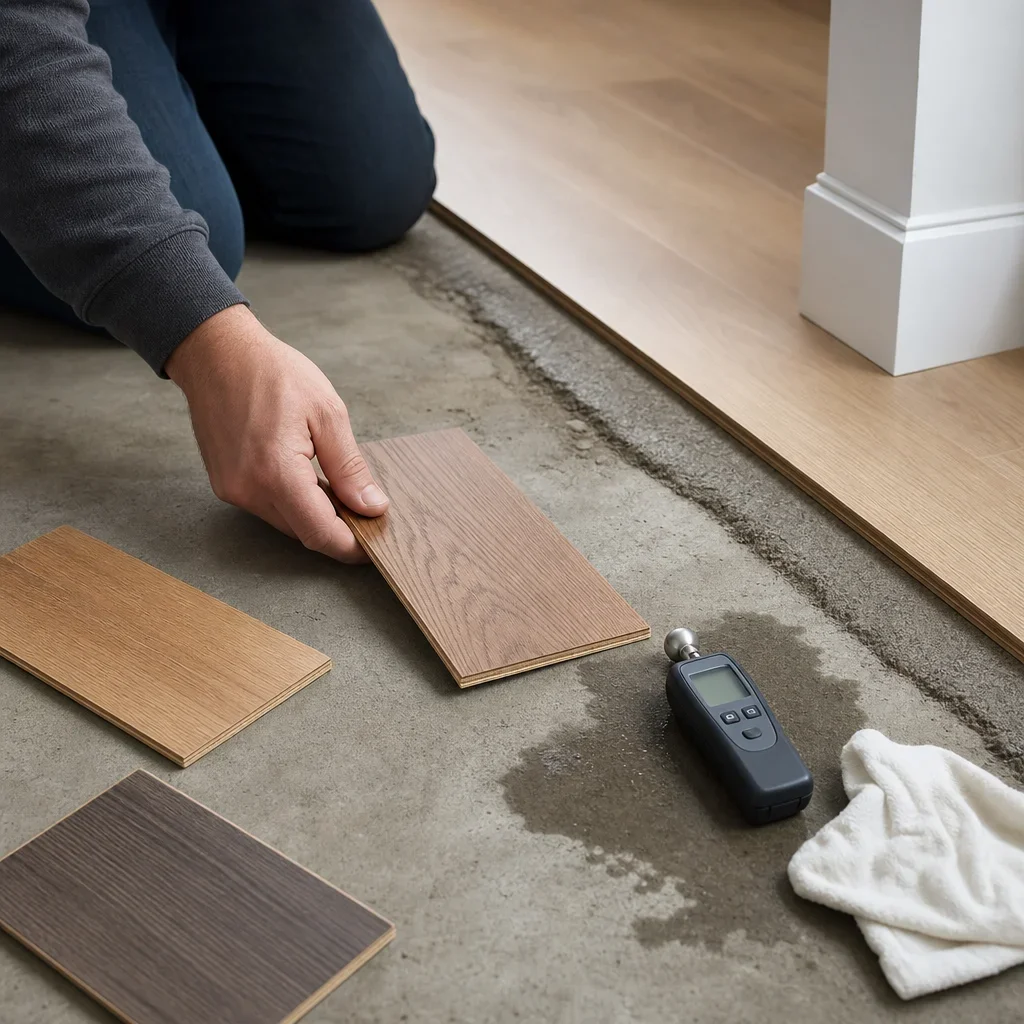
Neither standard laminate nor engineered hardwood should be treated as flood-proof. Water-resistant means a product can handle limited moisture exposure for a period of time, while waterproof claims usually apply to specific product constructions and still do not mean immune to standing water from leaks, tubs, or slab moisture .
Laminate often handles surface moisture better than hardwood in the short term, but the weak point is the seam and the core. Once water gets into unprotected edges or joints, swelling can be permanent .
Engineered hardwood handles seasonal humidity better than solid hardwood because its layered construction is more stable. That stability does not make it waterproof, and standing water can still stain, swell, or delaminate the floor .
Kitchens are a judgment call, not a yes-or-no rule. Engineered hardwood can work in kitchens where spills are cleaned quickly, while laminate can work where the product and seam system are suited to the space, but both need faster cleanup than vinyl or tile .
Bathrooms are where buyers should be careful. Full bathrooms and rooms with recurring standing water are usually better served by vinyl or tile than standard laminate, engineered wood, or solid hardwood .
Basements need moisture testing before product selection because below-grade spaces behave differently from main floors. Engineered may be suitable in some basements if the product allows it and the slab conditions are right, laminate can work in some cases with the right assembly, and solid hardwood is usually the highest-risk choice below grade .
Most moisture failures come from the same causes. Wet mopping, leaks left overnight, slab moisture, poor acclimation, and missing expansion gaps can all ruin a floor regardless of what the box promised .
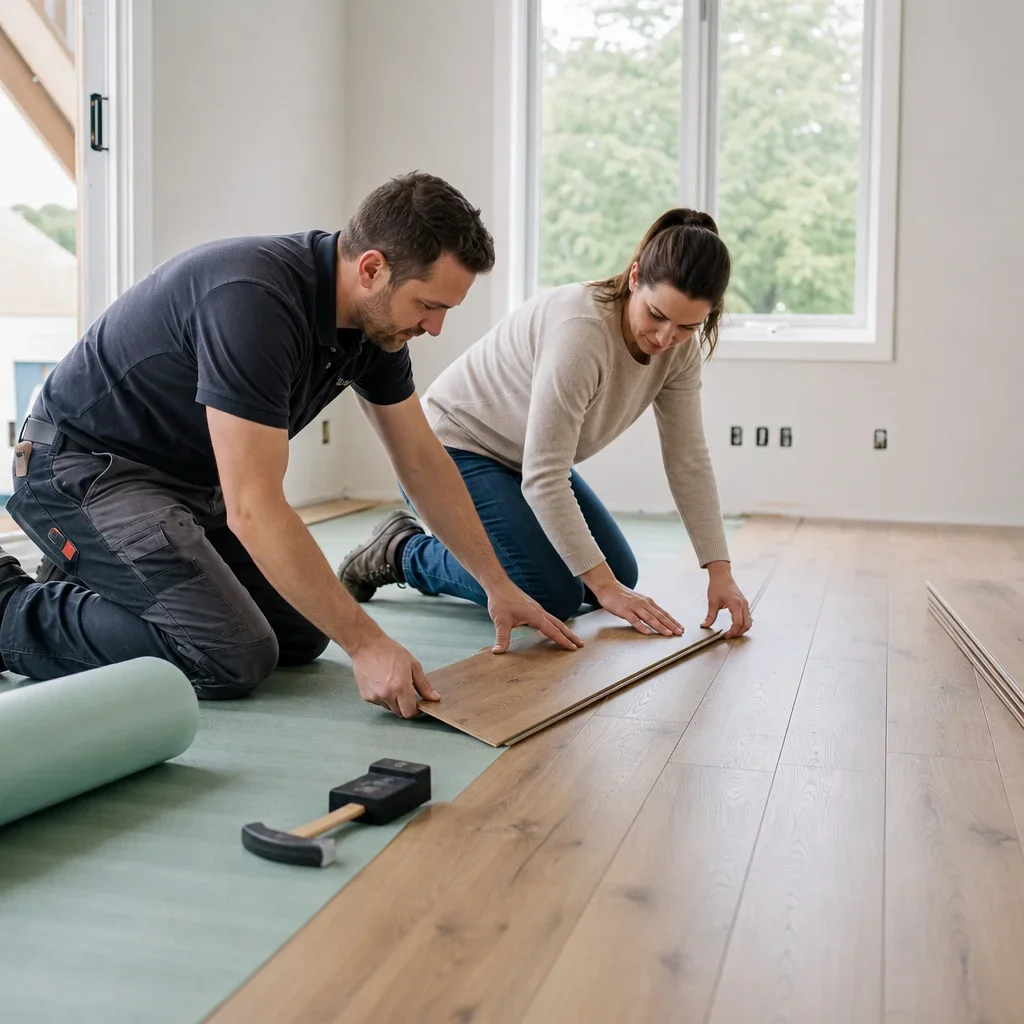
Laminate is usually the most DIY-friendly option because many products use a click-lock floating floor system. That means the planks lock together over the subfloor rather than being nailed down, although the subfloor still has to be flat, clean, and dry for good results .
Engineered hardwood gives you more installation methods, but that also makes product selection more technical. Depending on the floor and subfloor, engineered may be floated, glued, nailed, or stapled, while solid hardwood is usually nailed or stapled over a suitable wood subfloor .
Underlayment is often required for laminate unless the product has an attached pad or the manufacturer specifies a different assembly. The right underlayment can improve sound, comfort, and minor subfloor forgiveness, while the wrong one can affect performance or even warranty compliance .
Professional installation matters most when the job includes floor prep, slab moisture testing, transitions, stairs, door trimming, or awkward layouts. Those details usually decide whether the floor looks clean in year five, not just on day one .
Solid and engineered hardwood usually feel more natural underfoot than laminate. Real wood tends to sound less hollow and feel warmer, especially when the installation method and subfloor are well matched .
Laminate can feel perfectly good, but the assembly matters more. A thin product over a poor subfloor with the wrong underlayment can sound hard or hollow, while a better laminate over a flatter base can feel much more solid .
Plank thickness, underlayment, and subfloor condition affect comfort more than most buyers expect. That is why two floors that look similar on a sample board can feel completely different once installed .
Open-concept homes and condos need extra attention to sound transmission. Underlayment choice, product density, and installation method all affect how much footfall noise carries through the space .
The best spec to ask for on engineered flooring is the wear layer because that is what affects refinishing potential and long-term value. A thicker overall plank can feel more substantial, but total thickness alone does not tell you whether the top real-wood layer is robust enough for future restoration .
The most important laminate spec is not just thickness either. Core density, edge quality, AC rating, texture realism, and the quality of the locking system often matter more to real-world performance than an extra millimetre on paper .
Finish choice affects maintenance and appearance every day. Lower-gloss finishes usually hide dust, scratches, and everyday traffic better than high-gloss finishes, while embossed or textured surfaces can make laminate look more realistic .
The practical showroom checklist is short: ask what the plank is made of, how it installs, whether underlayment is attached, what rooms it is approved for, whether stairs are available, and what damage can actually be repaired later .
Laminate's biggest advantages are lower upfront price, strong surface scratch resistance, and easier DIY installation. Its biggest drawbacks are lower resale perception, a less natural feel, and the fact that damaged boards are usually replaced rather than refinished .
Engineered hardwood's biggest advantages are real-wood appearance, better resale appeal, and better dimensional stability than solid hardwood. Its biggest drawbacks are higher cost than laminate, less scratch resistance than many laminates, and product-to-product variation in wear layer and refinishing potential .
Solid hardwood's biggest advantages are long lifespan, the strongest refinishing potential, and the most authentic aging over time. Its biggest drawbacks are higher cost, greater sensitivity to moisture, and lower suitability for basements or other below-grade areas .
The best choice depends on what you are optimizing for, not what looks nicest on a sample board. If your goal is the cheapest reasonable floor, laminate usually wins; if your goal is better resale and a more natural look, engineered usually wins; if your goal is a premium long-term renovation, solid hardwood usually wins .
| Priority | Best fit | Why |
|---|---|---|
| Lowest upfront cost | Laminate | Lowest starting material price at $1.69/sq. ft. |
| Best resale perception | Solid hardwood or engineered | Real wood is usually valued more than laminate |
| Best DIY option | Laminate | Click-lock floating installation is usually simplest |
| Best for pets/kids | Laminate | Better scratch resistance in many households |
| Better for moisture-prone spaces | Vinyl first, then selected laminate/products | Wood categories are not waterproof |
| Better for basements | Selected engineered or laminate | Depends on moisture conditions and product approval |
| Better for rentals | Laminate | Lower cost and easier board replacement |
| Better for main-floor living areas | Engineered or solid hardwood | Better realism and resale appeal |
| Best long-term refinish value | Solid hardwood | Highest restoration potential |
Room-by-room guidance is more useful than generic pros and cons. Bedrooms and family rooms can work with any of the three, main-floor living spaces usually favour engineered or solid hardwood, kitchens can work with selected engineered or laminate if spills are handled quickly, basements need moisture-first planning, and full bathrooms are usually better with vinyl or tile .
Stairs deserve their own decision because not every product performs equally there. Engineered and solid hardwood are often the cleaner premium choice for stair finishing, while laminate stair options depend heavily on matching accessories and product compatibility .
If you plan to sell soon, engineered or hardwood often makes more sense than a cheap-looking laminate because buyer perception matters. If you plan to live in the home for 10 or more years, the right answer depends more on wear, maintenance habits, and whether you want future refinishing options .
If your shortlist now includes vinyl, that usually means moisture is becoming the deciding factor. In that case, compare this page with a hardwood-vs-vinyl or basement-flooring guide before you commit .
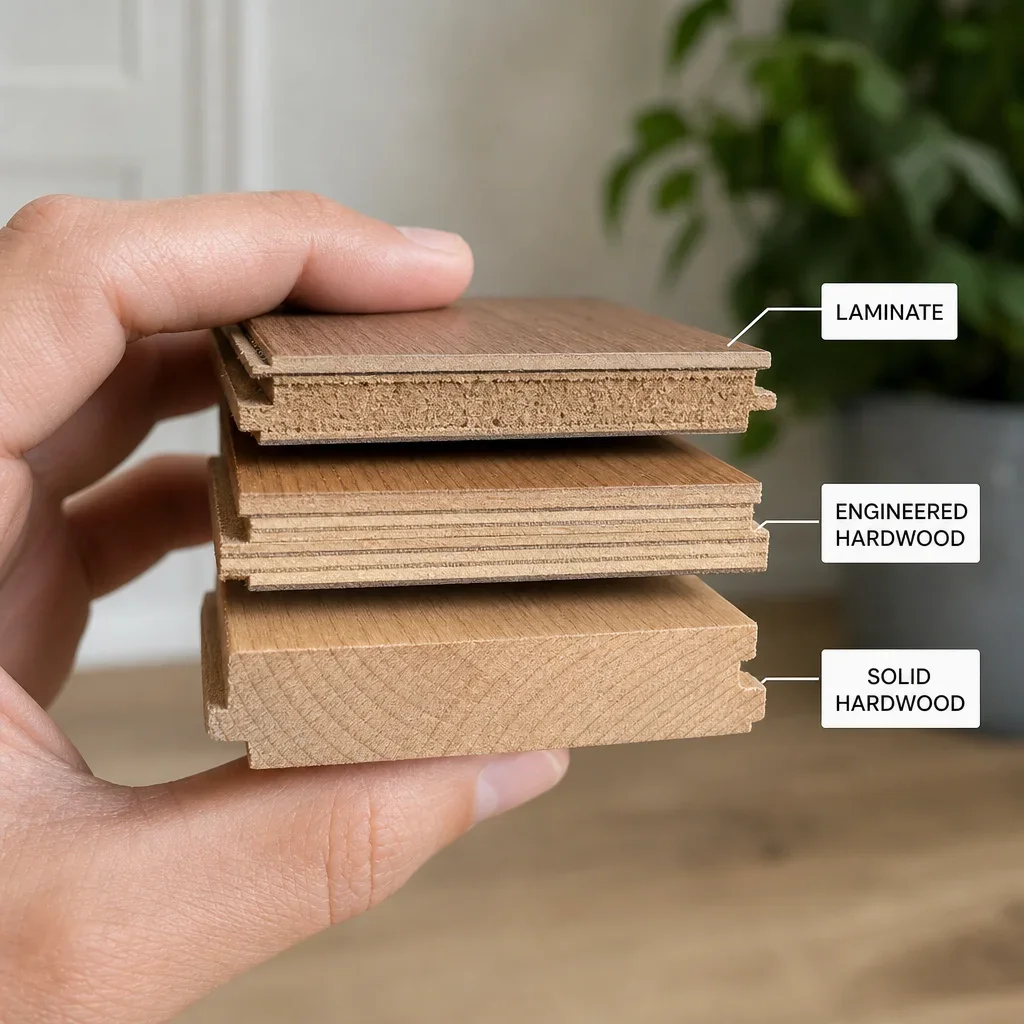
The fastest clue is pattern repetition. Laminate often repeats the same printed grain image across multiple planks, while real wood shows more natural variation from board to board .
The second clue is edge and surface texture. Engineered and solid hardwood usually have more believable grain depth, pores, and edge detail, while laminate can look extremely convincing from standing height but flatter at the edges or ends .
The best physical clue is an exposed edge or register opening because it lets you see the floor's construction. Laminate shows a fibreboard-style core, engineered shows a top wood layer over a layered core, and solid hardwood shows wood through the full thickness .
Sound can help, but it is not a perfect test. Floating laminate often sounds more hollow when tapped, while nailed or glued wood usually sounds denser, though premium laminates can still fool people without an exposed edge to inspect .
Both laminate and engineered hardwood should be cleaned with very little water. In practical terms, mopping should usually mean a well-wrung damp microfiber mop, not a wet string mop or pooled water left on the floor .
Engineered floors can usually be damp-mopped lightly if the manufacturer allows it, but soaking the floor is never a good idea. Excess water can work into seams and damage the wood or the core over time .
Laminate floors can also be damp-cleaned carefully, but too much water is one of the fastest ways to cause swollen edges and joint damage. That is why steam mops and overly wet mops are commonly discouraged on laminate .
Homemade cleaners and dish soap are a bad default for both categories because residue can dull the finish and unapproved chemicals can create maintenance problems. The safe rule is to follow the manufacturer's cleaner guidance first, especially before using Swiffer-style wet products or any DIY mix .
Do:
Don't:
The healthiest flooring choice is not one category for every home. Indoor air quality usually depends on emissions standards, adhesives, finishes, cleaning products, and how the floor is maintained, not just whether it is laminate, engineered, or solid hardwood .
Hard-surface floors are often preferred by buyers who want easier dust cleanup than carpet, but that is a lifestyle consideration, not a medical claim. If low-emission materials matter to you, ask about low-VOC products and third-party certifications where available before you buy .
The safest flooring trend for 2026 is not a dramatic colour. Natural-looking tones, lower-gloss finishes, and more realistic textures usually age better than very glossy red or orange wood looks or obviously fake printed visuals .
Wider-plank visuals and balanced neutral tones still feel current, but trend chasing should stay secondary to room use and resale context. A floor that fits the light, layout, and quality level of the home usually looks better longer than one chosen only because it feels new this year .
Engineered hardwood is usually better for appearance, feel, and resale perception, while laminate is usually better for upfront price and scratch resistance .
Engineered hardwood has a real wood top layer over a layered core, while laminate has a printed wood-look surface over an HDF core .
Solid hardwood is real wood through the full plank and can usually be refinished, while laminate is a manufactured product that usually cannot be refinished .
Laminate is usually cheaper overall because the material starts lower and installation is often simpler, but site prep, stairs, trims, and subfloor work can change the total job cost .
At CanFloor's posted starting prices, laminate starts from $1.69 per sq. ft., engineered starts from $2.99 per sq. ft., and hardwood starts from $3.99 per sq. ft., before labour and extras .
No. Laminate cannot be sanded and refinished because the decorative top layer is a printed surface .
Sometimes. It depends on the thickness of the real-wood wear layer and the condition of the floor .
It often is if you care about real wood, better resale perception, and a more natural look and feel. It may not be worth the premium if your top priorities are scratch resistance and lower upfront spend .
Laminate is often the better value choice for pets and kids because it usually resists surface scratches better than wood floors .
It can be, depending on the product and moisture conditions, but it should not be treated as immune to standing water or slab moisture .
Yes, lightly, if the manufacturer allows it. Use a well-wrung damp microfiber mop, not excessive water .
Yes, lightly and carefully. Too much water can swell edges and damage the core .
Usually yes, unless the laminate has an attached pad or the manufacturer specifies a different setup .
Look at an exposed edge, vent opening, or transition. Laminate shows a fibreboard-style core, while engineered shows a real-wood top layer over a layered core .
Solid hardwood usually gives the strongest resale perception, with engineered hardwood close behind. Laminate usually ranks lower on buyer perception .
Vinyl is often better where moisture is the main concern, while laminate often offers a harder wear surface and strong value in drier living spaces .
Do not assume laminate, engineered, or hardwood is 100% waterproof unless a specific product standard says so. In most real-home comparisons, vinyl or tile is the safer category for recurring water exposure .
The rule of 3 is a design guideline, not a hard rule. It usually means limiting a home to about three main flooring finishes so the space feels intentional rather than visually busy .
If you are still split between laminate and real wood, compare the samples in person before you decide. The fastest way to make the right call is to stand on them, look at the edges, and price the full job instead of the box alone.