
For a quicker response, please send all inquiries
via info@canfloor.com or
text to
416-735-0075.
| Monday - Friday | 10:00 am - 7:00 pm |
| Saturday & Sunday | 10:30 am - 4:00 pm |
The biggest mistake buyers make with a hardwood flooring sizes chart is treating size like a style detail only. Size changes the look, the installation, the transitions, and sometimes which product makes sense for your subfloor.
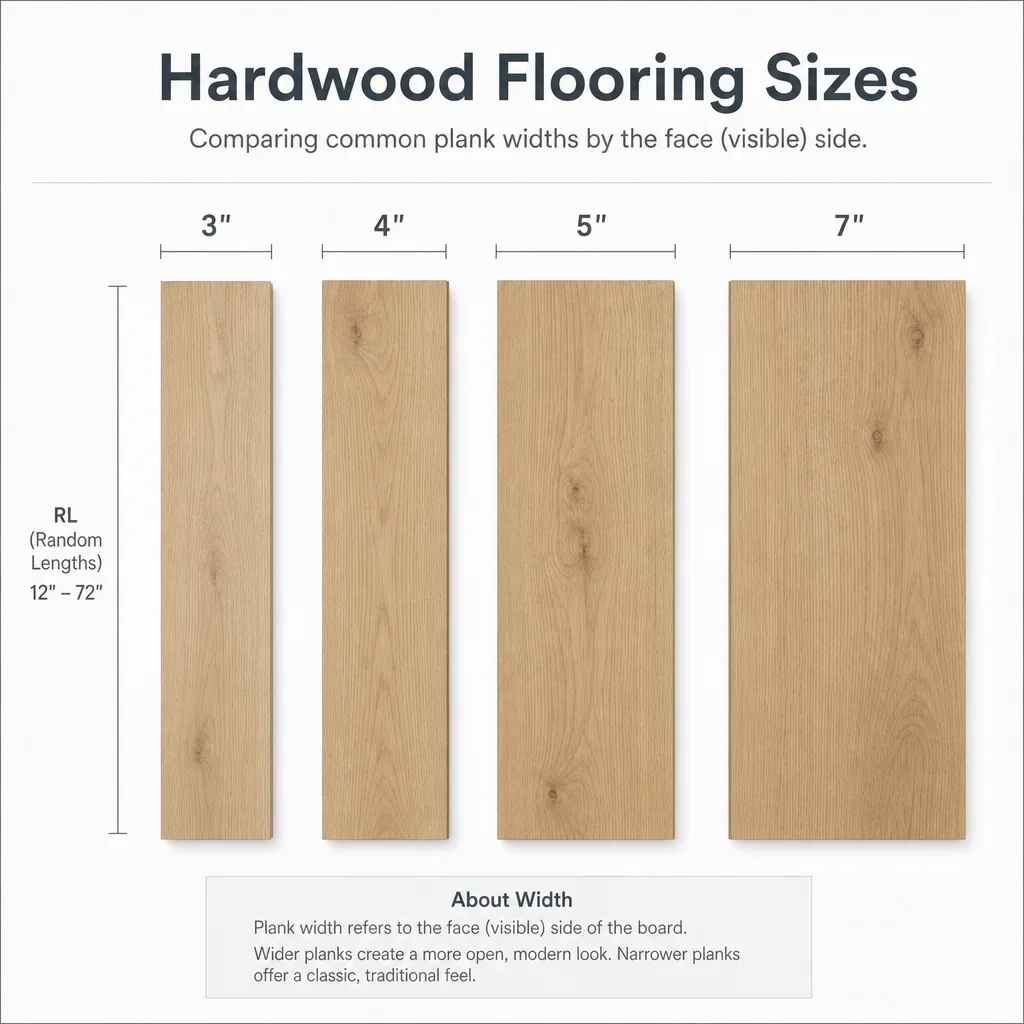
Standard hardwood floor plank sizes usually fall into a few practical groups, and exact dimensions vary by manufacturer, species, and collection. The chart below gives the clearest starting point for a hardwood flooring sizes chart Canada shoppers can use before comparing samples.
| Construction | Width category | Inches | Millimetres | Typical thickness | Typical length format |
|---|---|---|---|---|---|
| Solid hardwood | Narrow | 2 1/4" to 3" | 57 to 76 mm | Often 3/4" | Usually random lengths |
| Solid hardwood | Standard | 4" to 5" | 102 to 127 mm | Often 3/4" | Random or mixed lengths |
| Solid hardwood | Wide | 6" and wider | 152 mm and wider | Often 3/4" | Often longer mixed lengths |
| Engineered hardwood | Narrow | 3" to 5" | 76 to 127 mm | Commonly 3/8" to 5/8" | Random, nested, or fixed depending on collection |
| Engineered hardwood | Wide | 5" to 7 1/2"+ | 127 to 190 mm+ | Commonly 3/8" to 5/8" | Often longer board programs |
Board width is the visible face of each plank, thickness is the full board build, and length is the end-to-end board measurement. A hardwood flooring sizes chart in feet is less common than inches because hardwood plank width and thickness are usually sold in inches, while room planning is done in square feet.
[Design note: add a simple hardwood flooring sizes chart with pictures showing 3", 4", 5", and 7" plank faces side by side.]
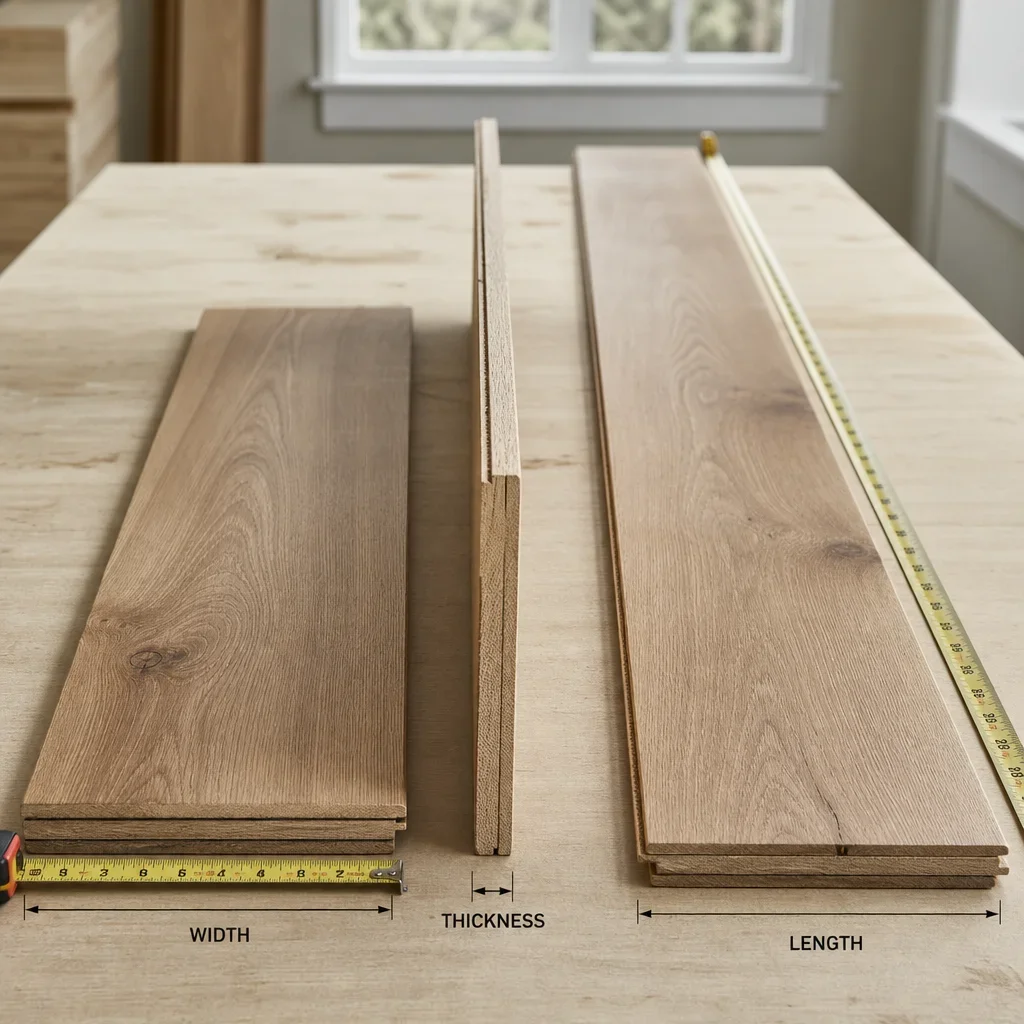
Width tells you how wide the visible top face of each board will look after installation. A larger hardwood plank width creates fewer seams across the room, while a smaller width creates more lines and a busier, more traditional pattern.
Thickness tells you the board construction, not the hardness of the wood. Hardness comes from species, while hardwood plank thickness affects floor height, transition planning, installation method, and in some products the refinishing potential.
Length tells you how many end joints you will see across the floor. Longer boards usually make open spaces look calmer, while shorter boards or mixed lengths create more movement and visual variation.
Board size is only one buying factor, and it should not be confused with species, grade, or finish. A 5-inch white oak floor and a 5-inch maple floor can be the same size but still look completely different because grain, colour, character, and sheen change the final result.
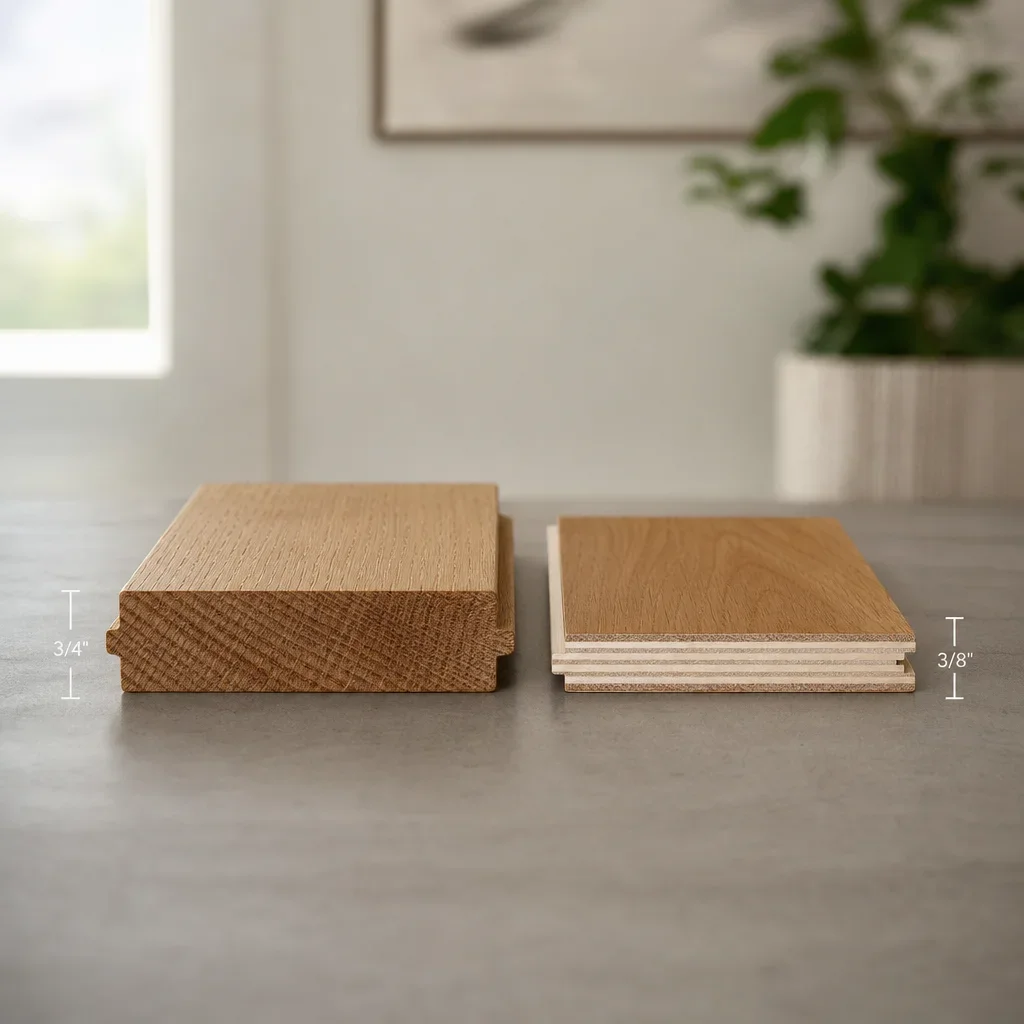
Solid hardwood sizes are usually more traditional in thickness, while engineered hardwood sizes usually offer more flexibility in width and installation conditions. Solid hardwood is often built at 3/4 inch thick , while engineered hardwood commonly lands around 3/8 inch to 5/8 inch total thickness .
Engineered hardwood often gives buyers more options in wider boards and varied lengths. That matters over concrete, over some radiant heat systems, or where floor height has to be managed carefully, but the right use still depends on the specific product specs and installation instructions.
A 5-inch plank can exist in both solid and engineered formats, so construction and appearance are separate decisions. We tell buyers to choose the look first, then confirm whether solid or engineered suits the subfloor, room conditions, and transition heights.
| Factor | Solid hardwood | Engineered hardwood |
|---|---|---|
| Typical thickness | Often 3/4" | Often 3/8" to 5/8" |
| Width availability | Traditional to wide, collection dependent | Often broader width selection |
| Subfloor flexibility | More limited by site conditions | Often better for concrete or radiant-heat-approved applications |
| Height matching | Higher profile is common | More options where height is tight |
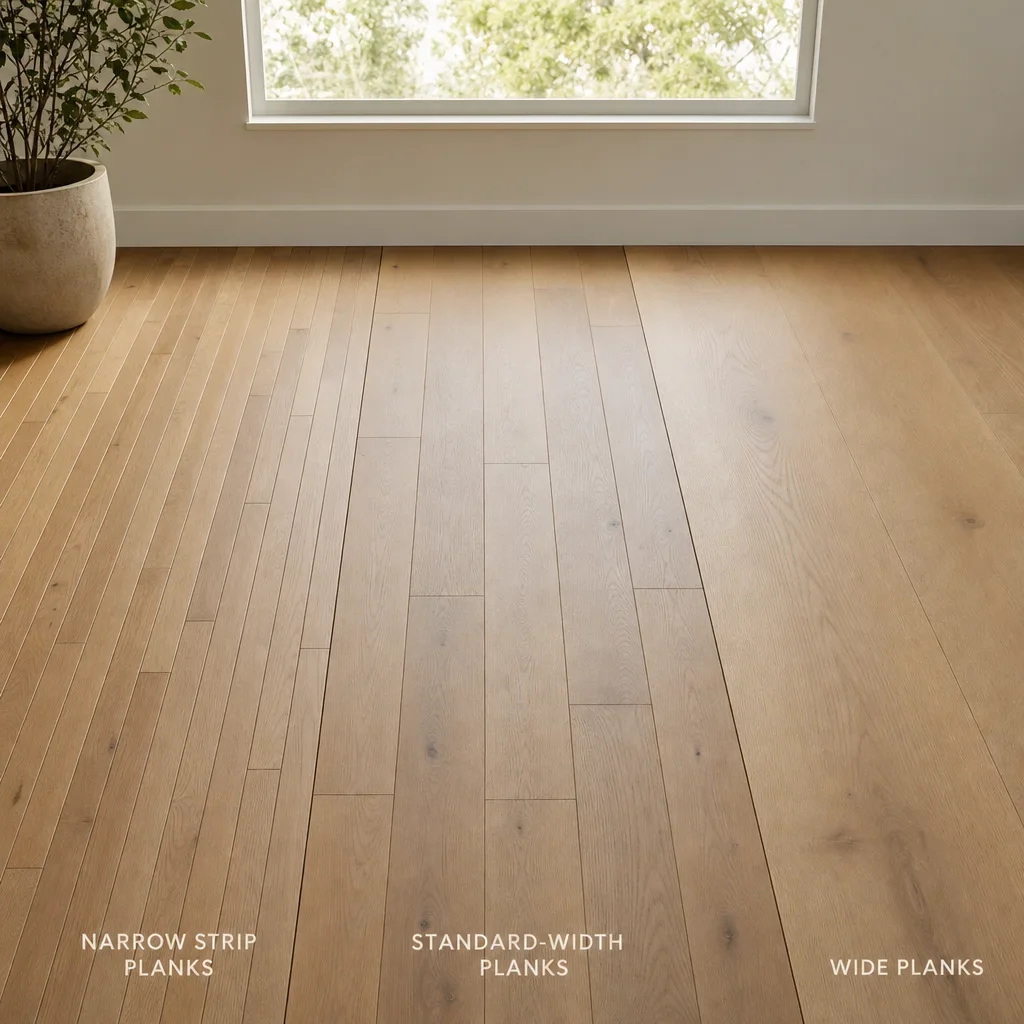
Narrow, standard, and wide planks each solve a different design problem. In most hardwood floor width trend discussions, narrow means about 2 1/4 to 3 inches, standard means about 4 to 5 inches, and wide means 6 inches and up.
Narrow planks create more seams and a more traditional rhythm. They fit older homes well, help when you are matching existing strip flooring, and can feel more proportional in smaller rooms or tighter hallways.
Standard widths are the safest middle ground for most homes. A 4 inch hardwood flooring option or a 5 inch hardwood flooring option usually works across traditional, transitional, and modern interiors without feeling extreme.
Wide planks create a broader, quieter visual field because you see fewer seams. They can make grain and character stand out more, and they usually need closer attention to subfloor flatness, room conditions, and product-specific installation limits.
| Width group | Approx. size | Best fit | Visual effect | Practical note |
|---|---|---|---|---|
| Narrow | 2 1/4" to 3" | Traditional homes, matching older floors | More seams, more texture | Easier visual fit in tight rooms |
| Standard | 4" to 5" | Most renovations and new installs | Balanced look | Good compromise for undecided buyers |
| Wide | 6"+ | Open layouts, contemporary styles | Fewer seams, bigger scale | Needs careful site and product review |
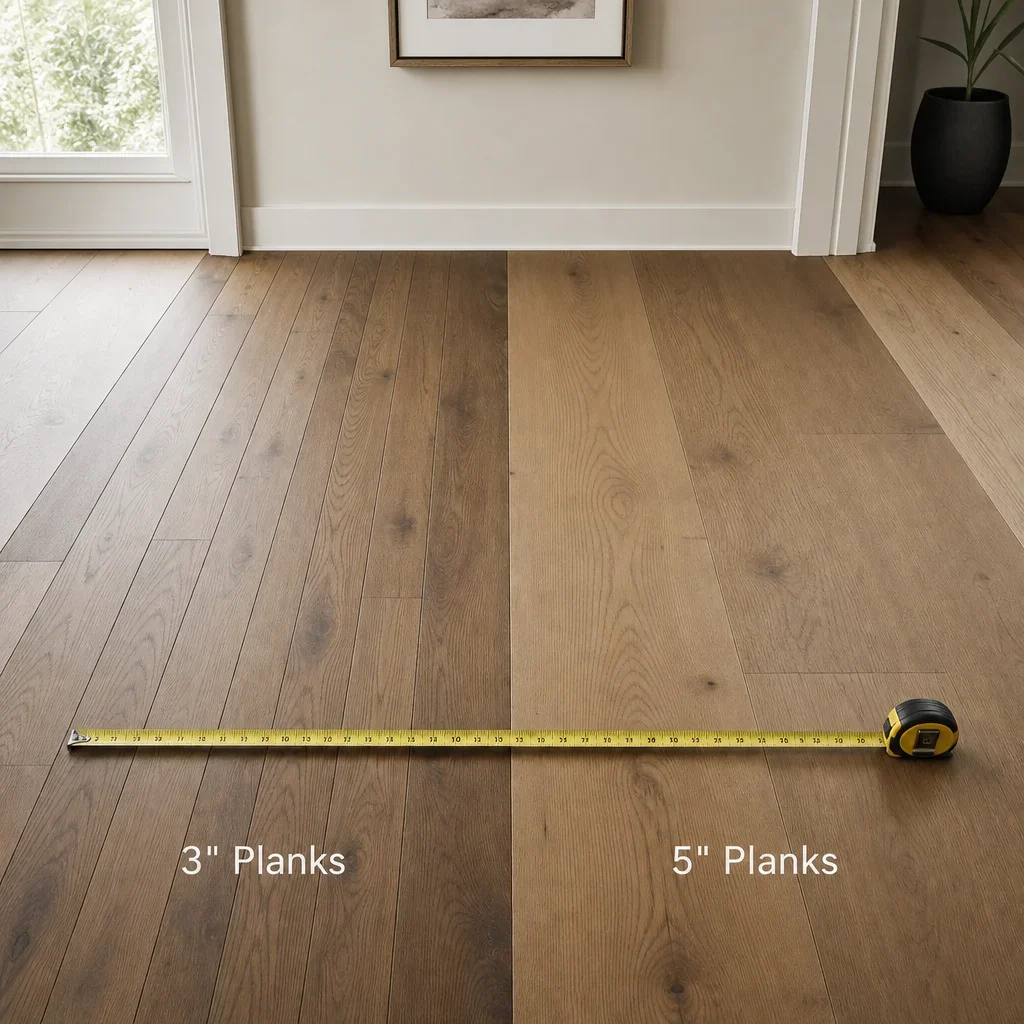
Neither is universally better. Hardwood flooring 3 vs 5 comes down to scale, style, and what the room already has.
A 3-inch floor gives you a classic strip look with more visible board lines. It usually suits traditional interiors, older Toronto houses, narrower rooms, and projects where you are tying into existing floors.
A 5-inch hardwood flooring layout looks more current without going fully wide plank. It usually suits newer homes, open rooms, and buyers who want fewer seams and a cleaner visual flow.
The practical difference is easy to picture: over a 15-inch span, five 3-inch boards fit across, while three 5-inch boards fit across. That means the 5-inch layout shows fewer seams across the same area.
Choose 3-inch if matching older strip flooring matters most, if the room is tight, or if you want a traditional look. Choose 5-inch if you want a more updated look, if the room has more visual breathing room, or if you want a middle ground between classic and wide plank.
The most popular width of hardwood flooring today is usually in the middle, not at either extreme. In real projects, 4- to 5-inch boards are often the easiest fit because they work in more room sizes and more home styles.
Popularity is not a hard rule and it changes by house type. Older homes still lean toward narrower strip looks, while condos, newer detached homes, and open renovations often lean toward standard or slightly wider engineered boards.
The current hardwood floor width trend is toward cleaner-looking floors with fewer seams, but that does not make narrow planks outdated. A narrow board still makes sense when you are matching existing flooring, keeping a classic look, or avoiding an oversized feel in a compact space.
Bedrooms usually handle 4- to 5-inch boards very well because that range feels balanced and easy to furnish around. Narrower planks can still work in smaller bedrooms, especially where the home already has traditional strip flooring.
Hallways usually look better when the width stays proportional to the corridor. Very wide boards can feel oversized in a tight run, while medium widths often keep the hallway from looking choppy without overwhelming it.
Kitchens need a construction choice before a style choice. If the room may see more moisture swings, engineered hardwood can be the better size option because it often comes in dimensions and constructions better suited to variable conditions, subject to the product's specs.
Open-concept rooms usually carry wider and longer boards more comfortably because the larger visual field gives those planks room to read properly. That is one reason 5-inch and wider boards show up often in combined living, dining, and kitchen areas.
Stairs need coordination, not guessing. Treads, risers, nosing profiles, and floor height all need to line up, so the board size you like on the main floor should be checked against the stair system before you order.
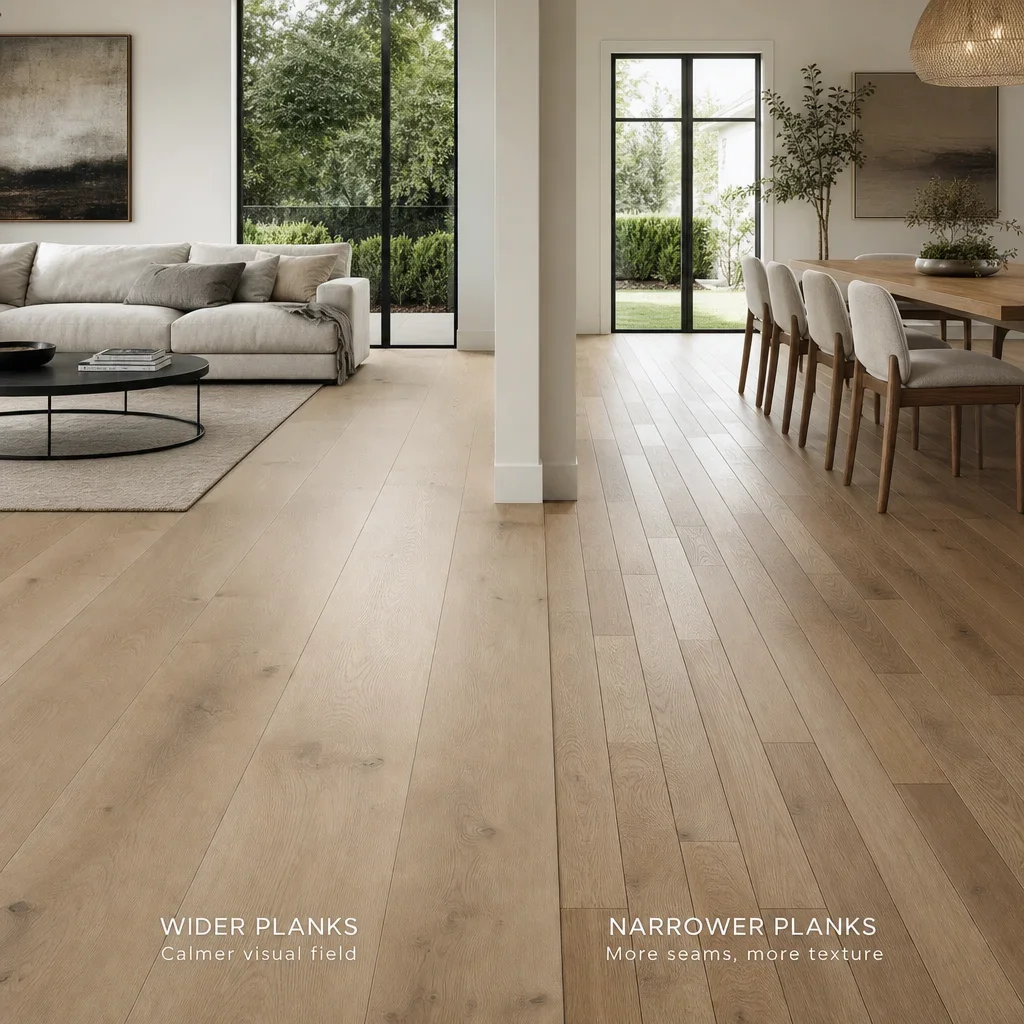
Wider boards make a room look calmer because they reduce seam visibility. Fewer plank lines across the floor usually means the eye reads the space in larger blocks rather than smaller strips.
Narrow boards add rhythm and detail because they create more repeated lines. That can make a room feel more textured and traditional, but it can also make a very busy room feel visually fuller.
Installation direction changes how width and length are perceived. Running boards along the longest sightline often makes the room feel more natural, while running them across a narrow span can visually widen that space.
Longer boards usually reduce end joints, while random length hardwood flooring creates a more varied pattern. Uniform length hardwood flooring looks more ordered and formal, but it can also look repetitive if the room is large and the layout is not planned carefully.
Bevels change seam visibility too. A deeper micro-bevel or eased edge can make each board line stand out more, while a cleaner edge profile can make the floor read more continuously.
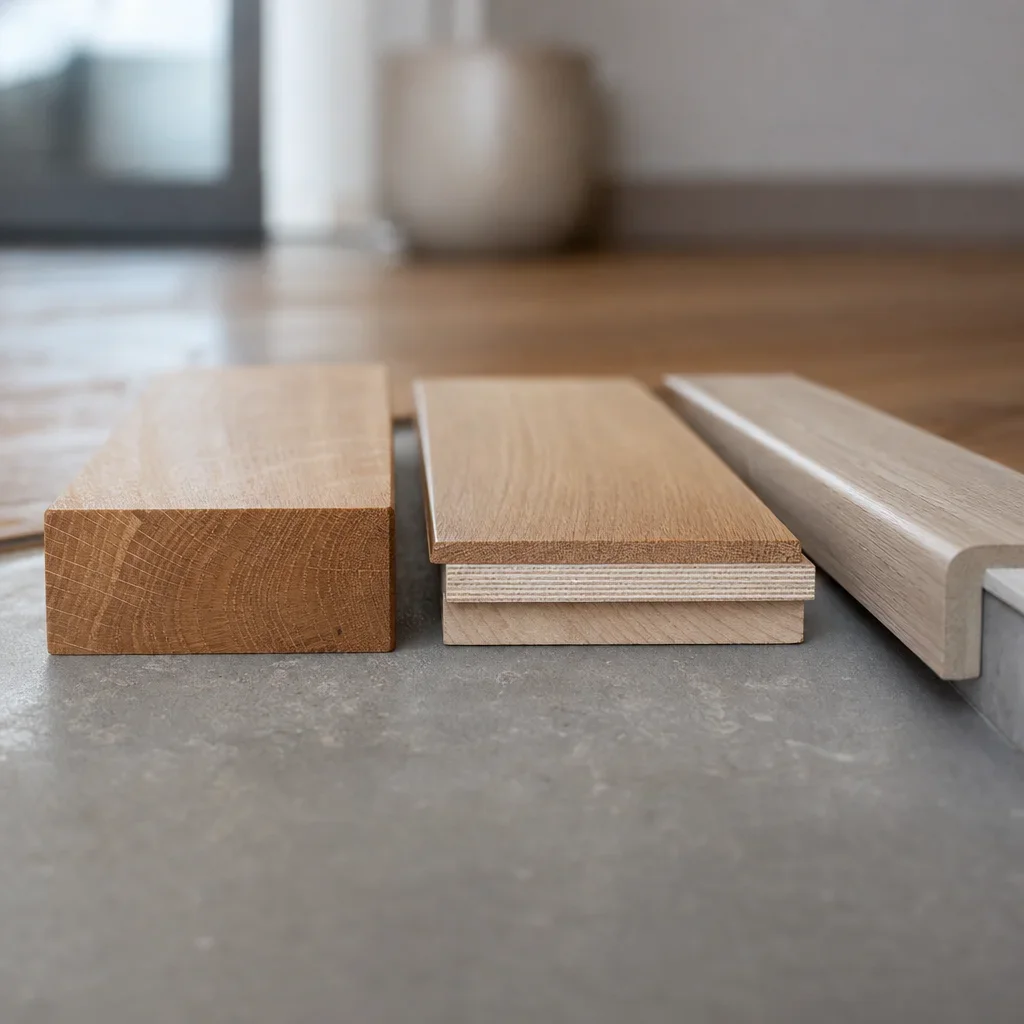
Thickness affects build and floor height more than dent resistance. If you want better dent resistance, look at species hardness first; if you want to manage transitions, subfloor height, or board construction, thickness matters more.
Solid hardwood is valued partly because its full-thickness construction gives you a traditional, substantial floor profile. Solid boards are commonly 3/4 inch thick , which is one reason they often pair well with older wood-floor assemblies and certain stair details.
Engineered hardwood should be judged by both total thickness and wear layer, not by total thickness alone. Two engineered products can both be 1/2 inch thick and still perform differently because the top hardwood layer, core build, and installation specs are not the same.
Thicker is not always better once transitions enter the job. A thicker floor can create more height difference against tile, existing hardwood, cabinetry, or stair nosings, so a thinner engineered option can be the smarter fit even when the room could physically take a thicker board.
Random length hardwood flooring means the carton includes boards in different lengths. That is common in many hardwood collections because it helps use material efficiently and gives the floor a more natural stagger once installed.
Uniform length hardwood flooring means boards are cut to the same length or a very tight length range. That creates a cleaner, more controlled pattern, but it needs more layout discipline so seams do not line up in a way that looks artificial.
Random lengths usually make a room feel more natural and less repetitive. Uniform lengths usually look more formal and graphic, which some buyers want in very modern spaces or patterned layouts.
Patterned floors usually use different board dimensions than standard straight-lay planks. Herringbone hardwood size and chevron hardwood size are often narrower and shorter so the pattern stays crisp and proportional.
Herringbone and chevron layouts work best when the board size fits the room scale. Very large pieces can make the pattern look heavy, while smaller pieces usually keep the geometry sharp and easier to read.
Parquet hardwood size also depends on the pattern unit, not just the board itself. Once the design shifts from straight lay to a repeating block or angle, the plank dimensions become part of the pattern math.
Mixed width hardwood can create a custom, old-world, or designer look, but it requires planning from the start. The widths, carton mix, room transitions, and stair coordination all need to be mapped before installation begins.
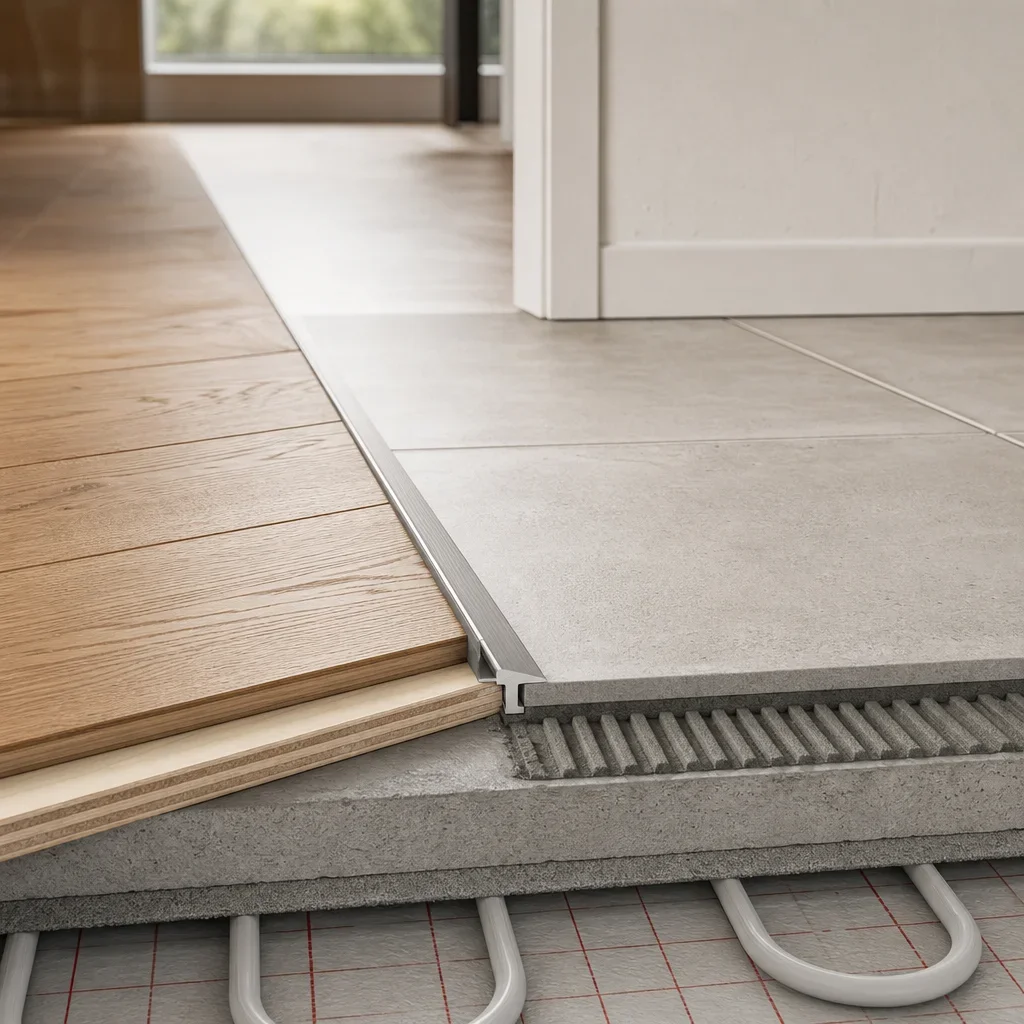
Plank size becomes technical the moment the floor has to meet another surface. Hardwood height transition issues show up where new flooring meets tile, older wood, vinyl, or stairs, and thickness is usually the first thing to check.
Subfloor flatness matters more as plank size gets larger. Wider and longer boards can telegraph unevenness more clearly, so subfloor hardwood prep is not optional if you want a clean install and fewer movement issues later.
Engineered hardwood is often the safer place to look for underfloor heating compatibility. That does not make every engineered product radiant-heat approved, but it is the category more buyers should check first when heat systems or variable site conditions are part of the job.
Moisture-prone rooms need product-specific caution, not blanket advice. Solid hardwood is not the automatic answer everywhere, and the right flooring choice depends on the room, the subfloor, the humidity pattern, and the manufacturer's installation rules.
Expansion gaps still matter regardless of width, but larger-format boards can make movement planning more important because the visual impact of any issue is easier to spot. Follow the product specifications and installer guidance rather than assuming one gap rule fits every floor.
Size, species, grade, and finish are separate choices, even though buyers often blur them together. White oak plank width changes scale, hardwood grade changes character, and matte vs glossy hardwood changes light reflection, but none of those is the same decision.
Species changes grain and hardness. Grade changes how much knotting, colour variation, and natural character you see. Finish changes the sheen and surface feel. Size changes the proportion and seam pattern.
A 5-inch matte white oak floor can look broad, calm, and contemporary, while a 3-inch semi-gloss maple floor can look cleaner, brighter, and more traditional. The construction may be similar, but the room will not read the same way.
Wider boards also make character more visible because each plank shows more grain, colour movement, and natural variation. That can be a benefit if you want a richer look, or a drawback if you want a more uniform floor.
Start with the room and the look you want, then narrow the board size from there. If you are matching older strip flooring, 3-inch boards are usually the first width to compare.
Move to 4-inch hardwood flooring if you want a balanced, flexible look that still feels classic. This width often works well when buyers do not want a very narrow strip or a more current wide-plank feel.
Move to 5-inch hardwood flooring if you want fewer seams and a more updated look without going oversized. This is a practical middle ground for many living areas, bedrooms, and open plans.
Pause before going wider if the room is tight, if the subfloor needs work, or if you have tricky transitions to tile or stairs. The wider the plank, the more important the technical side becomes.
Sample the floor in the actual room before you finalize it. Room light, wall colour, furniture scale, and adjoining flooring can change how 3-inch, 4-inch, and 5-inch boards feel once they are on site.
The right extra quantity depends on layout complexity, not just square footage. Straight-lay installs usually need less overage than herringbone, chevron, or rooms with many cuts and direction changes.
For straightforward layouts, a waste allowance of about 5% to 10% is a common planning range . More complex patterns or cut-heavy rooms usually need more, especially with patterned layouts, diagonal installs, or mixed-width material.
Plank size affects waste in practical ways. Longer boards can make layout planning more efficient in some rooms, but they can also create harder-to-use offcuts in tighter layouts. Wider boards can reduce seam count, but they still need careful staging around walls, islands, and transitions.
A measured quote is safer than guessing from room dimensions alone. If you are comparing samples in our North York showroom, bring room sizes, adjoining floor heights, and photos of any stairs or transitions so the estimate reflects the actual layout.
Hardwood flooring comes in a range of widths, thicknesses, and lengths. Common width groups run from about 2 1/4 to 3 inches for narrow planks, about 4 to 5 inches for standard planks, and 6 inches or more for wide planks.
Solid hardwood is usually associated with more traditional thickness, often around 3/4 inch , while engineered hardwood commonly comes around 3/8 inch to 5/8 inch total thickness and often offers more width options.
No, not automatically. A 5-inch floor can still work in a small room if the proportions, sightlines, and transitions make sense, but narrower boards may feel more natural when the room is tight or when you are matching older strip flooring.
3-inch is usually better for traditional looks and matching existing strip floors. 5-inch is usually better for a cleaner, more current look with fewer seams. Neither is universally better.
It means the carton includes boards of different lengths. That is normal in many hardwood collections and helps create a more natural staggered appearance.
Narrower and shorter pieces are usually easier to proportion well in herringbone. The exact size should follow the pattern design and product availability, not a one-size-fits-all rule.
That depends on the product type and the job. Solid hardwood is often 3/4 inch thick , while engineered hardwood commonly falls around 3/8 inch to 5/8 inch . The right thickness depends on transitions, subfloor, and installation method.
Yes, sometimes, but it needs to be checked before ordering. Thickness, underlayment, subfloor prep, and transition strips all affect the final finished height.
About 5% to 10% is a common planning range for straightforward layouts , with more needed for complex patterns, difficult room shapes, or specialty installations.
In flooring, the rule of 3 usually refers to layout practice rather than a product law. Installers often use it as a visual guideline to avoid repeating short boards or aligning end joints too closely across adjacent rows.
The broad direction still leans toward natural-looking wood visuals, medium-to-wide plank formats, and lower-sheen finishes. Trend cycles change quickly, so treat this as design direction, not a fixed rule.
Natural oak tones, lighter browns, warm neutrals, and low-gloss finishes are getting attention because they are easier to live with across different wall colours and furniture styles. Trends shift, so samples matter more than headlines.
Hard-surface floors are usually easier to clean than broadloom carpet, but there is no single best floor for every health situation. Product emissions, cleaning routine, and the full room environment matter more than one material claim.
If you are stuck between 3-inch, 4-inch, and 5-inch boards, compare them side by side before you buy. That one step usually tells you more than ten product pages do.