
Most buyers use a janka wood hardness chart as if it settles the whole flooring decision. It does not. Janka helps you compare dent resistance, but it does not tell you how a floor will scratch, fade, move with humidity, or look after five years of real traffic.
The Janka scale of hardness measures the force needed to press a steel ball halfway into a wood sample, so a higher number usually means better dent resistance. For flooring, that makes the janka wood hardness scale useful for comparing dropped items, chair legs, and concentrated pressure, but not as a stand-alone score for total durability.
A hardness scale for hardwood works best as a filter, not a verdict. Species hardness matters, but finish type, texture, gloss level, plank construction, colour variation, and maintenance habits also change how the floor performs in a real home. That is why a white oak floor with a low-sheen, wire-brushed finish can hide wear better than a harder but smoother, shinier species.
The chart below is the practical starting point most shoppers need. It groups common flooring species first, then domestic and exotic comparisons, then Canada-focused choices and an acacia section because that is one of the most confusing names on any wood janka hardness chart.
The chart people want is a hardness of wood flooring chart that covers species they can actually shop. The figures below are commonly cited Janka values in pounds-force, or lbf, and they are best used as comparison points rather than promises of identical performance across every lot, finish, or product line.
| Common name | Scientific name | Typical flooring use | Janka (lbf) | Red oak benchmark | Origin group | Notes / aliases |
|---|---|---|---|---|---|---|
| Eastern White Pine | Pinus strobus | Solid plank, character floors | 380 | Much softer than red oak | Domestic | Dents easily |
| Black Cherry | Prunus serotina | Solid and engineered | 950 | Softer than red oak | Domestic | Rich colour, darkens with light |
| Black Walnut | Juglans nigra | Premium solid and engineered | 1010 | Softer than red oak | Domestic | Loved for colour, not hardness |
| Douglas Fir | Pseudotsuga menziesii | Wide plank, character floors | 660 | Much softer than red oak | Domestic | Softwood, common benchmark |
| Red Oak | Quercus rubra | Major flooring benchmark | 1290 | Baseline | Domestic | Reference species on many charts |
| White Oak | Quercus alba | Major flooring benchmark | 1360 | Slightly harder than red oak | Domestic | Popular in Canada |
| American Ash | Fraxinus americana | Solid and engineered | 1320 | Similar to red oak | Domestic | Strong benchmark species |
| Yellow Birch | Betula alleghaniensis | Some Canadian flooring lines | 1260 | Near red oak | Domestic | Common Canada-relevant species |
| Hard Maple / Sugar Maple | Acer saccharum | High-traffic residential | 1450 | Harder than red oak | Domestic | Classic domestic benchmark |
| Teak | Tectona grandis | Specialty flooring | 1070 | Softer than red oak | Exotic | Oily wood, stability appeal |
| Hickory / Pecan | Carya spp. | High-traffic solid and engineered | 1820 | Much harder than red oak | Domestic | One of the hardest common domestic choices |
| Acacia* | trade name, multiple species | Solid and engineered | about 1100–2300 | Ranges from near oak to above hickory | Usually imported | Name covers multiple species |
| Jatoba / Brazilian Cherry | Hymenaea courbaril | Exotic hardwood flooring | 2350 | Much harder than red oak | Exotic | Common exotic benchmark |
| Black Locust | Robinia pseudoacacia | Less common flooring | 1700 | Harder than hard maple | Domestic | Very hard North American species |
| Cumaru / Brazilian Teak | Dipteryx odorata | Exotic hardwood flooring | 3540 | Far harder than red oak | Exotic | Dense, heavy species |
| Ipe / Brazilian Walnut | Handroanthus spp. | Specialty exotic flooring | 3680 | Far harder than red oak | Exotic | Extremely dense |
| Strand-woven Bamboo** | manufactured bamboo product | Engineered-style plank product | about 3000–5000 | Often far harder than red oak | Non-wood grass product | Varies by process and brand |
| Eucalyptus*** | multiple species | Specialty hard flooring | about 3000–4000 | Often far harder than red oak | Usually imported | Species and product vary |
\* Acacia values vary because retailers may use the name for multiple species.
\** Bamboo is a grass, not a hardwood tree species.
\*** Eucalyptus is a broad category and product-specific values can differ by species and manufacturing.
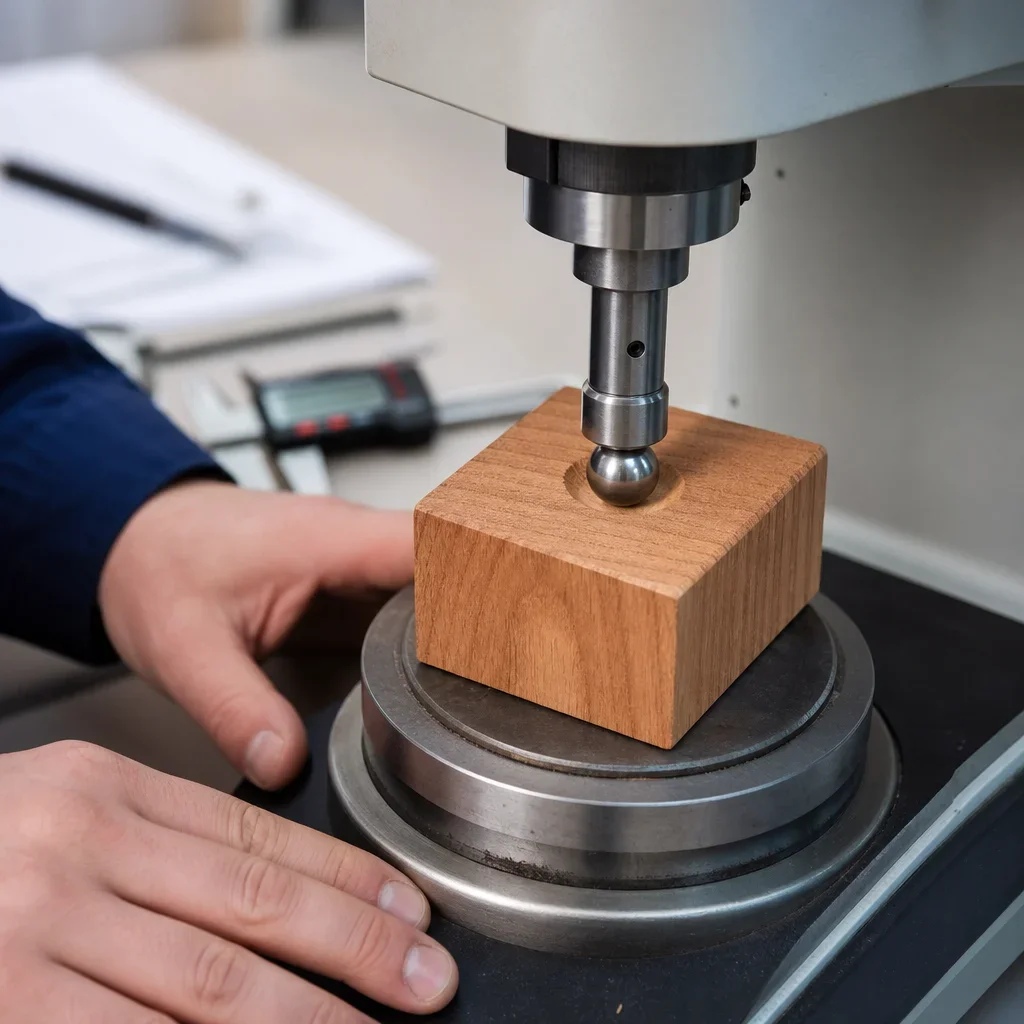
The Janka hardness test works by measuring the force needed to embed an 11.28 mm steel ball, or 0.444 inches, halfway into the wood. That gives you a dent-resistance comparison point, which is why this is the most common hardness scale for hardwood in flooring discussions.
The number matters because flooring gets hit by concentrated loads, not just foot traffic. Chair legs, pet nails under body weight, a dropped pan, or a heel edge can all leave dents, and the Janka result gives a rough comparison of how readily one species will indent versus another.
The test is still a lab comparison, not a performance guarantee. Moisture content, grain orientation, species variation, and product construction can all affect what happens in an installed floor, which is why a hardwood chart of hardness should be used with finish and construction details beside it.
A good Janka number for flooring is usually one that matches the room, the household, and the finish, not the highest figure on the page. Red oak at 1290 lbf is the benchmark many buyers understand, and it remains a practical reference point for normal family use.
For lower-traffic bedrooms or formal rooms, woods around walnut, cherry, birch, or oak can still work well if the finish and maintenance fit the space. Walnut around 1010 lbf and cherry around 950 lbf are softer than oak, but buyers still choose them for colour, grain, and a more premium furniture-like look.
For busier homes, stairs, kitchens, or homes with large dogs, buyers often compare oak, maple, hickory, and some acacia or exotic options first. Hard maple at 1450 lbf and hickory at 1820 lbf give more dent resistance than red oak on paper, but texture and sheen still change what daily wear looks like.
Very high numbers are not automatically better. Extremely hard species can be heavier to handle, tougher to cut, sometimes less forgiving during installation, and not always the best visual match for every room.
A domestic wood hardness chart is usually easier for shoppers to use because the species are familiar and the benchmarks are consistent. Red oak, white oak, maple, ash, hickory, walnut, cherry, birch, and black locust are the North American names most Canadian buyers will see in flooring conversations.
| Species | Janka (lbf) | Plain-English take |
|---|---|---|
| Eastern White Pine | 380 | Very soft for flooring |
| Douglas Fir | 660 | Soft reference species |
| Black Cherry | 950 | Softer, character-driven choice |
| Black Walnut | 1010 | Premium look, moderate dent resistance |
| Yellow Birch | 1260 | Near red oak |
| Red Oak | 1290 | Practical baseline |
| American Ash | 1320 | Similar to red oak |
| White Oak | 1360 | Slightly above red oak |
| Hard Maple | 1450 | Strong all-around choice |
| Black Locust | 1700 | Very hard domestic species |
| Hickory / Pecan | 1820 | One of the hardest common domestic flooring woods |
An exotic wood hardness chart often shows higher numbers, but that does not make exotic flooring the automatic best buy. Imported species may cost more, vary more in colour, need more careful sourcing, and can be harder to refinish or match later if you need repairs.
| Species | Janka (lbf) | Plain-English take |
|---|---|---|
| Teak | 1070 | Stable reputation, not ultra-hard |
| Acacia | about 1100–2300 | Wide range because the name is broad |
| Jatoba | 2350 | Very hard common exotic benchmark |
| Cumaru | 3540 | Extremely hard |
| Ipe | 3680 | Extremely hard and dense |
For many GTA homes, domestic species are the easier comparison set because availability, look, refinishing expectations, and sample matching are more straightforward. Exotics earn their place when you want a specific grain, colour, or higher dent resistance and you know the exact species you are buying.
For Canadian flooring buyers, the most relevant species are usually maple, red oak, white oak, birch, ash, cherry, and walnut because those are common on showroom floors and in engineered or solid hardwood programs. Hard maple at 1450 lbf, white oak at 1360 lbf, red oak at 1290 lbf, and yellow birch at 1260 lbf are practical Canada-facing benchmarks.
The hardest wood in Canada depends on what you mean. If you mean common flooring species sold in Canada, hickory at 1820 lbf sits near the top of familiar domestic options, while hard maple is one of the most common Canadian-relevant hard species. If you mean native North American species more broadly, black locust around 1700 lbf is another standout.
The hardest wood in Ontario for a normal buyer is not really a trivia answer. It is a shopping question, and the species most homeowners can realistically compare are oak, maple, birch, ash, hickory, walnut, cherry, and selected imported products like acacia. That is why a wood janka hardness chart Canada shoppers can use should stay close to retail flooring species, not just rare wood listings.
Red oak is the baseline because so many people know it. At 1290 lbf, it gives a practical middle reference for a hardwood floor strength chart.
| Species | Janka (lbf) | Compared with red oak |
|---|---|---|
| Eastern White Pine | 380 | Much softer |
| Douglas Fir | 660 | Much softer |
| Black Cherry | 950 | Softer |
| Black Walnut | 1010 | Softer |
| Yellow Birch | 1260 | Very close |
| Red Oak | 1290 | Baseline |
| American Ash | 1320 | Very close |
| White Oak | 1360 | Slightly harder |
| Hard Maple | 1450 | Noticeably harder |
| Hickory / Pecan | 1820 | Much harder |
White oak is slightly harder than red oak, but the bigger buying differences are usually grain, look, stain response, and design style. Hard maple is harder again, and hickory makes a clear jump in dent resistance among common domestic options. Walnut and cherry are both softer than oak, so buyers choose them more for appearance than raw hardness.
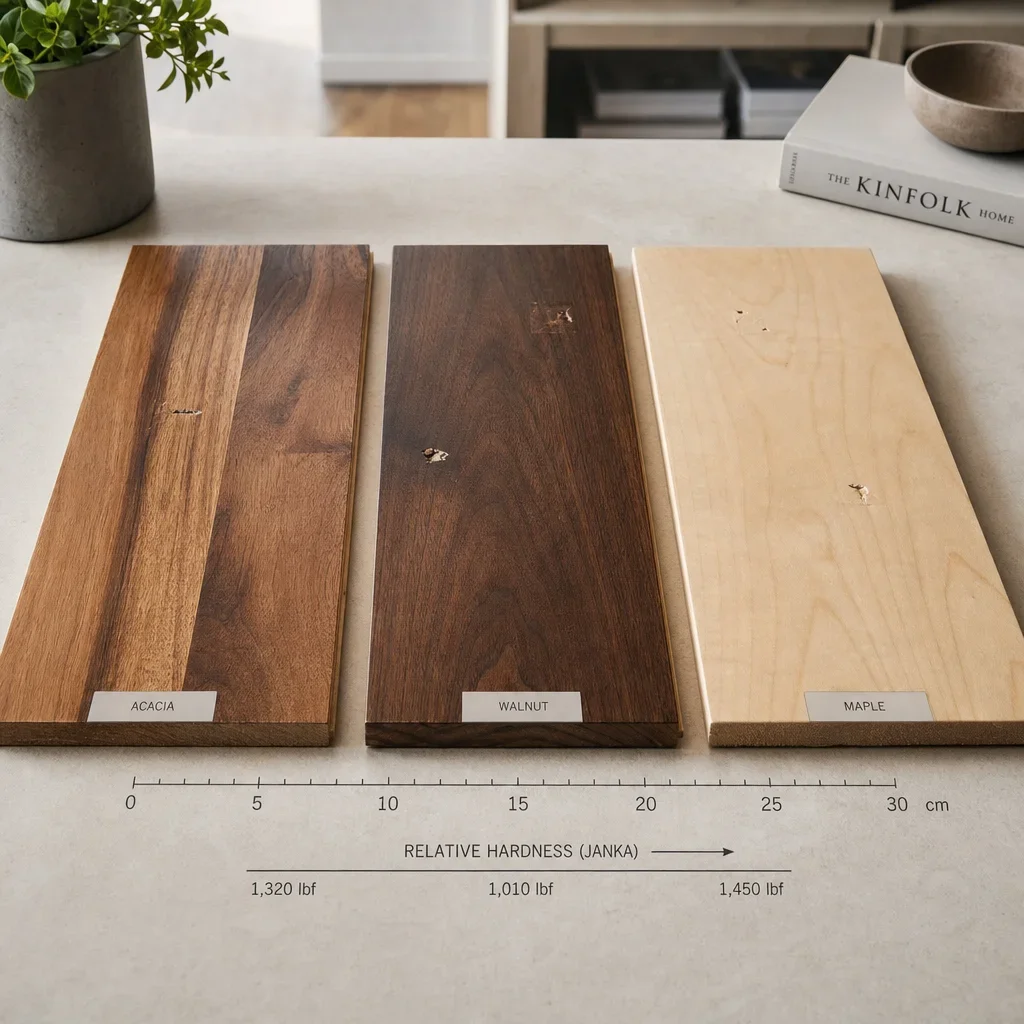
Acacia is one of the most confusing entries on any acacia wood hardness chart because acacia is often sold as a trade name covering multiple species. That is why one source may show acacia close to oak while another shows it above hickory.
A safe way to read acacia is as a category that often falls around 1100 to 2300 lbf in retail-facing charts, depending on the exact species and source. That means some acacia products are roughly in oak territory, while others are clearly harder than hard maple at 1450 lbf and much harder than walnut at 1010 lbf.
Walnut is generally softer than acacia in most flooring comparisons. Maple is harder than some acacia species and softer than others, so the honest answer is that acacia can be harder than maple, but not every acacia floor is harder than every maple floor.
The upside of acacia is its value appeal, dramatic grain, and often strong hardness numbers for the price. The downside is inconsistency in colour, mixed board appearance, broad species labeling, and wider variation from one product line to another than you usually see with standard red oak or white oak flooring.
If you are comparing engineered acacia flooring, the wear layer species is only part of the story. Core construction, top-layer thickness, finish quality, and milling precision still affect how the floor performs after installation.
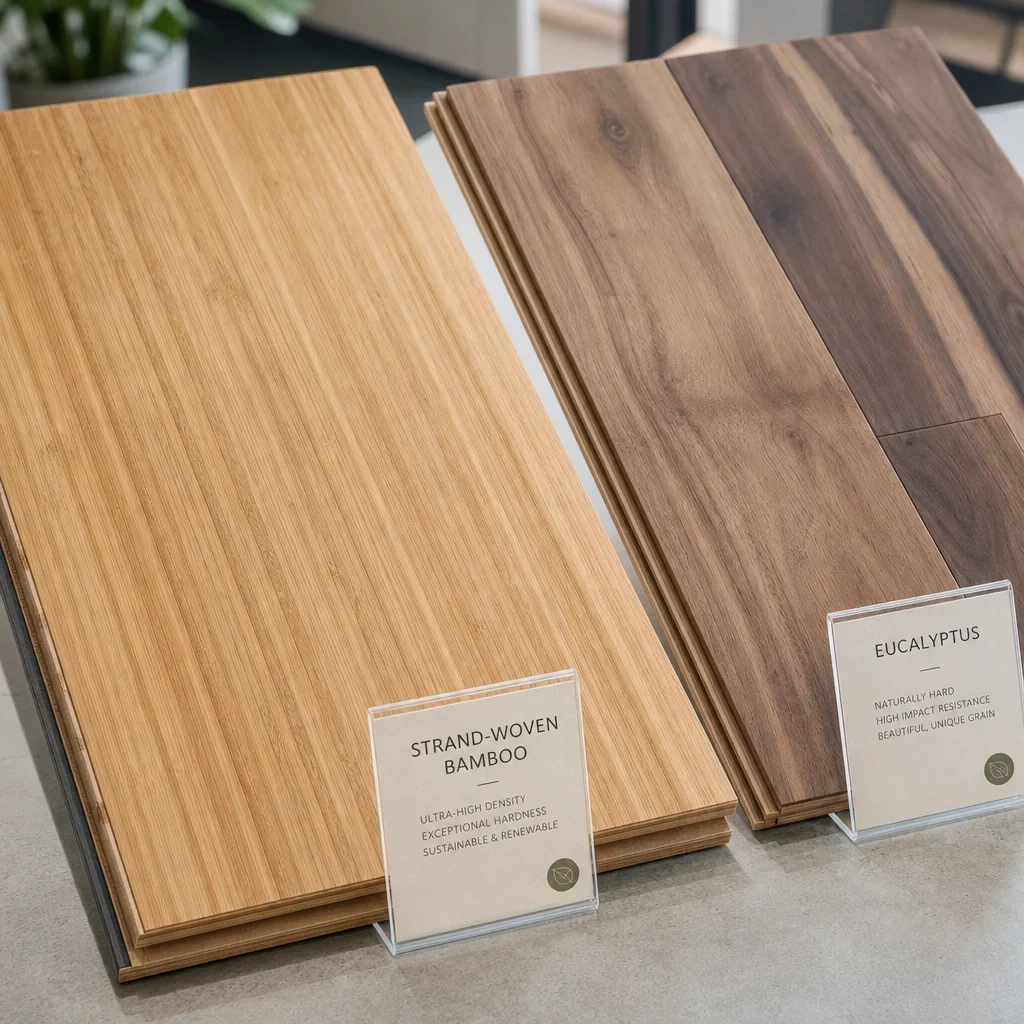
Bamboo shows up on many hardness chart for wood pages even though it is not wood in the tree-species sense. It is a grass product, and strand-woven bamboo can post very high published numbers, often around 3000 to 5000 lbf depending on the manufacturing method.
Those numbers do not make every bamboo floor superior. Product density, adhesives, finish quality, and quality control still matter, and two strand-woven products with similarly high published numbers can behave differently in a home.
Eucalyptus is another high-hardness option often grouped near the top of a hardwood durability chart, with some flooring products commonly cited in the 3000 to 4000 lbf range. As with acacia and bamboo, the exact species and the product line matter because the name can cover more than one commercial material.
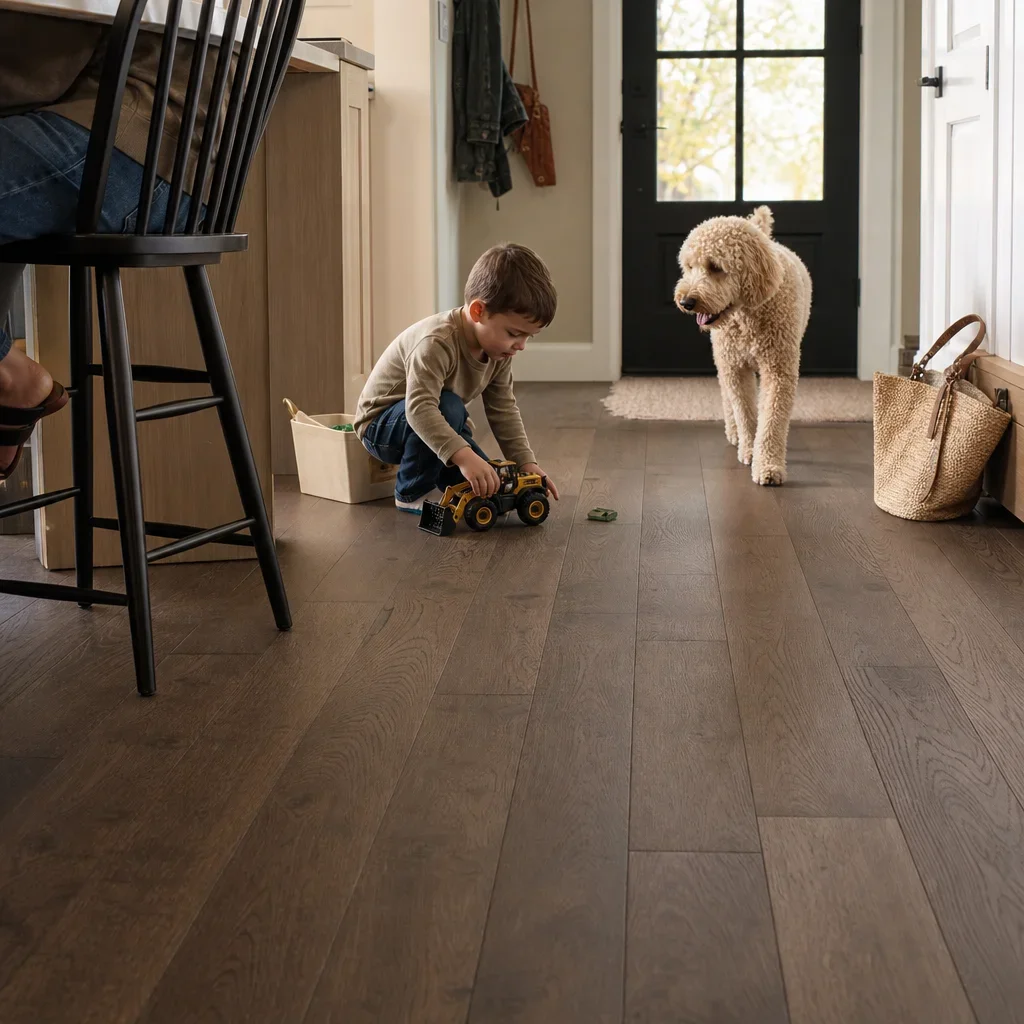
For pets and kids, a moderately hard to hard species paired with the right finish usually beats a harder species with the wrong finish. Low-sheen finishes, textured surfaces, and colours that do not highlight dust or nail marks can make daily wear less visible than a glossy floor with a higher Janka number.
For kitchens and entry areas, dent resistance matters, but maintenance matters just as much. Grit underfoot, water left near sinks, and chair movement can age a floor faster than the species number alone would suggest, which is why a hardwood floor durability chart should never be read without finish and care habits beside it.
For stairs, hardness helps because treads take concentrated impact on a narrow surface. Professional stair installation also matters because nosing details, fit, and finish consistency all affect how the staircase wears and how visible chips or dents become over time.
For very busy family homes, many buyers narrow the list to white oak, hard maple, hickory, or carefully selected acacia first, then compare style and construction. In some homes, laminate or vinyl is simply the smarter wear choice if moisture, pets, or rental turnover are bigger concerns than having real hardwood.
Conflicting Janka values are normal because the same common name can cover different species, subspecies, or trade-grouped materials. Acacia is the clearest example, but bamboo, eucalyptus, ironwood, and some Brazilian trade names can also vary depending on what exactly was tested.
Even when the species name is the same, results can shift with moisture content, growth conditions, sample selection, grain orientation, and the source chart's methodology. That is why you may see small differences for familiar species like maple or white oak and much larger differences for broad trade names.
The right way to use a janka wood hardness scale is to compare like with like. If you are shopping for flooring, compare flooring species and exact product specs, not just a random list from mixed woodworking sources.
Alias mapping makes a wood species hardness chart much easier to use because retail names do not always match one exact botanical name. Hickory and pecan are often grouped in flooring under the Carya genus, and acacia may be used for several imported species rather than one fixed species name.
| Trade name | Scientific name / group | Why the name can confuse buyers |
|---|---|---|
| Red Oak | Quercus rubra and related red oak groupings | Retail products may use the group name broadly |
| White Oak | Quercus alba and related white oak groupings | Style term is consistent, but sources may cite group or species |
| Hickory / Pecan | Carya spp. | Flooring often groups multiple close species |
| Acacia | multiple species/trade uses | One of the broadest and least precise retail labels |
| Brazilian Cherry | Hymenaea courbaril | Trade name does not mean true cherry |
| Brazilian Teak | Dipteryx odorata | Not true teak |
| Brazilian Walnut / Ipe | Handroanthus spp. and related naming usage | Dense exotic category, trade name can vary |
| Hard Maple | Acer saccharum | Often used interchangeably with sugar maple |
| Walnut | Juglans nigra | Usually clear, but imported walnuts can differ |
When a product name is broad, the safest step is to check the exact species on the specification sheet before treating a Janka figure as final.
Janka measures resistance to denting, not scratch resistance. A dog nail, dragged grit, or furniture edge can mark the finish long before the wood itself is deeply dented, which is why a harder floor can still show scratches.
Finish quality changes daily appearance more than many buyers expect. Matte and low-gloss finishes hide hairline wear better than high-gloss finishes, textured surfaces disguise small marks, and natural colour variation can make traffic lines less obvious over time.
Engineered hardwood can also outperform solid hardwood in some environments because layered construction usually improves dimensional stability. The wear layer species still has its own hardness, but the overall plank may handle seasonal moisture swings more predictably than a wide solid board.
Lifespan depends on species, wear layer thickness, finish, maintenance, and whether the floor can be refinished. A well-made hardwood floor can last for decades, and solid hardwood often has the longest refinishing life, while engineered longevity depends heavily on the top layer and product build.
White oak is one of the best all-around choices because 1360 lbf gives a practical hardness benchmark, the grain suits many interiors, and the look works in both classic and modern homes.
Hard maple and hickory are strong picks for busy family homes because 1450 lbf and 1820 lbf respectively put them above red oak on the hardness scale for hardwood, while still being familiar flooring species.
Walnut and cherry fit buyers who want richer colour and a more furniture-like look, even though they sit below oak on a hardwood flooring strength chart. That is a style-first decision, not a mistake, as long as you understand the trade-off.
Acacia fits buyers who want strong visual variation and potentially high hardness at an approachable price, but only if the exact species and product details are clear. Imported ultra-hard species fit buyers who want maximum dent resistance and accept the trade-offs in cost, sourcing, and sometimes more dramatic colour movement.
If moisture, pets, rental turnover, or budget are the bigger concern, laminate or vinyl can be the better floor. For buyers comparing solid hardwood, engineered hardwood, stairs, or custom finish options side by side, seeing real samples in person is still the fastest way to narrow the choice. CanFloor's North York showroom carries hardwood, engineered wood, laminate, vinyl, and stair installation options, with financing available.
It is a test that measures the force needed to press an 11.28 mm steel ball halfway into wood, giving a standard dent-resistance comparison.
A good rating is one that suits the room and finish, not a single magic number. Red oak at 1290 lbf is the common benchmark, with maple at 1450 lbf and hickory at 1820 lbf used when buyers want more dent resistance.
Among flooring species people commonly see discussed, Ipe at 3680 lbf and Cumaru at 3540 lbf are near the top of many published charts. Some manufactured products like strand-woven bamboo can publish similarly high or higher numbers.
Among commonly sold hardwood species, very dense exotics such as Ipe and Cumaru are harder than oak, maple, and hickory on published Janka charts. They are not automatically the best choice for every home.
The most durable floor is the one that balances species hardness, finish, construction, texture, installation quality, and maintenance. Janka alone does not answer that.
White oak at 1360 lbf is slightly harder than red oak at 1290 lbf.
Yes. Hickory at 1820 lbf is harder than both red oak at 1290 lbf and white oak at 1360 lbf.
Sometimes. Acacia sold for flooring spans a broad range, so some acacia is softer than hard maple at 1450 lbf and some is harder.
Acacia is usually harder than walnut in retail flooring comparisons. Walnut is around 1010 lbf, while acacia often lands somewhere above that depending on species.
Acacia is not one fixed number. Retail charts often place it around 1100 to 2300 lbf, depending on the exact species and product line.
Among common North American flooring species, hickory at 1820 lbf is one of the hardest familiar choices. Black locust at about 1700 lbf is another very hard domestic species.
For flooring shoppers in Canada, hickory is one of the hardest domestic-style options they are likely to compare in the market. If the question is about common Canadian hardwoods, hard maple is one of the most relevant hard species.
Maple, red oak, white oak, yellow birch, ash, cherry, and walnut are all common Canadian-relevant hardwood species in flooring discussions.
Yes. Janka measures dent resistance, not scratch resistance, so finish and sheen still matter.
Values can change because trade names may cover multiple species and because sample conditions, moisture content, and source methodology differ.
Some strand-woven bamboo products publish harder numbers than many hardwood species, often around 3000 to 5000 lbf, but bamboo is a manufactured grass product and quality varies by brand and construction.
White oak, hard maple, and hickory are common starting points, but low-sheen finishes and textures often matter as much as the species choice.
Oak, maple, and hickory are practical flooring standards for stairs and busy areas because they pair familiar performance with easier sourcing and finishing options. Professional stair installation also matters.
If you want one practical takeaway, use the hardwood janka chart to narrow the field, then compare real samples for finish, texture, colour movement, and construction. The hardest floor on paper is rarely the only answer that matters.