
The biggest myth in this comparison is that engineered means fake. The real difference between engineered hardwood and solid hardwood is construction, and that changes cost, stability, refinishing, and where each floor works best.
Both are real wood floors, but they are built differently. Solid hardwood is one piece of wood all the way through . Engineered hardwood has a real hardwood top layer over a layered core . That core usually handles humidity and temperature swings better, while solid usually gives you more sanding life over the long run. In Toronto condos, basements over concrete, and wide-plank designs, engineered is often the safer pick. In above-grade rooms with a plywood subfloor and a long ownership horizon, solid hardwood is often the classic choice. There is no universal winner. Your subfloor, room, budget, and timeline decide it.
Solid hardwood is a single-piece wood plank, while engineered uses a real-wood surface over a layered core .
Engineered hardwood floors are real wood, not laminate or vinyl .
Solid usually offers more refinishing potential because the wear surface is thicker through the board .
Engineered is usually more dimensionally stable in changing humidity because of its cross-layer construction .
Neither engineered nor solid hardwood is waterproof, and neither is ideal for full bathrooms with frequent standing water .
CanFloor lists hardwood from $3.99 per sq. ft. and engineered wood from $2.99 per sq. ft., with product-dependent "from" pricing .
| Factor | Solid Hardwood | Engineered Hardwood |
|---|---|---|
| Construction | One piece of hardwood through the plank | Real hardwood top layer over a layered core |
| Real wood? | Yes | Yes |
| Typical thickness | Often around 3/4 inch | Often about 3/8 to 9/16 inch, depending on product |
| Best subfloor | Usually best on wood subfloors with nail-down installs | Works on wood subfloors and is commonly used over concrete with the right method |
| Installation methods | Usually nail-down | Can be floated, glued, or nailed, depending on product |
| Humidity stability | Moves more with seasonal humidity | Usually more stable in changing conditions |
| Refinishing potential | Usually highest | Depends on wear layer and manufacturer allowance |
| Wide planks | Can be used, but movement matters more | Often preferred for wider planks |
| Basement suitability | Generally not the first choice below grade | Often the better real-wood choice over a prepared slab |
| Radiant heat | Product- and system-dependent, often more restrictive | More commonly used with approved radiant heat systems |
| Sound and feel | Traditional, solid underfoot | Varies by install method; floating can sound hollower |
| Upfront product pricing | Often starts higher, but category overlap exists | Often starts lower, but premium lines can exceed entry-level solid |
| Best for | Long-term sanding life and classic above-grade installs | Condos, concrete, wide planks, and homes with more seasonal movement |
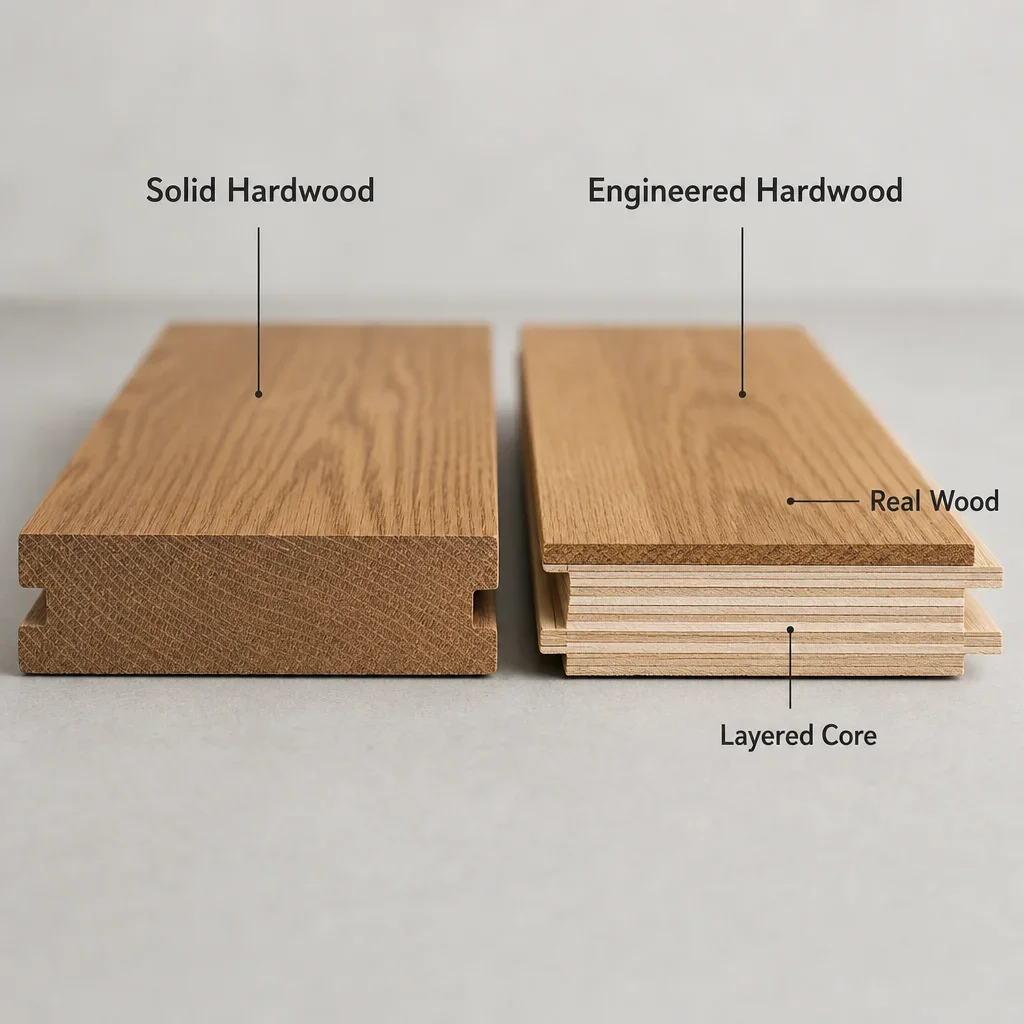
The difference between hardwood and engineered hardwood starts with how the plank is made. Solid hardwood is cut from a single piece of hardwood, so the wood runs through the full board thickness . Engineered hardwood uses a real hardwood face bonded to a layered core, often plywood-style layers set in opposing directions for stability .
That layered build is why the difference between engineered and hardwood flooring matters in real homes. Wood naturally expands and contracts as indoor humidity changes . A solid plank can move more across its width, especially in wide boards or rooms with dry winters and humid summers. An engineered core helps reduce that movement, which is why engineered is common in condos, slab-on-grade homes, and wider-plank collections.
The simplest way to picture the difference between engineered hardwood and hardwood floors is this: solid is real wood all the way through, while engineered is real wood on top with a stable platform underneath. That does not make engineered lower quality by default. It makes it a different product category with different strengths.
Yes, engineered hardwood is real wood because the visible top layer is real hardwood . That answers the question, are engineered hardwood floors real wood, directly. The grain, texture, and wear surface you see are wood, not a printed photo layer.
Engineered hardwood is different from laminate and vinyl plank in one key way. Laminate usually uses a photographic wood-look image under a clear wear layer, and vinyl plank uses a synthetic core with a printed design layer . Neither has a real hardwood wear surface. That is why hardwood vs engineered hardwood vs laminate is not just a price discussion. It is also a material discussion.
The easiest way to tell the difference between engineered hardwood and hardwood is to look at the sample edge. A solid board shows one continuous wood body from top to bottom . An engineered board shows a hardwood face over visible core layers. Once installed, though, good engineered hardwood can look almost identical to solid from the top.
Marketing language is where buyers get tripped up. "Engineered wood," "wood-look," "water resistant," and "waterproof" do not mean the same thing . If a label does not clearly say real hardwood veneer or hardwood wear layer, check the edge profile or ask for the product spec sheet.
Engineered hardwood's biggest advantages are stability, flexibility, and room fit. It is usually more stable in seasonal humidity, often works better over concrete, and may be approved for floating, glue-down, or nail-down installation depending on the product . It is also a common answer for wide-plank looks and condo projects.
The main disadvantages of engineered wood flooring are quality spread and sanding limits. Some entry products have thin wear layers that may allow little or no meaningful refinishing, while better products offer more headroom . Floating installations can also sound more hollow than glue-down or nail-down floors.
Solid hardwood's biggest strengths are tradition, longevity, and refinishing potential. Because the board is solid wood through the wear surface, it generally gives the most sanding life over time . Many buyers also like the classic feel and the strong resale recognition that comes with real solid wood floors.
Solid hardwood's main drawbacks are movement and installation limits. It reacts more to humidity swings, is usually less suitable for below-grade spaces, and commonly needs a wood subfloor for a standard nail-down installation . That can increase prep demands and narrow where it makes sense.
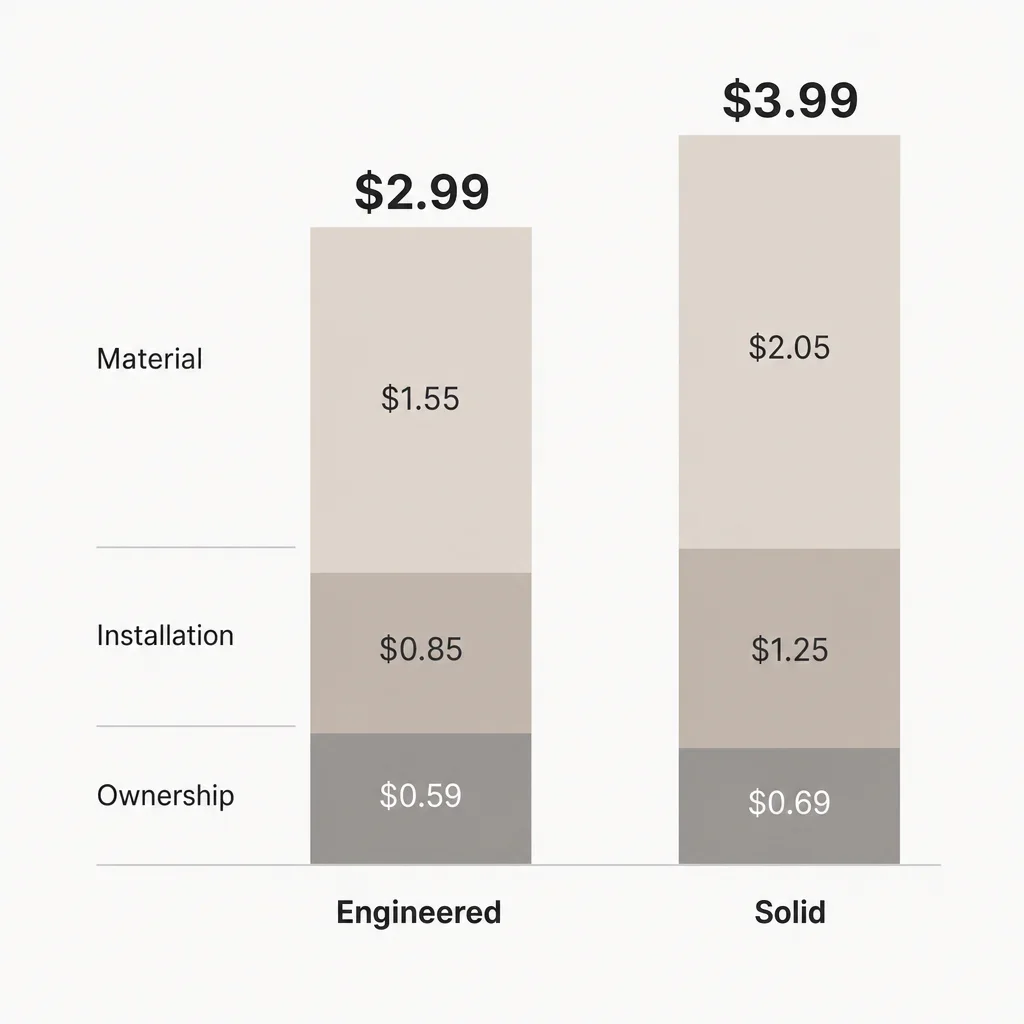
The cost engineered hardwood vs hardwood question has three parts: product price, installation cost, and long-term ownership cost. Comparing just one number usually leads to the wrong decision.
At CanFloor, hardwood starts from $3.99 per sq. ft. and engineered wood starts from $2.99 per sq. ft. . Those are starting prices, not apples-to-apples product matches. Species, grade, plank width, finish, core construction, and brand tier can move the number up quickly.
The cost of hardwood vs engineered flooring also changes with installation method. Solid hardwood is often nail-down, while engineered may be floated, glued, or nailed depending on the product . A floating engineered floor can reduce labour compared with a more involved solid installation, but slab prep, levelling, glue, underlayment, trim, stairs, and old-floor removal can erase that gap.
A fair cost comparison hardwood vs engineered hardwood has to match quality level. Premium engineered can cost more than entry-level solid, especially in wider planks, longer boards, designer finishes, or thicker wear-layer collections. Entry-level numbers are useful for budgeting, but they do not settle the quality question.
For a 1,000 sq. ft. project, material-only pricing at the listed starting points works out to about $2,990 for engineered and about $3,990 for solid . For 1,500 sq. ft., the same math is about $4,485 for engineered and about $5,985 for solid . Those figures exclude underlayment, glue, trim, prep, stairs, delivery, and labour.
Total ownership cost can flip the result. A forever-home buyer on a plywood subfloor may spend more upfront on solid and value the extra refinishing life later. A condo owner on concrete may find engineered cheaper overall because the product suits the slab, the install method is simpler, and the floor is less likely to fight seasonal movement.
Lifespan depends more on product quality and site conditions than on category alone. Species hardness, finish system, traffic, moisture exposure, maintenance, and installation quality all affect how long the floor looks good and performs well .
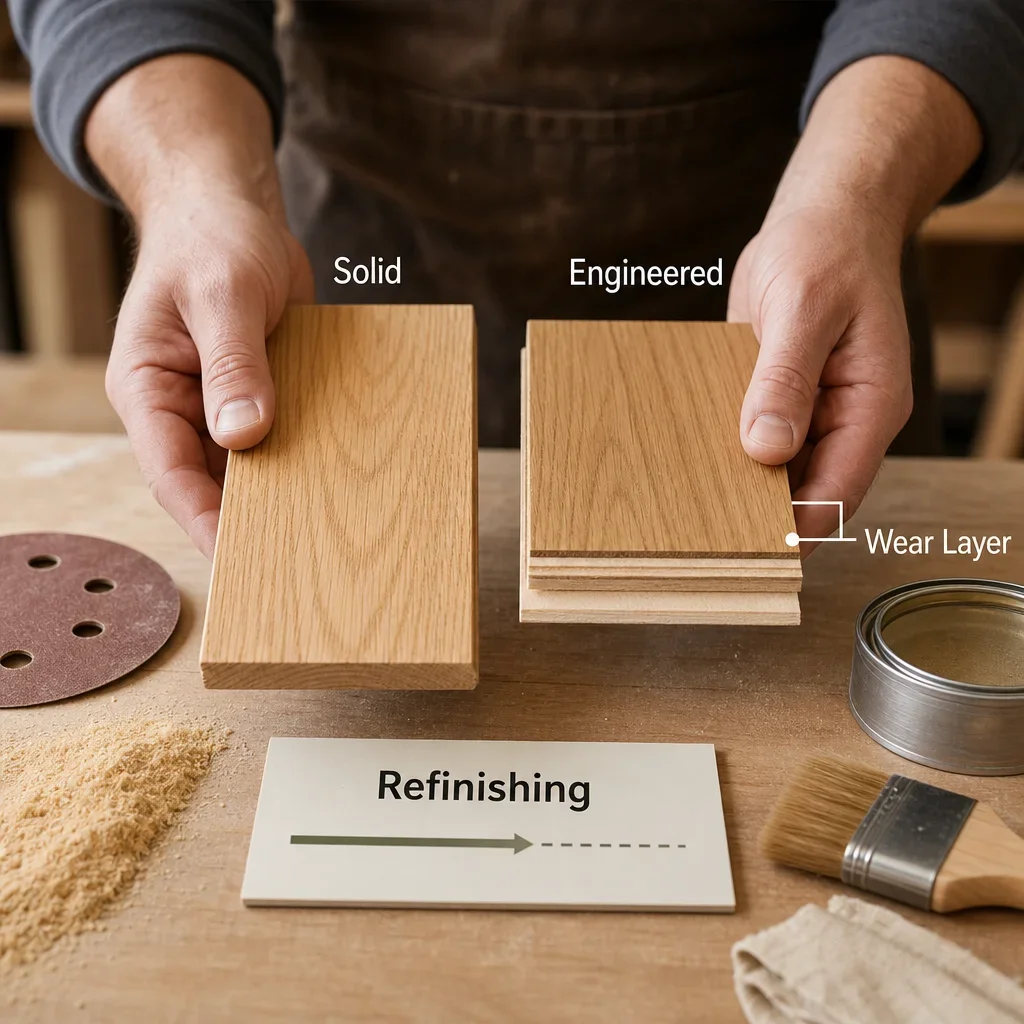
Solid hardwood generally gives the most refinishing headroom because the wear surface is solid wood through the board . That is the main long-term advantage if you plan to stay put for decades and want the option to sand out wear later.
Engineered hardwood can sometimes be refinished, but the answer depends on the wear layer and the manufacturer's rules. Some products offer little sanding margin, while others have thicker top layers that may allow limited refinishing . That is why "engineered" by itself does not tell you enough.
The right question to ask is not just how many times can engineered hardwood be refinished. Ask for the exact wear-layer thickness, whether the manufacturer allows sanding, and whether refinishing affects the warranty. Thin-veneer entry products and thicker premium engineered should not be treated as the same floor.
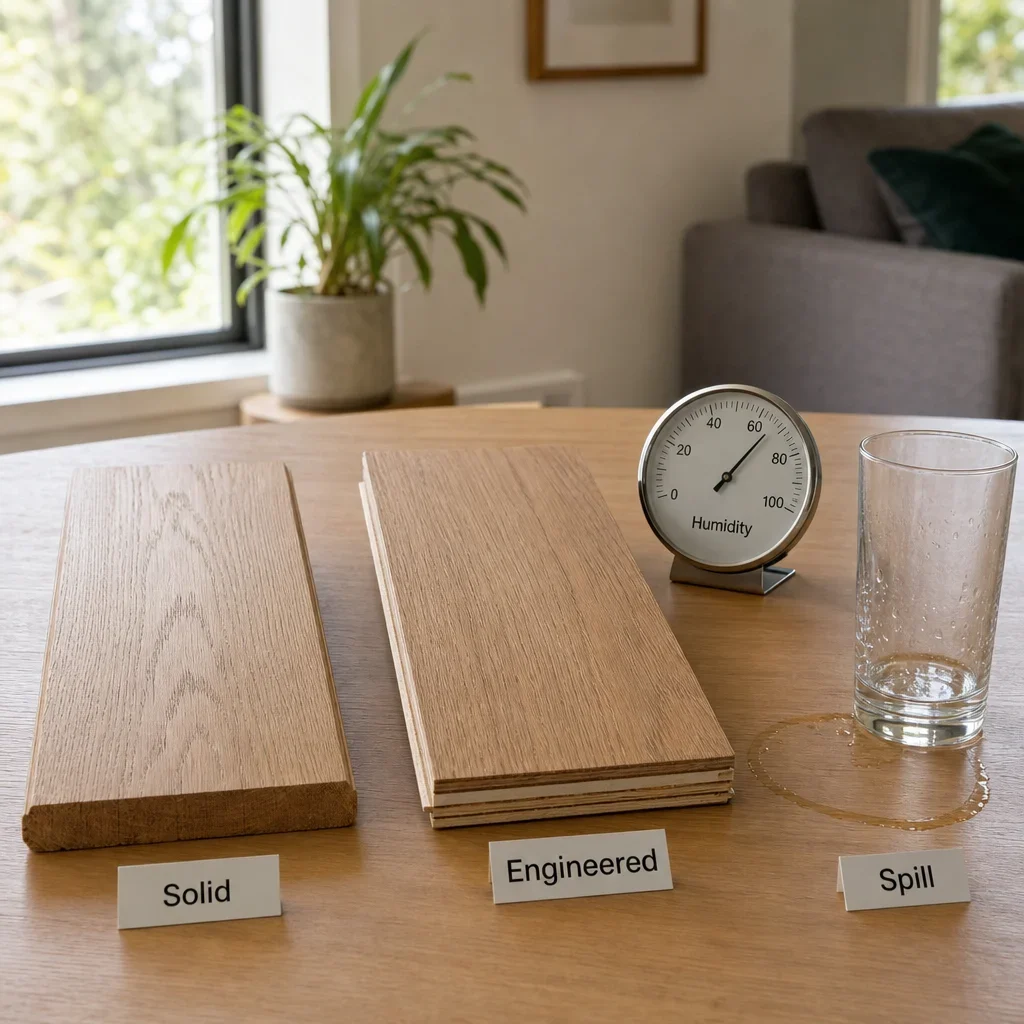
Engineered hardwood is usually more stable than solid hardwood when humidity and temperature change. Its layered core is designed to reduce expansion and contraction compared with a one-piece solid board .
That makes engineered a practical fit for Toronto and GTA homes where winter air can get very dry and summer humidity can climb, especially in condos with varying HVAC patterns. Board width, subfloor type, installation method, and indoor climate control still matter, but the category advantage is real.
Neither floor is waterproof. If you are asking "is engineered hardwood waterproof," the answer is no . Some products may handle minor spills better than solid because of their construction and finish, but standing water can still damage the wood surface, the joints, or the core.
Water resistant and waterproof are not interchangeable terms. A real-wood floor can offer better dimensional stability or spill tolerance than another wood floor without being appropriate for full wet-room exposure. For bathrooms with frequent splashing or any area with repeated standing water, real wood is usually not the first recommendation.
Living rooms, dining rooms, and bedrooms above grade can work well with either option if the subfloor and humidity conditions are right. In these spaces, the choice usually comes down to install method, plank width, budget, and how much future refinishing matters.
Basements and concrete subfloors usually favour engineered hardwood if you want real wood. That is because engineered is commonly used over properly prepared slabs and generally handles site movement better than solid . Solid hardwood is usually not the first choice below grade.
Kitchens sit in the middle. Engineered is often the safer real-wood choice if the home sees moderate spills and seasonal movement, but neither option should be treated like a waterproof floor. Fast cleanup, stable indoor humidity, and realistic expectations matter more here than category labels.
Bathrooms are where caution matters most. Frequent standing water and repeated wet exposure make both solid and engineered risky compared with more water-tolerant categories. If the room behaves like a wet area, look closely at vinyl or tile instead.
Condos often lean engineered because of concrete slabs, width preferences, and acoustic rules. Floating, glue-down, or approved acoustic assemblies are common considerations in condo work, and those factors usually push buyers toward engineered rather than solid.
Wide open-concept main floors often favour engineered if you want wide planks and better movement control across large spans. In older homes with plywood subfloors and a more traditional strip-floor look, solid can still be a strong fit.
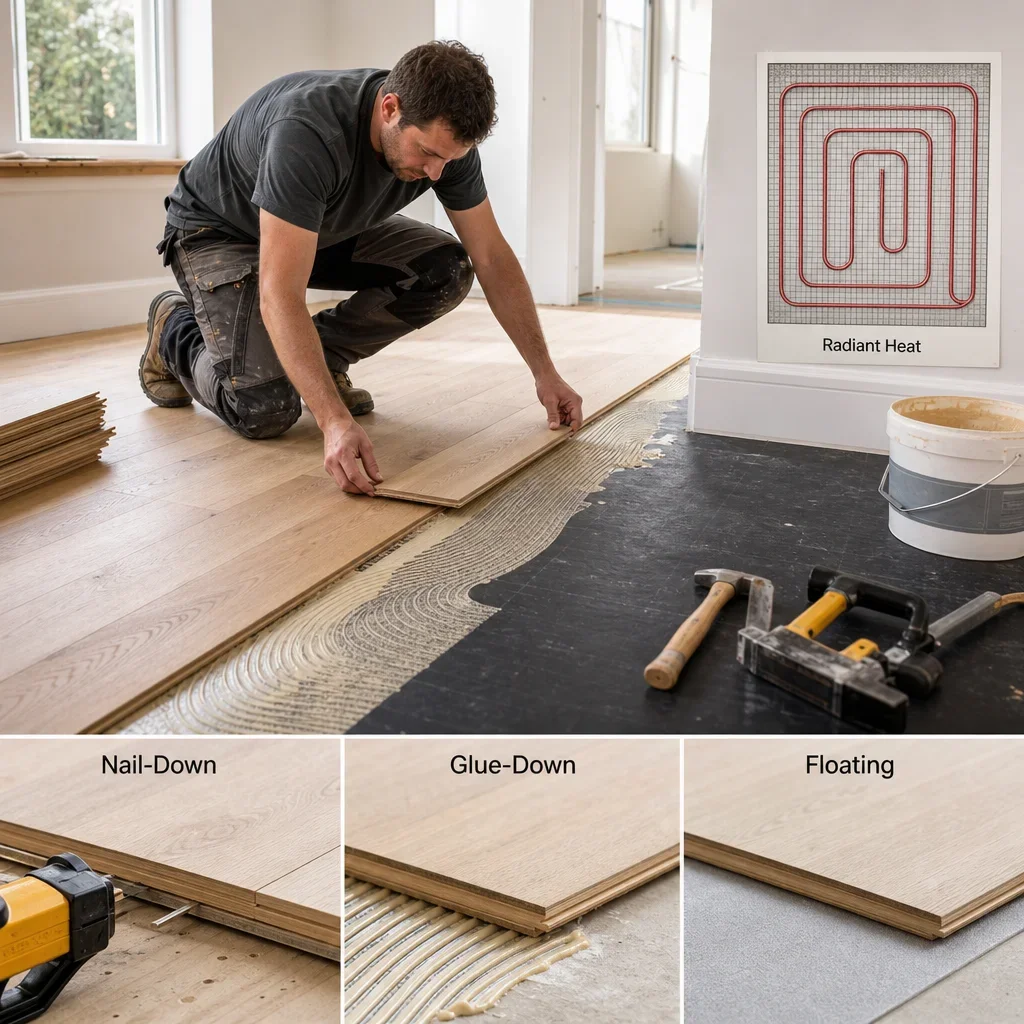
Solid hardwood is usually installed with a nail-down method over a suitable wood subfloor . That is one reason the difference between engineered and solid hardwood shows up early in the planning stage. The room may suit either floor, but the subfloor may not.
Engineered hardwood is more flexible on installation. Depending on the product, it may be floated, glued down, or nailed down . That flexibility is a major reason engineered is common in condos, slab projects, and renovations where the existing structure limits your options.
Concrete compatibility depends on more than the board type. Moisture testing, slab condition, levelling, adhesive choice, underlayment system, and manufacturer approval all matter . A concrete floor that looks dry can still create problems if prep is skipped.
For a straightforward 1,000 sq. ft. installation, a reasonable working range is roughly 2 to 5 days . That range can stretch if the job includes subfloor repair, levelling, furniture moving, stairs, trim work, old-floor removal, or drying time for adhesives and patching compounds.
Radiant heat usually favours engineered hardwood, provided the specific product is approved for that system. Solid can be more restrictive because natural wood movement becomes a bigger issue when heat cycles are involved . The product spec matters more than assumptions here.
DIY suitability also tilts toward engineered on some projects, especially click or floating systems. Real wood floors still punish bad prep. Flatness, moisture, expansion gaps, and transition details matter enough that professional installation is usually worth it.
The best floor for pets and kids is not decided by engineered versus solid alone. Species hardness, finish type, surface texture, sheen level, colour, and day-to-day habits affect visible wear more than the category label .
Matte and lower-gloss finishes usually hide scratches better than high-gloss floors. Textured surfaces and lighter, lower-contrast colours also tend to disguise daily wear better than dark, shiny planks .
Some premium engineered floors will look better over time than softer solid species in busy households. That is why a direct product comparison beats a category argument. A well-finished, harder engineered floor can outperform a softer solid floor in scratch appearance.
For active homes, practical choices matter. Harder species, durable finishes, entry mats, felt pads, trimmed pet nails, and quick spill cleanup will usually do more for the floor than arguing over whether engineered or solid is inherently tougher.
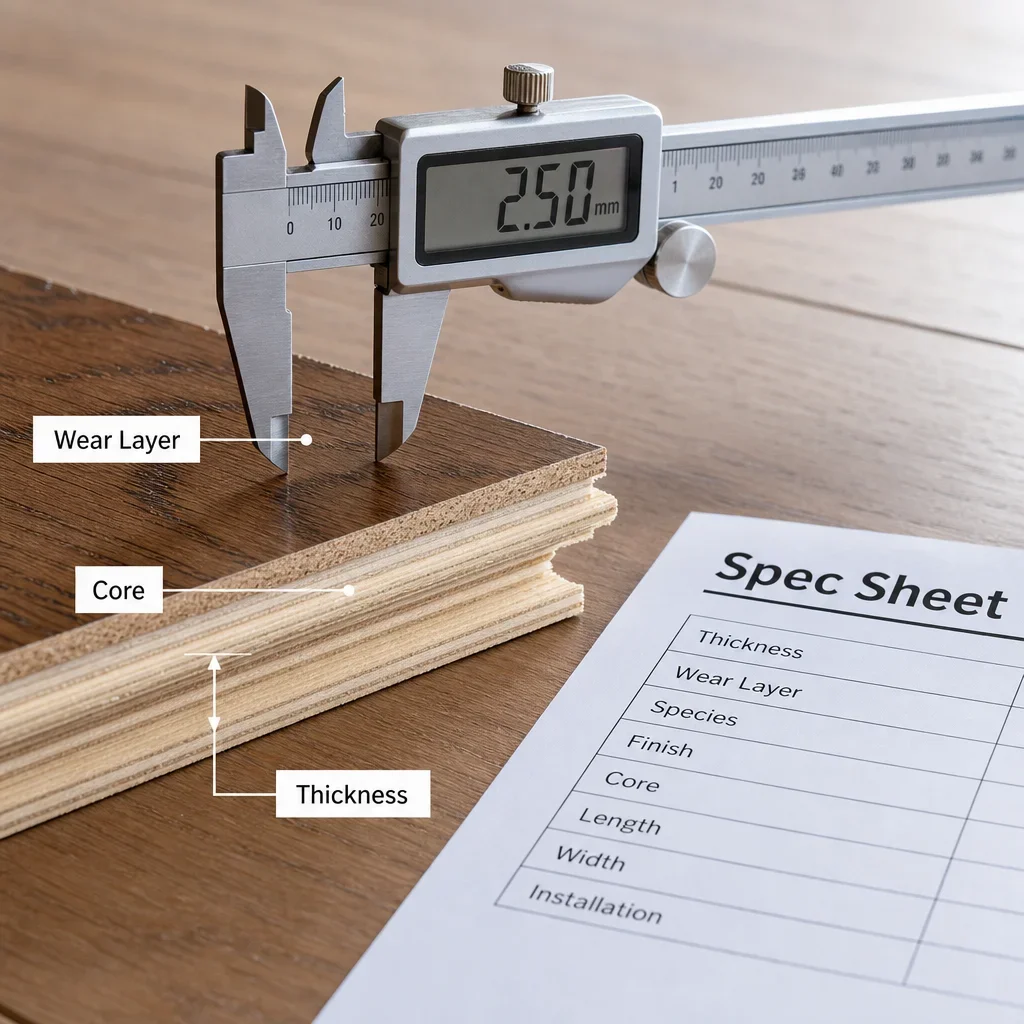
The wear layer is the real hardwood top layer on engineered flooring, and it is one of the most important quality details to verify . It affects the floor's look, how it wears, and whether future refinishing is realistic.
Thin wear layers usually belong to entry-level products, while thicker wear layers are more common in higher-end engineered floors. Without a verified spec, you cannot assume an engineered plank can be sanded later. This is one of the biggest buying mistakes we see.
Core construction matters too. A stable, well-made layered core helps the floor resist movement, while lower-grade construction can limit performance even if the top veneer looks good at first glance. Ask what the core is, what install methods are approved, and whether the floor is suitable over concrete or radiant heat.
Price alone is a weak way to compare categories. A cheap solid floor is not automatically better than a premium engineered floor, and a premium engineered floor is not automatically overkill. Compare wear layer, board size, finish system, warranty terms, and site fit.
Installation method changes the sound and feel more than many buyers expect. Floating floors can sound a bit hollower, while glue-down and nail-down installations usually feel more grounded .
Solid hardwood often has the traditional underfoot feel buyers expect from older wood-floor homes. A well-installed engineered floor can still feel substantial, especially in glue-down or nail-down applications, but a light floating install may feel different.
Subfloor type also matters. Concrete, acoustic underlayments, and condo sound-control assemblies can all change the feel underfoot and the amount of echo in the room. That is why showroom walking samples are useful when you are comparing similar-looking products.
Real wood floors usually support perceived value better than many lower-cost look-alike options because buyers recognize wood as a premium surface . Condition, colour choice, plank size, and overall design fit still decide how much value that perception adds.
Solid hardwood still carries strong traditional prestige, especially in detached homes and classic above-grade installations. High-quality engineered hardwood is also widely accepted in higher-end homes, particularly for wide-plank looks, condos, and projects over slabs.
Short-term resale projects and long-term ownership projects do not always want the same floor. If the goal is a clean, attractive update that fits the structure and budget, engineered may be the smarter move. If the goal is decades of sanding headroom in a long-term family home, solid may deserve the premium.
Engineered hardwood is real wood, while laminate and vinyl plank are look-alike products with different core constructions . If your priority is authentic wood grain and a real hardwood surface, engineered and solid stay in the running. Laminate and vinyl do not offer the same material authenticity.
If your priority is true waterproof performance, neither solid nor engineered hardwood is the best answer. Vinyl plank is usually the more practical category for wet-prone areas because the product is built for higher water tolerance than real wood .
Price also shifts by category. CanFloor lists laminate from $1.69 per sq. ft. and vinyl from $1.99 per sq. ft. . Those starting points help explain why some buyers comparing hardwood vs engineered hardwood vs vinyl plank decide that real wood is worth the premium in living areas but not in bathrooms, mudrooms, or some basements.
A smart engineered or solid hardwood purchase starts with the spec sheet and the site conditions, not just the sample face. Ask what the wear layer is, what the core is made from, which install methods are approved, and whether the product is suitable over concrete or radiant heat.
A complete quote should also spell out what is included. Ask about underlayment, adhesives, trim, transitions, stair work, old-floor removal, subfloor levelling, delivery, and moisture testing. Quotes that skip those items can look cheap at first and expensive later.
Red flags are usually easy to spot. Be careful with vague "waterproof engineered hardwood" claims, missing wear-layer information, no moisture-testing plan for slab installs, and estimates that leave out trim, prep, or stair details .
Seeing samples in person still matters. Large boards, finish sheen, colour variation, and edge detail read differently in a showroom than they do on a phone screen. If you are comparing solid and engineered, look at the board edges and walk on installed displays if possible.
Choose solid hardwood if you have an above-grade room, a suitable wood subfloor, and a long ownership horizon where maximum refinishing life matters most. That is the classic fit for buyers who want the most traditional wood-floor structure.
Choose engineered hardwood if you are working over concrete, dealing with condo constraints, planning wide planks, considering radiant heat, or expecting more seasonal humidity movement. That is usually the stronger answer when site conditions are less forgiving.
For a basement renovation, engineered is usually the better real-wood option. For a forever home with a plywood subfloor and a classic layout, solid often makes sense. For a pet-heavy family home, focus on species, finish, and sheen before you focus on the category label.
A simple decision matrix helps:
If you want to compare them side by side, a showroom visit is worth it. At CanFloor's North York location, buyers can look at solid and engineered samples in person, compare finishes and custom options, and get a quote based on the room, subfloor, and budget. Installation services and financing are available as support if needed .
Yes. Engineered hardwood uses a real hardwood top layer over a layered core .
Not universally. Solid is usually better for maximum refinishing life, while engineered is usually better for humidity stability, concrete subfloors, and wider planks .
Often, but not always. CanFloor lists engineered from $2.99 per sq. ft. and hardwood from $3.99 per sq. ft., yet premium engineered can cost more than entry-level solid .
Solid hardwood is one piece of wood through the full plank, while engineered has a real-wood surface over a layered core .
Engineered is usually the better real-wood choice for basements because it is more commonly used over properly prepared concrete and handles movement better .
Yes, many engineered products can be installed over concrete with an approved method and proper moisture testing .
Often yes, if the product is specifically approved for radiant heat by the manufacturer .
There is no safe universal number. It depends on the wear layer and the manufacturer's refinishing allowance .
Solid generally offers more refinishing potential than engineered because the wear surface is solid wood through the plank .
Material-only pricing at CanFloor's listed hardwood starting point is about $3,990 for 1,000 sq. ft. . Full installed cost depends on product choice, labour, prep, trim, stairs, and removal.
Material-only pricing at CanFloor's listed engineered starting point is about $4,485 for 1,500 sq. ft. . Installation and prep are extra.
Yes, but use a damp, not wet, mop and avoid excess water because engineered hardwood is not waterproof .
It is safer to follow the flooring manufacturer's cleaning guidance rather than improvise with household soaps. Residue and excess moisture can create issues on wood-floor finishes .
Check the edge or floor vent cutout. Solid shows continuous wood through the board, while engineered shows a hardwood face over core layers .
No. Engineered hardwood is real wood and should be treated as water resistant at best, not waterproof .